The Youth’s Instructor, Vol. 30, No. 21.

SPIDERS

The Youth’s Instructor

May 24, 1882

S. D. A. Publishing Association · Battle Creek, Mich. · May 24, 1882
SPIDERS

MANY will wonder what can be said that is interesting about “those disgusting creatures.” But if instead of crushing under your foot the first one you spy, you will follow it to its home, and there study its habits, you will discover more intelligence in the hitherto despised animal than you have given it credit for. Even Robert Bruce, by watching a spider, learned a lesson of perseverance which enabled him to regain the throne of Scotland. And who knows but some of the INSTRUCTOR family may learn by the same means some important lesson in life.
Instead of having the animal itself described, you will in this talk be told some things about their homes and habits. We have all brushed down many a spider’s web, little knowing how much labor it has cost the tiny creature to make it, nor suspecting the pleasure it would afford us to watch the operation. These webs are all made of silken threads, which are spun by the animal itself, and are of two kinds,—one a smooth, dry thread which does not stick to the animals’ feet, while the other is composed of a gluey substance which adheres to everything it touches. The spider uses the smooth thread to make his scaffolding, and to travel on while building his web, which is composed of the gluey thread, and entangles in its meshes whatever insect comes in contact with it. These threads, though so minute as to be hardly seen singly, are sometimes composed of as many as a thousand strands coiled into one, and are very strong for their size. So skillfully do these creatures construct their webs that even a large “bottle fly” finds it very difficult to escape from one before the ferocious householder will pounce upon him and inflict his deadly wound.
After his house is built, the owner destroys most of the smooth threads used in constructing it, and stations himself on one side of the web, where he is apparently asleep. But if you will examine closely, you will see that he is spread out with his eight legs upon as many different threads, and as his feet are the most sensitive part of the body, let any of the threads vibrate ever so slightly, and he is instantly on the alert. He runs rapidly to the center and looks for the cause. If some unwary fly has with limb or wing touched one of those fatal threads, he is immediately pierced with the spider’s poisonous fang, one wound from which will cause death. After the conquest, if the spider is not then hungry, he winds several threads about his prey and hangs it up for a future meal, when he will suck the life blood from the body and leave its dry and crisp carcass as a warning to others not to pass that way.
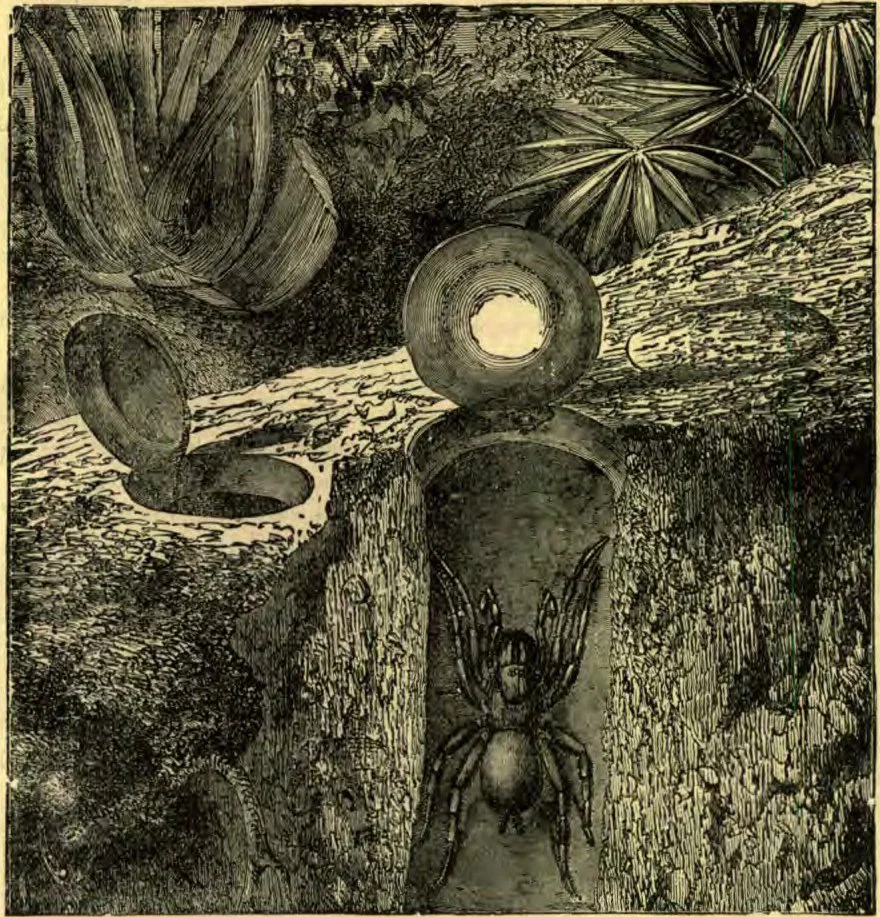
But all spiders do not live in webs nor use their silk for the same purpose. Some, like the one in the picture, build their houses in the ground. These they line with a silken tube, forming at its entrance a movable lid, composed of earth and silk, and attached to the silken lining by a sort of hinge. This cover closes whenever the spider enters or leaves the house, and so perfectly does it fit that when closed, its existence would hardly be detected.
This kind is called the Mining Spider, and is found in the south of Europe. Some species use their silken threads merely to wind around their victims, and others to travel by. They descend by their thread head downward, but climb up on it head upward, rolling it into a ball during the ascent. When they wish to go from tree to tree, some let go a thread in the direction of the wind, and when their delicate sense of touch tells them it has reached the object, they pass over it. In this way they travel long distances without descending to the ground, their tiny cables being frequently seen in dewy mornings of spring or autumn. Some small gossamer spiders even speed through the air, buoyed up by their light threads.
These little creatures are very cleanly in their habits, spending much of their time in removing the dirt and dust from their bodies by means of tiny toothed combs and brushes, with which they are supplied by nature. Many curious stories are told of their ingenuity and intelligence. A prisoner in the Bastile so nearly tamed a spider that at the call of a musical instrument he would come to devour the flies caught for him by the prisoner. Many attempts have been made to use their silk in manufacturing, but without success. But though not proving useful in this direction, they are put to good service in some parts of South Africa, where they grow to a large size, and are gathered by the natives for food. C. H. G.

APPLE BLOSSOMS.

Up through the wood-path, with bird-songs about her, May has come softly, the beautiful child! Skies that were sullen and joyless without her, Broke into sunshine above her, and smiled.
Green on the uplands the wheat-fields are springing, Cowslips are shining, and daisies are white; Through the still meadow the waters are singing, Brimming with melody, flashing with light.
Blooming with clover the orchards are growing, Flecked by the shadows that tremble and glide; Round their gray trunks, when the west wind is blowing, Sways the young grass in a billowy tide.
Strong as the arms of a giant, yet tender, See what a treasure they lift to the sky! Take your red roses—aflame with their splendor— We love the apple-trees,—Robin and I.
Hark! how the oriole, flashing and glowing— Trills his clear whistle, so mellow and mild, Where, o'er their tops with a lavish bestowing, Drift upon drift, the sweet blossoms are piled.
Where is the lip that has worthily sung them,— Tinted like sea-shells, or whiter than snow? Bees, all the day, as they linger among them, Drowsy with nectar, are murmuring low.
Pillowed beneath them, I dream as I listen How the long summer above them shall shine, Till on the boughs the ripe fruitage shall glisten, Tawny and golden, or redder than wine.
In the bright days of the mellow September, How we shall shout as we gather them in,— Hoarding their wealth for the chilly December, Heaping them high in the cellar and bin.
Then, when the snow in the moonlight is gleaming, Up from the darkness the apples we'll bring, Praising their sweets, where the firelight is beaming; Globes of rich nectar, a poet might sing.
Tales of the Vikings our lips will be telling; Yet, when the Sagas are done, we shall say, “Here's to the land where the summer is dwelling! Here's to the apple-tree, monarch of May!”
—Emily Huntington Miller.

AN HOUR IN MOTHER'S ROOM.

My mother's room was the prettiest in the whole house. It was large and bright. The west windows were deep and wide, displaying a pleasant landscape. Far away to the edge of the horizon ran a line of hills, and nearer lay the smooth meadow-land through which sluggishly flowed the shining waters of Cedar Creek. The cows loved to stand in its cool waters on hot days, and lazily move their sleepy bodies back and forth with enjoyment. Beside this brook grew the gnarled trunks of old sycamores, and the drooping boughs of the weeping willow, and one tall, straight poplar, that stood out all alone against the sky like a church spire. This poplar was mother's favorite tree. She said it looked to her like a sentinel keeping guard over the hills and fields and brook.
My mother was a great sufferer for many long years. I cannot remember when she was strong and well. But through all the years of my childhood, I do not recall one cross, complaining, or even impatient word. She was always gentle, always cheerful, always loving. Everybody was welcome in mother's room. Everybody went there when they wanted a cool, quiet, delightful place to rest. My brother Rob and I went every day to bid our mother good-morning, and to say “Our Father” at her knee. I can well remember how she would take our faces between her small hands, and looking into our eyes, she would tell us how she loved and trusted her “two boys,” and how she prayed every day that we might grow into noble manhood. It seemed to me it would be impossible for me to do a low, mean act, or even think a vile thought, and then receive my mother's pure kisses. It was a rule at our house that Rob and I were to sit for an hour every day with our mother. During this hour she read to us or taught us a short poem or some Bible verses, and sometimes she prepared little talks that were full of the truths and principles of Christianity. One of these talks I recall with great clearness. I can never forget it. It has been in my heart all through these years that I have had to fight with the world, and and learn that to control myself was my hardest battle.
It was a dark day in November, about a year before my mother's death. She was not as well as usual that day, so she was lying on her cot when Rob and I tapped softly at her door. She had us draw two footstools beside her, and when we had seated ourselves, mother questioned us about our studies. Then she closed her eyes, and lay very still awhile. Rob and I looked at each other in fear and silence. Presently she again opened her eyes, and taking from her table a new magazine, she opened it, and pointed to the table of contents printed on the first page. She explained to us that whatever we saw named in that table of contents we would find on the inside of the magazine. She told us that we would find more than the mere title. She said there would be an article, sometimes several pages long, sometimes shorter, written under the title given in the table. Mother then went on to tell us how a boy's face is a table of contents as to what is written on the heart. She told us how easily people could read on a boy's face, honor, courage, truth, gentleness, politeness, and all that speak of the refinement of a truly good and noble heart. But if the character be wicked and vicious, as plainly are written the signs of dishonesty, selfishness, cowardice, vulgarity, and rudeness. Mother said that every noble act, every pure thought, every polite kindness, printed the lines on our faces deeper and plainer. And just the same way with every low, vulgar thought, every dishonest deed, every rude unkindness,—the face grew more and more degraded, the eyes more sullen and downcast, and every feature gradually became that of an outcast and a ruffian.
She told us how all was written more plainly on the heart than even on the face, and that this is what God looks at and judges men by. Mother said she once saw a criminal who had committed murder. In the fight he had received a deep gash between the eyes. Nothing could ever hide that white glaring scar. No matter how you looked at his face, the mark of his sin was plainly visible. Having once seen it, you could never forget it. But our mother said the stain of blood on the prisoner's soul was more terrible and more plainly seen by God's eye than the scar on his face.
Many a year have the rains and winds and sunshine swept over my sweet mother's grave. Long ago strangers filled her quiet room, and no more am I a boy, with all a boy's temptations; but through all these years the teachings of that gentle voice have lived in my heart, and shall live until I again join that lost mother, and meet the Christ she taught me to worship, and whom she loved so well.—S. S. Times.

GOD BLESS EVERYBODY.

A LITTLE girl was saying her prayers one evening, closing up with, “God bless papa and mamma, little sister and everybody, and keep us from harm this night. Amen.”
The little sister, a bright-eyed puss of five years, quietly remarked,—
“If you’d said ‘everybody’ to begin with, you needn’t have made such a long prayer.”
Many of our prayers might be shortened, by leaving out things which we ask for and do not expect to receive; but the prayer for “everybody” is a very good prayer; and it is perfectly right to mention with “everybody” those who are near and dear to us, and those whom we know to stand in special need of divine help and wisdom.
We are to do good to all men as we have opportunity; but there are those around us whom we have opportunity to benefit, and we are to take special pains to benefit them. Just so while we pray for all, it is right to remember especially those near to us, or whose wants we know and feel.
“I exhort therefore, that, first of all, supplications, prayers, intercessions, and giving of thanks be made for all men. For kings, and for all that are in authority; that we may lead a quiet and peaceable life in all godliness and honesty. For this is good and acceptable in the sight of God our Saviour, who will have all men to be saved, and to come unto the knowledge of the truth. . . . I will therefore that men pray everywhere, lifting up holy hands, without wrath and doubting.” 1 Tim 2: 1-4, 8.

TRAILING ARBUTUS.

Fair child of the spring-time sleeping low, Under deep banks of the winter’s snow, Waking, and creeping silently forth, While chilling winds still come from the north. Ah, who could dream from its cheerful smile, Of the hunger and cold it has felt ere while! Its pure sweet lips never breathe a word, Of the frost king’s threat it has felt and heard. It whispers no tale of the dreary past— Only praise that sunlight has come at last. Hidden beneath the sheltering leaves, O’er its lowly lot it never grieves. A delicate perfume fills the air, And the honey-bee comes for his share, While merry children with bounding feet, Bear off its clusters so rare and sweet. The dear child faces are so pure uplift, As the invalid takes their floral gift, And her eyes will moisten, and brighter grow, As they rest on friends of the long ago. The weary form feels less of its pain, As the joyous past comes back again, While the heart renders thanks for the blessings God-given— “Of such”—children and flowers—“is the kingdom Of heaven.”
MARY MARTIN.

THE HIDING-PLACE.

A GENTLEMAN sat beside an open window one summer day, and saw a little bird flying about in great alarm. A fierce hawk was swooping down to seize it in his cruel talons. There was no hiding place in leafy tree or shady vine, no cleft in the gray stone wall. But in its fright it flew right in at this open window, and took refuge, panting, under the coat of the gentleman beside it. It was tenderly cared for until the danger was past, and then it was set free to sing a glad song of rejoicing.
But a sweeter song sang itself in the heart of this good man, who was Charles Wesley, a devout Christian, and a great preacher; and taking his pen, he wrote the beautiful hymn we all so love to sing:—
“Jesus, lover of my soul, Let me to thy bosom fly.”
How much we all owe to that little bird! How many hearts have been comforted by those precious words, and how many more will be before they are forgotten. I do not believe they ever will be forgotten.
Think of that little bird, dear children, when you are in any trouble, and remember that you may fly to Jesus for safety, for he is our hiding place. As the hymn says:—
“All my trust on thee is stayed, All my help from thee I bring; Cover my defenseless head With the shadow of thy wing.”
Will you not learn this beautiful hymn!
—Morning Light.

Finding Happiness in Everyday Duties

The only true way to be happy, is to take the drops of happiness as God gives them to us every day of our lives. The boy must learn to be happy while he is plodding over his lessons, the apprentice while he is learning his trade, the merchant while he is making his fortune. If he fails to learn this art, he will be sure to miss his enjoyment when he gains what he has sighed for.

NEW-TESTAMENT HISTORY.

LESSON 83.—TRIUMPHAL ENTRY INTO JERUSALEM.

In our last advance lesson we left our Lord at the house of Simon in Bethany, where he had stopped to stay over the Sabbath, and where Mary, the sister of Lazarus, anointed him. This anointing took place on Saturday, and on Sunday he went on his way to Jerusalem. “On the next day much people that were come to the feast, when they heard that Jesus was coming to Jerusalem, took branches of palm trees, and went forth to meet him, and cried, Hosanna: Blessed is the King of Israel that cometh in the name of the Lord.” “And when they drew nigh unto Jerusalem, and were come to Bethphage, unto the mount of Olives, then sent Jesus two disciples,” “and saith unto them, Go your way into the village over against you: and as soon as ye be entered into it, ye shall find a colt tied, whereon never man sat; loose him, and bring him. And if any man say unto you, Why do ye this? say ye that the Lord hath need of him; and straightway he will send him hither. And they went their way, and found the colt tied by the door without in a place where two ways met; and they loose him. And certain of them that stood there, said unto them, What do ye, loosing the colt? And they said unto them even as Jesus had commanded; and they let them go. And they brought the colt to Jesus, and cast their garments on him; and he sat upon him.” “All this was done, that it might be fulfilled which was spoken by the prophet, saying, Tell ye the daughter of Sion, behold, thy King cometh unto thee, meek, and sitting upon an ass, and a colt the foal of an ass. . . . And a very great multitude spread their garments in the way; others cut down branches from the trees, and strewed them in the way.” “And when he was come nigh, even now at the descent of the mount of Olives, the whole multitude of the disciples began to rejoice and praise God with a loud voice for all the mighty works that they had seen;” Saying, “Hosanna! Blessed is the King of Israel that cometh in the name of the Lord. These things understood not his disciples at the first; but when Jesus was glorified, then remembered they that these things were written of him, and that they had done these things unto him. The people therefore that was with him when he called Lazarus out of his grave, and raised him from the dead, bare record. For this cause the people also met him, for that they had heard that he had done this miracle. The Pharisees therefore said among themselves, Perceive ye how ye prevail nothing? Behold, the world is gone after him.” “And some of the Pharisees from among the multitude said unto him, Master, rebuke thy disciples. And he answered and said unto them, I tell you that, if these should hold their peace, the stones would immediately cry out. And when he was come near, he beheld the city, and wept over it, saying, If thou hadst known, even thou, at least in this thy day, the things which belong unto thy peace! but now they are hid from thine eyes. For the days shall come upon thee, that thine enemies shall cast a trench about thee, and compass thee round, and keep thee in on every side, and shall lay thee even with the ground, and thy children within thee; and they shall not leave in thee one stone upon another; because thou knewest not the time of thy visitation.” “And when he was come into Jerusalem, all the city was moved, saying, Who is this? And the multitude said, This is Jesus the prophet of Nazareth of Galilee.”
And when he had looked about on everything in the temple, and evening drew on, he went out unto Bethany with the twelve. After remaining in Bethany over night, our Lord returned, on Monday morning, to Jerusalem. St. Mark says, “And on the morrow, when they were come from Bethany, he was hungry; and seeing a fig-tree afar off having leaves, he came, if haply he might find anything thereon; and when he came to it, he found nothing but leaves; for the time of figs was not yet. And Jesus answered and said unto it, No man eat fruit of thee hereafter for ever. And his disciples heard it. And they came to Jerusalem; and Jesus went into the temple, and began to cast out them that sold and bought in the temple, and overthrew the tables of the money-changers, and the seats of them that sold doves; and would not suffer that any man should carry any vessel through the temple. And he taught, saying unto them, Is it not written, My house shall be called of all nations the house of prayer? but ye have made it a den of thieves.” “And the blind and the lame came to him in the temple; and he healed them. And when the chief priests and scribes saw the wonderful things that he did, and the children crying in the temple, and saying, Hosanna to the son of David; they were sore displeased, and said unto him, Hearest thou what these say? And Jesus saith unto them, Yea; have ye never read, Out of the mouth of babes and sucklings thou hast perfected praise?” “And in the day-time he was teaching in the temple; and at night he went out, and abode in the mount that is called the mount of Olives. And all the people came early in the morning to him in the temple, for to hear him.”

QUESTIONS.

1. Where did we leave our Lord at the close of our last advance lesson?
2. For what purpose did he remain over one day in the house of Simon, at Bethany?
3. When did he go on his way to Jerusalem?
4. When the people who had come to the feast heard that Jesus was coming to Jerusalem, what did they do? John 12:12, 13.
5. What did Jesus do when he had come as far as Bethphage on the Mount of Olives? Matt. 21:1; Mark 11:2.
6. What did he tell them to say to any one who should question their right to take the colt? Verse 3.
7. How did the disciples carry out these instructions?
8. What was done with the colt when they had brought him to Jesus?
9. What prophecy was thus fulfilled? Matt. 21:4, 5.
10. How did they prepare the way before him? Verse 8.
11. In what other way did they honor him? Luke 19:37.
12. Give some of their words of praise? John 12:13.
13. Did the disciples understand the import of these things at the time? John 12:16.
14. What came to their mind after Jesus had risen from the dead and gone to heaven?
15. Who besides the disciples bore record of these things?
16. What caused the people to come out to meet Jesus, and honor him as they did?
17. How did the Pharisees manifest their perplexity and displeasure?
18. What did some of them say to Jesus? Luke 19:39.
19. How did he answer them?
20. How did he manifest his compassion for the city as he came in sight of it?
21. What did he say of the blindness of the people?
22. What great calamities did he say should come upon the city?
23. Why was the city doomed to destruction?
24. How were the people affected as Jesus made his triumphal entry into Jerusalem?
25. What did they say?
26. Where did Jesus go with his disciples when night drew on?
27. After remaining in this place over night, what did he do on Monday morning?
28. What seems to indicate that he went very early to Jerusalem? Matt. 21:18; Mark 11:12.
29. Where did he seek food?
30. How was he disappointed?
31. What did he say to the tree?
32. What instructive lesson may be drawn from this?
33. What did Jesus do when he had come to Jerusalem, and entered into the temple?
34. What did he forbid?
35. What did he say to those who were desecrating the house of God?
36. How did Jesus improve the opportunity for doing good to the great concourse of people that had assembled at the Passover? Matt. 21:14.
37. What provoked the displeasure of the chief priests and scribes?
38. What did they say to him?
39. How did he answer them?
40. How did he improve the time of this eventful week? Luke 21:37, 38; Matt. 21:17.

SCENES IN THE LIFE OF CHRIST.

LESSON 70.—REVIEW.

1. What prayer did Jesus teach his disciples? Luke 11.
2. By what parable did he teach them to be earnest in prayer?
3. By what promises did he encourage faith in prayer?
4. How did he show the willingness of our Father in heaven to give to his children every gift which is really for their good?
5. What astonished a Pharisee with whom Jesus went to dine?
6. How did the Saviour make this incident the means of teaching a lesson to those who sat at meat?
7. What was the lesson thus taught?
8. What had these Pharisees neglected, while at the same time they professed strict obedience to the law of God?
9. What did Jesus say to them about their duty in this matter?
10. What had been their motive in appearing religious?
11. How did the Saviour reprove a desire in his followers for titles of honor? Matt. 23 : 8, 9.
12. Who will receive most honor from God?
13. How did the people show their anxiety to hear Jesus at this time? Luke 12.
14. To whom did Jesus first begin to talk?
15. What warning did he give them?
16. What use were they to make of his teachings to them?
17. How did the Saviour show that it is better to fear God than man?
18. How did he assure them that in whatever danger they might be placed, God’s care would ever be over them?
19. What was said about confessing Christ before men?
20. What was said about receiving him?
21. What reward was promised to those who treated the Lord’s servants with kindness?
22. How were the disciples warned of the persecutions which they must suffer from men, for Christ’s sake?
23. What promise was made them for such times of peril?
24. By what parable did our Lord teach how unwise it is to set the heart on things of this world? Verses 17–20.
25. What led him to give this parable?
26. What did he say about covetousness?
27. In what words did Jesus make plain the lesson taught by this parable? Verse 21.
28. By what admonition did he show that we ought not to be too anxious about our food and clothes?
29. What example did he give of God’s care for his creatures?
30. What beautiful lesson did he draw from nature?
31. How did he encourage his followers to make the things of his kingdom of first importance? Verse 31.
32. What comforting assurance did he give them?
33. Where is the only safe place to lay up treasure?
34. How may this be done?
35. Why is it of so great importance that our treasure should be in the right place?
36. What did the Saviour teach his followers in all ages about the duty of watchfulness?
37. What comparison did he make in regard to the watching of his people?
38. What solemn words are spoken to those who profess to be looking for him? Verse 40.
39. Of whom will most be required in the day of Judgment? Verse 48.

Punctuality in Sabbath-School Teaching
If you do not intend to be regular and punctual, better not undertake the work of teaching a Sabbath-school class. If you have undertaken it, make it a matter of ambition, honor, affection, conscience, to go, and to go in good time. Better spare, fair sister, some of those last touches at the glass, if necessary, in order to wear the precious ornament of punctuality.—J.A. Broadus, Louisville, Ky.

THE MOSQUE OF THE PIGEONS.

MANY years ago, in a country far across the sea, lived a man who was named Mohammed. He was born in the city of Mecca, in Arabia, and for the first thirty-five years of his life, he lived very much as other men did. After awhile he claimed to have visions from God, in which he said he was shown the true way for men to live. At first no one would believe what he said, but finally some of his own family and friends came to think him a prophet. He went from place to place teaching his new doctrines, and telling the people he was a prophet from God. Many scoffed at him, but others believed in him, and the number of his followers grew very large, until there finally came to be more Mohammedans than Christians in the world. Mohammed wrote out the things which he claimed were shown him in vision. This book was called the Koran, and is the Bible of the Mohammedans.
This man and his hosts of followers fought many battles with the enemies of their faith, and they expected finally to rule the world. Their wars were called the “Holy Wars,” and many were the brave men who laid down their lives for what they really thought was the truth. When you are older, you will often hear and read of the “Holy Wars,” and if you remember this, you will know what is meant. Mohammed’s life was often in great danger, but he finally died a peaceful death, and was buried in the city of Medina. Every year great numbers of Mohammedans make pilgrimages to Mecca, the birthplace of their great prophet, and also to Medina, his burial-place.
Mohammed and his followers built many mosques, or places of worship; indeed, some of the grandest buildings in the world are Mohammedan mosques. Of the many hundreds of these, there are three which are thought to be holier than the others. These are the “Mosque of the Prophet,” at Medina; the “Great Mosque,” at Mecca; and the “Mosque of Omar,” at Jerusalem, on the very spot where the temple of God once stood.
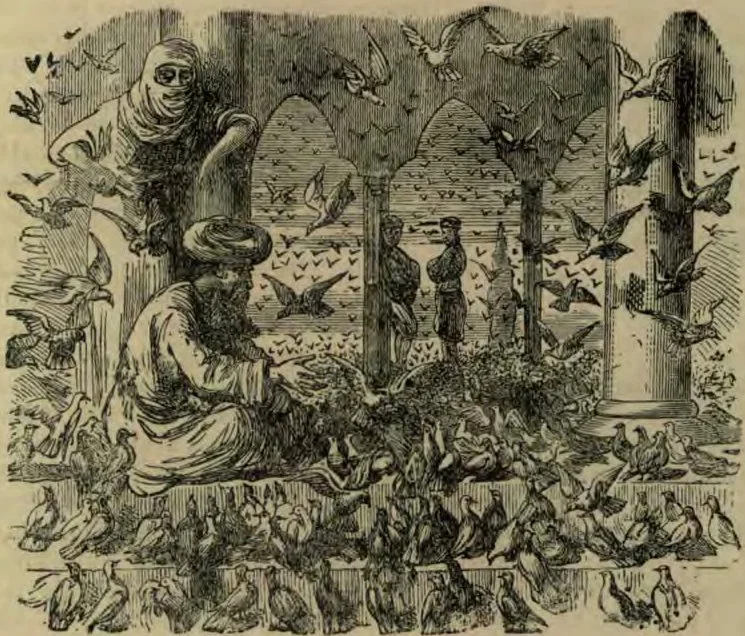
But you will wonder what all this has to do with the birds in the picture. Well, you shall hear now about the “Mosque of the Pigeons.” It seems that a pigeon was once the means of saving Mohammed’s life, and so ever after that, it was regarded by the Mohammedans as a sacred bird. A mosque was finally built for these birds in Constantinople, and here great numbers of them are still reared. It is a part of the inside of this mosque which is shown in the picture. Many good Mohammedans are foolish enough to think they are serving God by giving their whole time to the care of these pigeons. How thankful we ought to be that we know a better way to serve God. E. B.

LETTER BUDGET.

F. E. SMITH writes from Sedalia, Missouri: “I keep the Sabbath with my parents and sisters; my two brothers are not at home; one of them is in the Black Hills, and never heard the present truth. We have kept the Sabbath about four years. I was baptized last fall at the camp-meeting, by Eld. J. G. Wood. We take the INSTRUCTOR through the Sabbath-school, and like it very much. I don’t know how I could get along without it. I learn the lessons entitled ‘Scenes in the Life of Christ.’ I like to study them, and always try to have good lessons. I have about two miles to go to day-school, but sister and I have been all winter. I haven’t missed but two days this year, and then I was at camp-meeting; and I suppose I learned as much as if I had been at school. I like to go to the camp-meetings; they are always so nice. I send my best wishes to the readers of the INSTRUCTOR, and hope to be remembered in their prayers.”
EDITH NAYLOR writes from Ft. Scott, Kansas. She says: “I take my INSTRUCTORS to school, and lend them to my school-mates. They like to read them, and sometimes their mammas read them too. I hope to get some subscribers in this way. Will the little vegetarians from Minnesota (Ruth and Ruby Maddock) write me how they live, so that I may learn to live right. I am nine years old. I send my love to the INSTRUCTOR family.”

THE MIST ON THE MOUNTAIN.

I was once stopping at a friend’s house. He and myself were talking in the parlor, when his little girl came in, and said, “O papa, I don’t want to knit this stocking; I don’t want to begin. It looks so tiresome.”
A few minutes afterward his little boy came in and said, “O papa, I don’t want to add up this great large sum. It looks so big. I don’t want to begin.”
My friend did not speak in a cross way to his children, but he only said, “Emma and Walter, would you like to hear a story?” “O yes, indeed,” cried both the little ones. Emma threw down her knitting, and Walter’s slate went flying into the corner.
“Some years ago,” said Mr. Roundly, “I was traveling in the White Mountains with a companion who had been there before. We stopped a certain night at a hotel, and my friend said that he desired to remain there three or four days, because there were some fine mountain scenes which he wished me to see. So the next morning he awoke me early, and said, ‘Come, let us be off on our tramp. There is the first mountain. You and I must climb to the top of that to-day.’ I was surprised. The mountain seemed to stand almost straight up and down. ‘No,’ said I, ‘no indeed; you don’t catch me trying to get up there. Why, we would not go far before we would begin to slip down again. No indeed!’ ‘Oh come!’ said my friend. But he could not persuade me. At last, the next day, to please him, I started out, although I told him that I would not know how to commence climbing such a high mountain. We went up and up. The walk did not seem very tiresome, and I said, ‘How soon will we begin to mount the highest part?’ ‘Why, we are mounting now,’ said my friend, ‘and are nearly at the top.’ ‘At the top,’ said I. ‘Yes, indeed, and here we are.’ As he spoke, a glorious view burst upon us. Our hotel seemed a little speck in the distance far below. ‘Is it possible?’ I exclaimed. The banks of mist around the brow of the mountain had made it look taller and steeper than it really was. But when we once bravely commenced to go up, we found the difficulties vanish.”
As my friend ceased, he looked at his two children. “Do you understand the meaning of my story, Emma and Walter?”
“O yes, we do, papa,” cried both in one voice.
“Yes,” said Emma, “and I will go to work at my knitting. It will not be so hard after I begin.”
“And I,” said Walter, “will go at my sum.”
If we take hold of every duty in life with a strong will, it gets easier and easier.—S. S. World.

DO YOUR BEST.

This is the duty of all. Anything less than this is degrading to any man. Whatever your business, never be satisfied with anything less than the very best you can do at the time; and do better next time if you can. You are then sure of progress. Remember, the question is not how much you can do, but how well you can do it. This is your true measure of success in any vocation of life. A man in high position, when taunted with once being a cobbler, said, “Did I not do my work well?” That is the question, whether cobbler, legislator, or minister of the gospel, “Did I do my work well?” Do your best.—Morning Star.

Our Conversation and the Lord's Presence

WE often miss our Lord’s company, because our conversation does not please him. When our Beloved goes down into his garden, it is to feed there and gather lilies; but if thorns and nettles are the only products of the soil, he will soon be away to the true beds of spices.—Spurgeon.
Continue reading: SONG OF THE BLOSSOMS