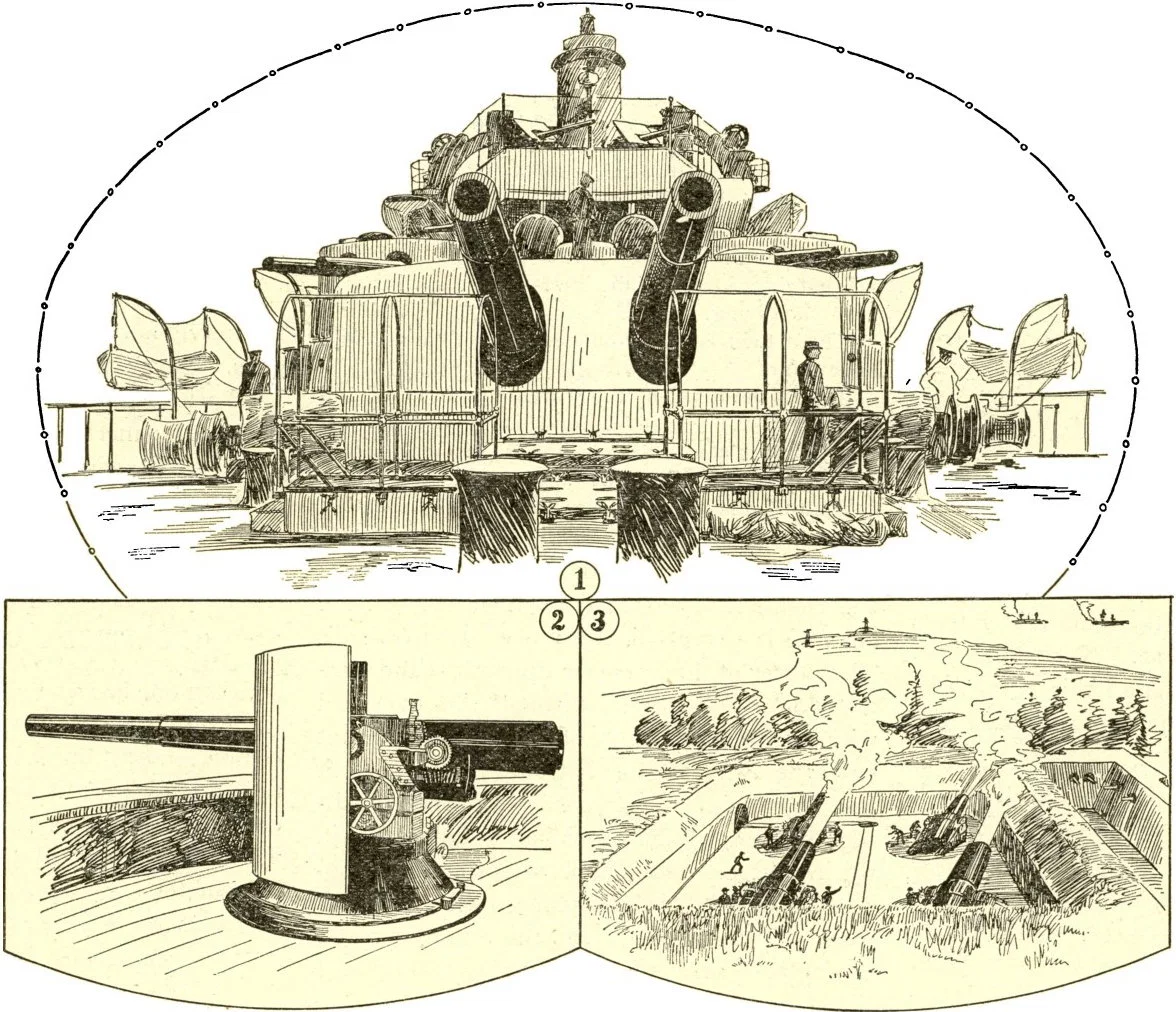
No. 1. The after part of the battle-ship Oregon, showing her aft revolving turret with two of her 13-inch guns…
No. 1. The after part of the battle-ship Oregon, showing her aft revolving turret with two of her 13-inch guns protruding from the same. On either side may be seen one of her broad-side revolving turrets with two of her eight 8-inch guns projecting from each. Some of her small rapid-fire guns may be seen near the top of the cut. The 13-inch guns use a charge of 550 lbs. of powder and throw a shell weighing 1,100 pounds, with a velocity of 2,100 feet, or nearly half a mile, per second. The 8-inch guns use 115 pounds of powder and throw a 250-pound shell with a velocity of 2,080 feet per second. The forward part of the Oregon has the same heavy guns, while her secondary rapid-fire battery, of twenty 6-pounders, six 1-pounders, and four Gatling guns, can shoot out a regular hailstorm of steel. No. 2. A 4-inch rapid-fire gun, with revolving shield, such as is used on the men-of-war. It uses a charge of from 12 to 14 pounds of powder, and throws a 33-pound shell with a velocity of 2,000 feet per second. At the muzzle its projectile would pierce 10 inches of wrought iron. It is fired with such rapidity that in the ordinary range, 5 balls may be kept in the air flying toward the mark. Thirty-six years ago the iron-clad Monitor pounded the sides of the Merrimac for over half a day with her two 11-inch smooth-bore guns. And, altho the Merrimac had only 4-inch iron armor, yet no shot perforated her during the whole fight. This 4-inch gun would have made a veritable pepper box out of her in short order. No. 3. A section of a battery at the entrance to New York harbor. Ships may pass and repass this battery without being seen by the men within; neither would those on board the ship get any idea of a battery being there from any outward appearance. The mortars are down behind great earthworks, and within these earthworks are massive walls with an intervening space so as to protect them from a charge from the enemy's infantry if they should succeed in landing. As shown in the engraving, some machine guns are so arranged in the diagonally opposite corners of this outer space that they could mow men down as fast as they could rush in. The harbor is all carefully mapped off in squares, and an officer on a prominence a mile or so away from the battery, by means of his range-finder and chart can tell what square the enemy's ship is occupying. He telegraphs this to the officer in charge of the mortar battery, and he immediately gives his pieces the proper elevation and fires them, either one, two, three, or on up to sixteen at a time, just as he likes. They have the matter so accurately figured out, and the men have become so skilled in their work, that a shot from one of these mortars can be dropped down on the space of a vessel's deck anywhere within a radius of five miles, the plan of a mortar being, of course, to throw a shell high into the air and let it fall on its target, bursting as it strikes. The shells thrown by the mortars shown in our cut weigh 1,000 pounds and are charged with 100 pounds of a high explosive. They would make short work of any hostile war ship that came within their range.
From Signs of the Times, Vol. 24, No. 24., June 16, 1898