The Iberian Peninsula

9%

Review and Herald Publishing Association · Takoma Park Station, Washington, D. C. · Jun 14, 1906

FromReview and Herald, Vol. 83, No. 24.

Read the full edition

The Iberian Peninsula

C. E. RENTFRO
MANY are the experiences and varied the history on this large peninsula in southwestern Europe. While at the present time it has two kingdoms, once there were twenty-three different tribes. The history of these dates back beyond 200 B. C. Some of the general names are Celts, Iberians, Galicians, Lusitanians, Cuneenses, and Carthaginians. Rome waged two wars to subjugate what was then called Spain; the first from 197 to 178 B. C., and the second from 153 to 133 B. C. Many leaders arose to free Spain from the Roman yoke, but this was not accomplished until the invasions of the barbarians from the north. The Romans left many traces of their power. One main benefit was the unification of their languages.
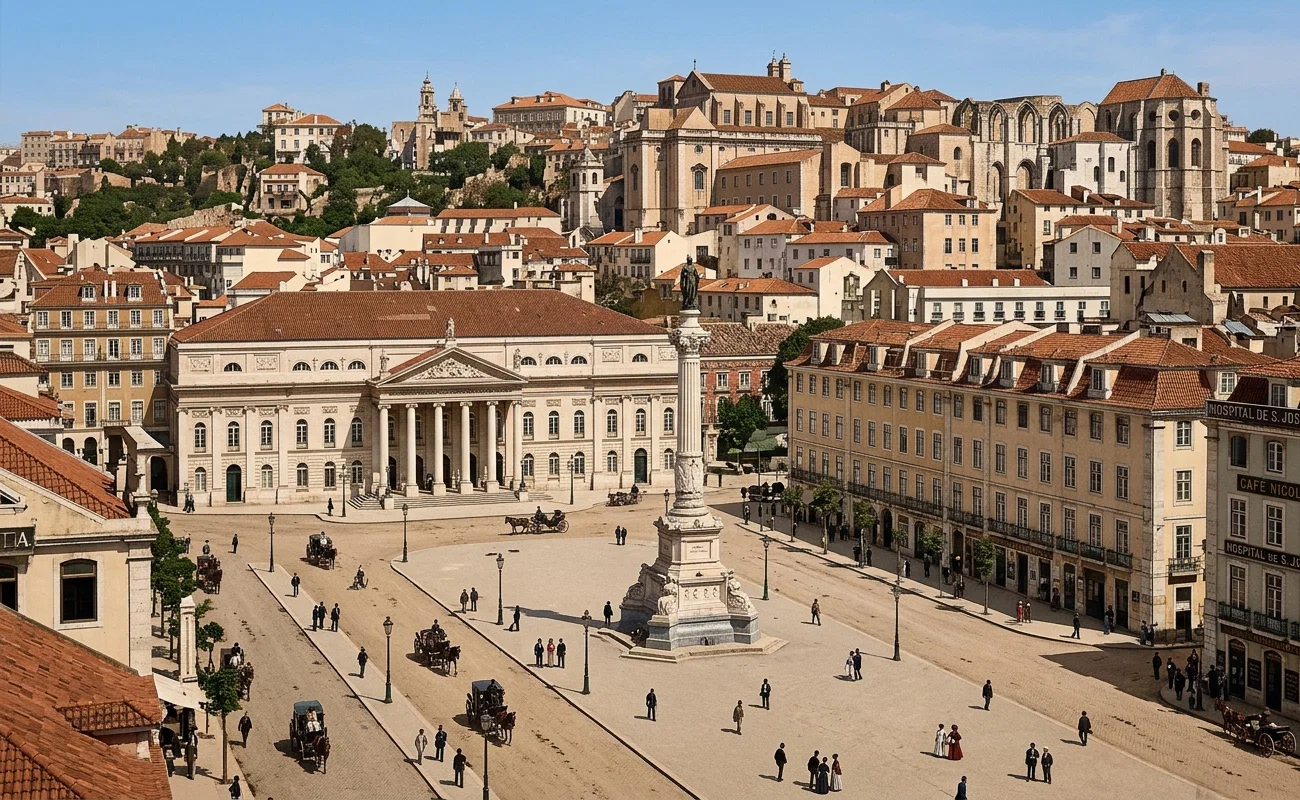
A VIEW IN LISBON. THE THEATER WITH SIX PILLARS WAS THE OLD INQUISITION BUILDING
The sovereignty of Rome was broken by the invasions of the Alani and Suevi during the fifth century. These were followed by the Visigoths, who ruled until the eighth century, and were in turn conquered by the Mussulmans. The Goths left traces of their rule in the architecture of noted buildings, and in the language, especially in northern Spain. The Saracen, or Mohammedan, invasion, brought the Moors into the peninsula, and wars raged between them and the so-called Christians until they were driven out in the twelfth century. Many Moorish mosques dot the country reminding the people of the presence of days gone by. These also remind the Bible student of the prophecy in Revelation 9, about the Mohammedan religion, in its inroads over the domains of the papacy.
In the eighth century a descendant of the Gothic kings accepted the command of a body of warriors, and taking refuge in northern Spain formed an independent state called the kingdom of Oviedo, between the mountains and bay of Biscay. As they grew stronger by fighting the Moors, the capital was changed to Leon, farther inland. Beside the kingdom of Leon, three others were constituted,—Castella, Navarra, and Aragon.
A descendant of the Duke of Burgundy, on entering the kingdom of Leon, was given a portion of land with a title, Count Henry of Portugal. This land lies between two rivers in north Portugal to-day, but a son of the count by conquest enlarged his dominions south to Lisbon and along the Tagus. We may picture the geography of the times. Leon lay east and north of Portugal, One Castella farther east to about half the frontier between Spain and France, and Aragon in the center and northeast. The Moors occupied the country from Lisbon to Valencia on the Mediterranean and all the southern portion of the peninsula.
In 1139, D. Alfonso Henriques was acclaimed king of Portugal, and the kingdom was recognized by the pope in 1144. In 1230 the kingdoms of Leon and Castella were united by inheritance of Ferdinand III, king of Castella. In 1479 Aragon and Castella were united by the marriage of D. Ferdinand II to D. Isabel of Castella. Little by little the Portuguese drove the Moors away from their territory, and the Spanish as well. This was completely accomplished in 1610. In all these years many were the wars between the neighbors on the peninsula. The Portuguese were helped by the English in wars against Spain and France, but now peace reigns between the two. We note that the Inquisition raged inthe two countries at about the same time, although first in Spain as a machine of the state as well as of the church. The expulsion of the Jesuits by the Marquez de Pombal broke the power of the Inquisition in Portugal, and it shortly ceased.
One thing we see now is the cordial relations between the two peninsular powers. The postal system provides for the same rates between the two as exist in each country. A letter sent to Gibraltar, English territory, is five cents, but to any part of Spain or her possessions it costs two and one-half cents. The rate on printed matter is very low. As the two languages are so similar, a paper could be published in the two, thus building up a unity in the two fields. Another thing may be done as the necessities demand, and that is there could be opened a union school for training workers in the two fields so close together.
We have noticed reports of workers in lands of Bible fame, yet perhaps few know that Spain and Portugal represent a place where Paul the apostle desired to go. In Romans 15 he twice mentions his desire to go to Spain on his return from Jerusalem by way of Rome. Now if Paul realized the importance of going there, surely it is more important now, especially when is due the last warning message to the world.
About three years ago the Brethren Bond started work in the ancient kingdom of Aragon, in and near Barcelona, and they report between fifteen and twenty Sabbath-keepers. With this start, the land of the Visigoths, of the Moors, of the kingdoms of Castella, Leon, and Aragon, will not long hence hear the sound of the loud cry of the third angel's message. The work in the land of the Suevi, the Moors, and the kingdom of Portugal, is still in the “rooting” stage. We who are here are sowing seed. May God bring the fruit, and bless the work in the Iberian Peninsula.