ELDER A. N. ALLEN and the writer were met by Brother F. A. Stahl, of Bolivia, at Puno, Peru, May 20, on their way to visit our Indian brethren about eighteen miles from Puno. Brother Camacho, who was the first among them to accept the truth, and who has been the means in God’s hands of teaching it to many others, secured horses from several of their number, and sent them for our use. The next morning we started for our destination, reaching the home of this brother in the afternoon. Six miles away some of the Indian brethren met us. Their numbers gradually increased until one hundred fifty or more were accompanying us. These, having twenty-five Peruvian flags, formed themselves into two lines, between which we rode. Men, women, and children seemed to have no difficulty in keeping up, whether our horses walked or trotted. They met us with hearty hand-shakes and embraces. From fields and houses along the way, they ran to meet and greet us. I had never experienced such a reception before; surely none more hearty. The scene made me think of pictures I had seen of Indians on the war-path, but here they were in the path of peace. Their heartiness and deep interest did not abate during our week’s stay among them, and when we finally left, twenty-five or more accompanied us a distance of six miles.
Our brethren have recently heard a great deal about this people, and the good work that has been begun among them. I would say that the report has not been exaggerated. What I witnessed among these Indians, who have been kept in ignorance, been exploited and oppressed so many centuries, I shall not soon forget. In many respects they are like children, but in the independent stand they have taken to obey God, and in their firmness, they are men and women full grown. What a change has been wrought in their lives, not only in those who have been baptized, but in scores of others who have been affected by the saving gospel.
As we rode along the street, we met drunken men and women, their mouths foul with coca and blasphemy, their clothing unwashed, and their faces and hands unseemly. Of the hundreds who came to the meetings or to be treated for ailments, none were drunken; coca was seen in the mouth of only one; the faces and bodies of many had been washed; and when they came to meeting on the Sabbath, many were dressed in clean or new clothes, while others were careful to tell us that they, too, would soon have new clothes, as they had not yet finished making them. While we heard of Indian brawls, these dear brethren were as orderly and kind as any company I have ever seen. Instead of carousing and blaspheming, they would gather in the meeting-place and sing (although still imperfectly) hymns of praise, long into the night. “This is the Lord’s doing; it is marvelous in our eyes.”
A door for great usefulness is open here. Other denominations that have tried to do something for the Indians are surprised. For many miles the Indians come to receive help. Some of the cures wrought have been wonderful. The influence of the work is felt by friend and foe. The confidence of the otherwise suspicious Indian seems to be fully won.
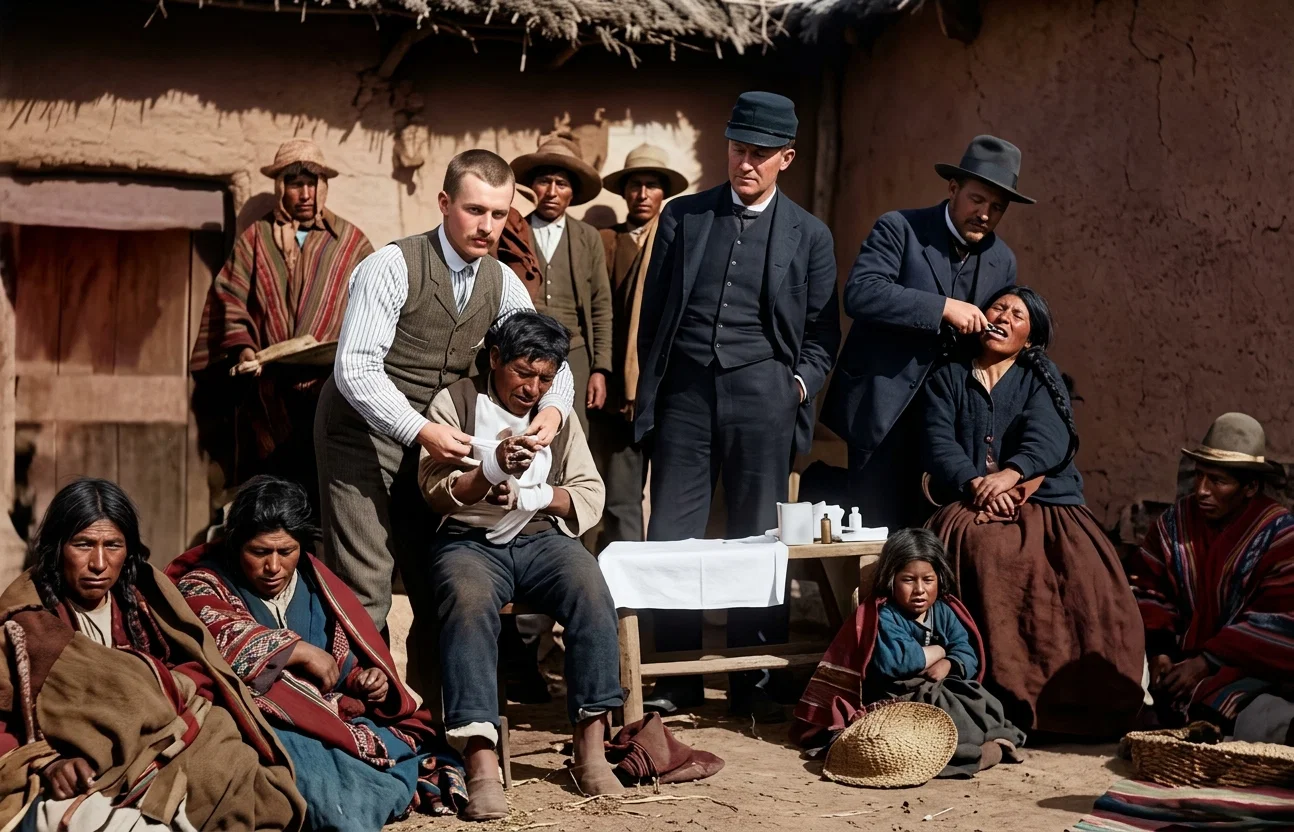
To give some idea of the medical work that is being done for them, I will mention the experience of one afternoon, when I kept count of the patients and the character of their diseases. The total number of patients was thirty-five. All but three were really in need of medical care, many of the cases being serious ones. A few were as follows: Gangrene of the hand, broken arm that had been neglected, tumor of the neck, disuse of a finger (which was healed in five minutes with electricity), stiff neck of a year’s standing, rheumatism of ankles, chronic headache, tumor in foot, ulcer of tongue, typhoid fever, constipation, stomach trouble, smallpox (sent for medicine), lumbago, etc. It was a busy afternoon, but not exceptionally so. The morning we left it was difficult for Brother Stahl to get away. By daybreak a horse was waiting to take him to see a patient far up the mountainside. On his return he was busy till he mounted his horse and tore himself away from others who desired his attention. As I saw this, I could not but wonder if there are not hundreds of places where people are suffering, and where, with similar methods, they would be helped, and best of all, scores of souls saved, as has been the case here already. It would be a less pretentious work than to have charge of a grand sanitarium, or be an employee in such an institution, in a country having hundreds of physicians and plenty of hospitals. But when we consider that an Indian’s soul is worth as much as a white man’s, the soul of an ignorant man worth as much as that of an educated man, the soul of a savage as much as that of a civilized man, how shall we compare the good that might be done with that which is done? As I have witnessed this work, I have wondered at our slowness to learn the methods of Christ, even in medical work, in proclaiming the third angel’s message.
TREATING INDIANS,— BROTHER STAHL AT LEFT ATTENDING TO A GANGRENED HAND; BROTHER ALLEN EXTRACTING TEETH
To lay aside pride and comfort and ease, to leave the great world and be swallowed up in some obscure work among an unknown and despised and ignorant people, to make one’s self one of them and be recognized by them as a brother,—this is the great work of the missionary. This is what the Saviour did. This will bring glorious results.
The Sabbath was a day long to be remembered. A goodly number had requested baptism. After a discourse on our work and our duty to it, by the writer, a call was made for those who desired baptism to come forward. Over thirty responded. Several of these were advised not to take this step now. Twenty-nine were accepted. One, on account of sickness, could not be present. After a thorough examination of the candidates by Elder Allen, we repaired to a dam that the brethren had made the day before in a mountain valley, about a thousand feet above, and in plain13sight of, the beautiful Lake Titicaca, where it was my privilege to bury these precious ones with Christ by baptism. This lake, around which so many unrecorded historic events had crowded, which had witnessed so many centuries of pagan and papal idolatry, now saw the unpretentious, humble burial of twenty-nine of its dusky sons. It has witnessed also their resurrection, and may it witness the holy living of these and many others who shall be saved. More than three hundred were present at the meeting and at the baptism. The order maintained and the respect shown were perfect.
I have never baptized a large company that seemed better prepared. It was therefore a privilege to organize a church in the afternoon. Including the fifteen who had previously been baptized, and Brother and Sister Stahl, a church of forty-six members was organized. The only white members are Brother and Sister Stahl. There are one or two who have a little white blood. Brother Stahl was chosen elder, and Brother Camacho deacon.
We have tried to impress these people with the responsibility of helping sustain the work. They brought in a good supply of food while we were there,—potatoes, eggs, mutton, chicken, cheese, chuno, etc. One brought a bag of potatoes as tithe. For the treatments and medicine a charge is made,—twenty centavos, about eight cents in gold,—enough to meet the actual outlay, and they pay it gladly. Brother Stahl does not need to collect this, for one of the brethren always sees to it.
For the purpose of putting the work on a more solid basis, two small tracts of land have been purchased, located on opposite sides of the main road from Arequipa and Puno to La Paz, Bolivia. The one on the upper side of the road is about 115 x 130 feet. On this a small house will be built for Brother Stahl, and as soon as possible a school building. For the present, the school will be held in a room owned by Brother Camacho, who will act as teacher. The other piece is about 130 x 180 feet. At each front corner is a spring, one of which is good for domestic purposes, but the other is mineral water. On this land there will be erected a small dispensary and treatment-room, with a few rooms where the sick, when they come, may stay overnight. A bath-tub will be made, with the mineral water running through it. The land cost thirty dollars gold, which is very cheap, a favor of the interested Indians. The cost of the whole, not including school buildings, will probably not exceed five hundred dollars. It is felt that all our money must not be invested here, for there are other places that should have a similar work done for them.
While this is to be the center of the work for the time being, it is not expected that Brother Stahl will labor exclusively at this place. Bolivia will also demand a part of his attention. We trust that from this center, which is on a much frequented road, the truth will become known in distant parts, and that it may be a permanent beginning of the enlightening of the fifty thousand Aymara Indians, and a door to the millions of the Quichuas.
Each time when Brother Stahl has left them, some effort has been made against the Indians. Just before our arrival, three hundred, from the farm of a priest on a peninsula several leagues distant, incited by the latter, started out to kill Brother Camacho and burn his house. On the way they began talking about why they were going to kill him. They said he had never done them harm. As the result, the mob was broken up. When another attempt was made, only seventy-five of them assembled, and they dispersed in the same way as before. When they came together again, there were too few to do anything. In the meantime, friendly Indians, but strangers to Brother Camacho, spoke with his persecutors. The result was that they cheered him, crying: “Viva Camacho! Viva la libertad de los cultos! Viva el evangelio!”
When Brethren Allen and Stahl went to Chucuito to see about having the papers made for the property purchased, they were insulted by two men, one of whom hit Brother Stahl’s horse over the head with a club.
Brother Stahl and the writer visited the subprefecto at Puno on our way to La Paz. He received us very coolly, and told us plainly that he would do all possible to hinder our work for the Indians. The large gatherings of the Indian brethren were characterized as Indian uprisings. He declared that they needed no new religion, notwithstanding the fact that the Catholic rule of four hundred years has not only not raised them either morally, spiritually, or as men and women, but has positively lowered them. Other authorities were favorable to us and our work.
We trust that nothing will hinder our work for them. Thus far every hindrance has been made a “favoring gale.” Recently the priest went from house to house forbidding the Indians to attend the meetings. The attendance immediately increased, and it is now larger than ever. Pray for the work among this long-neglected people.