Halley’s Comet

10%

Pacific Press Publishing Association · Mountain View, California · Nov 24, 1909

FromSigns of the Times, Vol. 36, No. 46.

Read the full edition

Halley’s Comet

HERE is very much said in the newspapers regarding Halley’s comet, and a great many sensational things are said also. This comet has made visits to the solar system fourteen times since 240 B.C. In this present visit, according to astronomical reckoning, it will pass between the earth and the sun, 54,740,000 miles from the sun. At one point the nucleus of the comet will be at a distance of 13,020,000 miles from the earth. That will be May 18 of next year. On that day the earth, comet, and sun will approach as nearly as possible, Astronomer Larkin tells us, the same straight line; the comet in between the earth and the sun. Should the nucleus reach the exact straight line, it would pass between the earth and the sun, and be seen in transit across the sun’s disc; but it might not be visible at the time of transit, however, as that lasts but a few seconds.
The same astronomer also says the gigantic comet of 1882 actually made transit across the sun’s disc; but the nucleus was so nearly transparent that it could not be observed. He also tells us that if the tail of the comet is as long as it seems to be, pointing away from the sun, on May 18 of next year the earth will dash through it, or rather the tail will sweep over the earth. These comets’ tails are supposed to be made of fine illuminated dust; and there may also be more or less gas connected with them. But these are still questions.
The comet of 1858 had a tail length of 42,000,000 miles; the comet of 1843, 200,000,000 miles. No one is able to predict the length of these streamers, because the quantity of comet dust and the rate of activity of nuclei are not known.
So all this question regarding the tail of the comet is yet problematical. It has been predicted that when the earth passes through the tail of this comet there will be a shower of meteors; but that too is questionable.
The orbit of this comet was calculated first about 1705 by Halley. He declared that it would come to perihelion—that is, nearest the sun—in 1758 or early in 1759. It reached that position on March 13, 1759. This achievement was considered so great by his brother astronomers that the comet was named after him. This is the first comet whose orbit was located in space; and the computation was made possible only a short time before by the discovery of the law of gravitation by Newton.
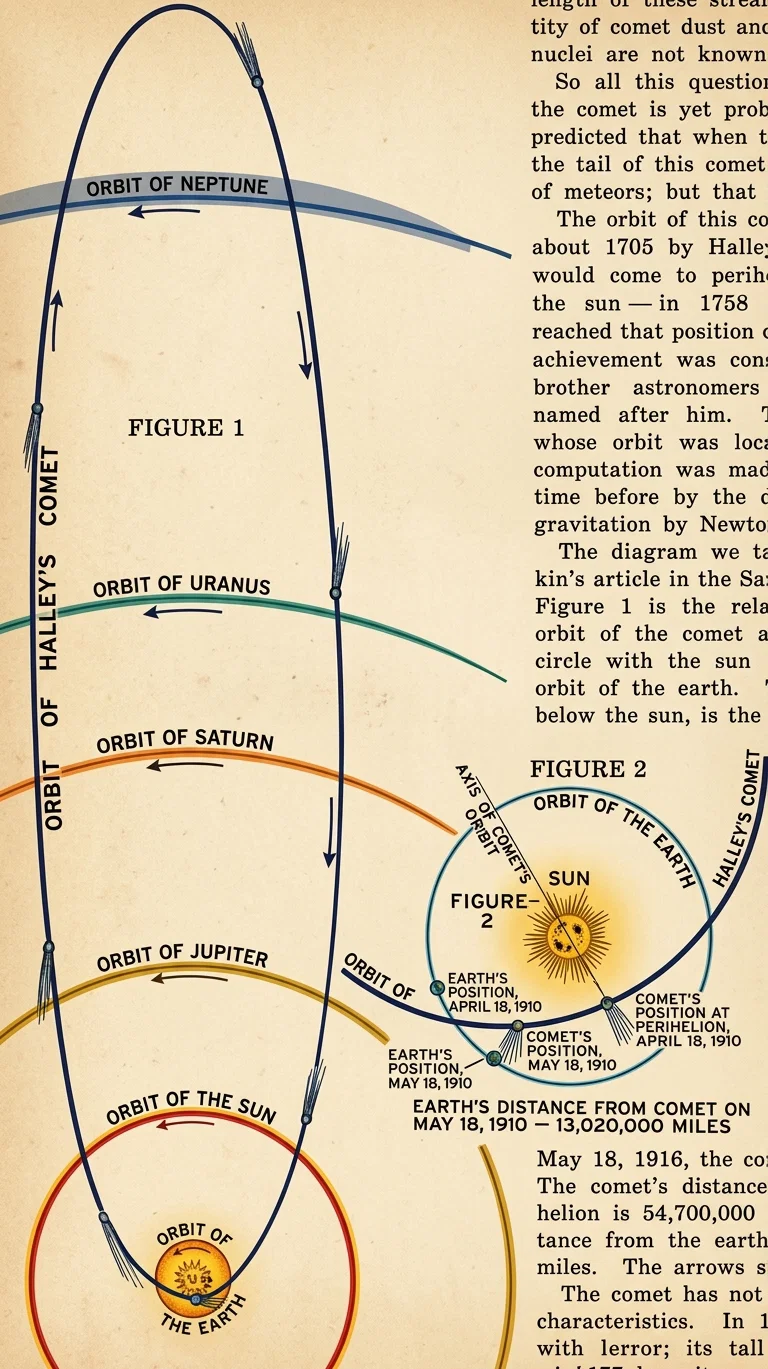
The diagram we take from Professor Larkin’s article in the San Francisco “Examiner.” Figure 1 is the relative dimensions of the orbit of the comet and planets. The small circle with the sun (s) in its center is the orbit of the earth. The body with the tail, below the sun, is the comet at perihelion; the opposite end of the great ellipse is aphelion. The greatest distance across the ellipse is 3,348,000,000 miles. Figure 2 presents the orbits of the earth and the comet, an enlarged view of the orbit of the earth and a part of the orbit of the comet. The comet is in perihelion April 18, 1910. The earth’s position at that time is shown. May 18, 1910, the comet is nearest the earth. The comet’s distance from the sun at perihelion is 54,700,000 miles. The comet’s distance from the earth May 18, is 13,020,000 miles. The arrows show directions.
The comet has not always shown the same characteristics. In 1456 it filled all Europe with terror; its tail was enormously large. In 1607 its tail was small. In 1759 it was not easily seen north of the equator. Its motion is retrograde, opposite to that of all the planets and nearly all comets.
Mr. Larkin concludes his article by asking, “And now will professional scientists stop spreading unrest and distress among the people?”