THE TWO COVENANTS

5%

Seventh-day Adventist Publishing Association · Battle Creek, Mich. · Apr 10, 1883

FromReview and Herald, Vol. 60, No. 15.

Read the full edition

THE TWO COVENANTS.

BY ELD. J. O. CORLISS.
(Continued.)
Are the Gentiles then cast out forever? Just how the Gentiles from this low state can be brought to share in the blessings of the new covenant will be noticed further on, but for the present we will waive this part of the subject to consider the important point of when and how the new covenant was instituted.
In Matt. 26: 26–30 is an account of the institution of the Lord’s supper: “He took the cup, and gave thanks, and gave it to them saying, ‘Drink ye all of it; for this is my blood of the new testament, which is shed for many for the remission of sins.’” The blood of Christ is the blood of the new covenant, the word testament, as already noticed, being the same as covenant. The disciples present on this occasion were Jews, and there, as representatives of the whole Christian church, they entered into the new covenant with the Lord. God had now set forth Christ as the Saviour of the world, virtually proposing to all that if they would receive him and his offering, on the conditions which he, in his divine teaching for three years and a half, had set before them, they should receive the remission of their sins, as it was for this purpose that his blood was shed. And they, by partaking of those emblems, accepted the arrangement.
The following day the Author of the covenant dies; the blood of Christ is spilled, and he cries out, “It is finished.” The new covenant is there ratified and sealed, and from that moment is in full force. This is verified by the statement of Paul: “For a testament is of force after men are dead; otherwise it is of no strength at all while the testator liveth.” Heb. 9: 17.
But what effect did this change from the old to the new covenant have upon God’s law, the ten commandments? Did it abolish the law or supercede it by another? Hear the emphatic declaration of God by the mouth of the prophet: “I will put my law in their inward parts, and write it in their hearts.” As Paul quotes it, it reads, “I will put my laws into their mind, and write them in their hearts.” To what law does this prophecy refer?—To that which was the law of God in the days of Jeremiah, which no one will dispute was the ten commandments. If it does not mean this, then it should have read, I will put a new law into their minds, and write it in their hearts.
And if, as our opponents contend, the law of ten commandments was the old covenant to be abolished, the prophecy of the change should have read, This shall be the covenant that I will make with the house of Israel: I will abolish my law, and take it out of their way. Or if the law was not to be abolished, but only changed, that fact should have been noted in some such language as this: This shall be the covenant that I will make with the house of Israel: I will change my law, and adapt it to the genius of the gospel dispensation.
But it says nothing of this kind, as the reader has sufficiently noticed. It says, “I will put my law into their inward parts, and write it in their hearts.” I will incorporate it into their very being; I will take away the carnal mind, which is not subject to the law of God, so that it will be their delight to keep it in sincerity and truth.
And this is further indicated in the fact that when the Minister of the new covenant came to take away the first and establish the second, he said, “I delight to do thy will, O my God; yea, thy law is within my heart.” Ps. 40: 8; Heb. 10: 5–9. And as he was, in all holy affections and loyalty to God, so must all his followers be.
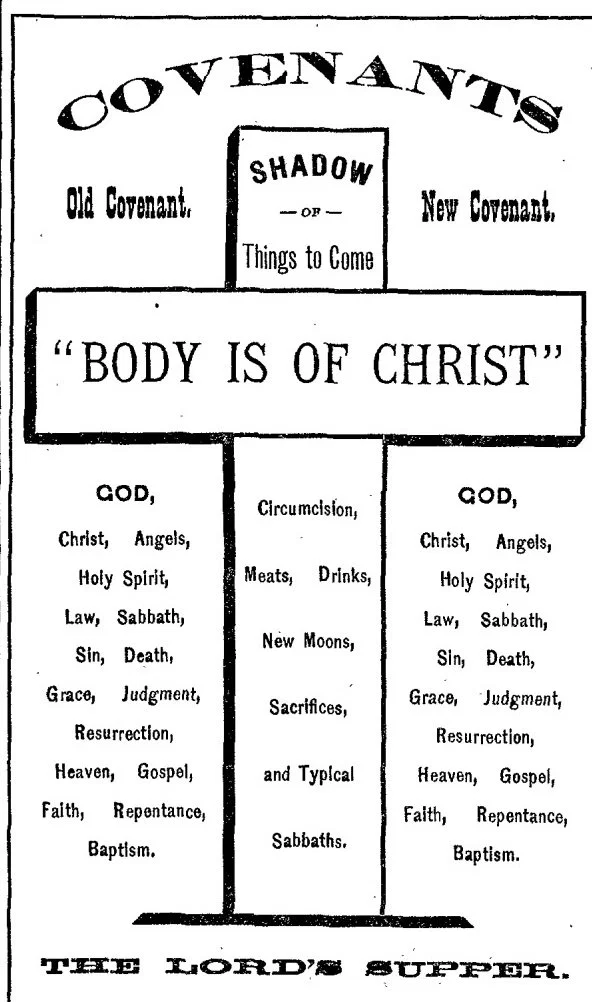
Then in what does the difference between the two covenants really consist? This can be readily shown by the use of the accompanying diagram:—
THE LORD'S SUPPER.
THE LORD'S SUPPER.
As previously shown, the death of Christ on the cross marked the close of the old covenant and the establishment of the new. So let the cross in the diagram represent the division between the two covenants, the space on the left side of the cross representing the old covenant, and that upon the right representing the new covenant. The question now under consideration is: What is embraced in the new covenant that was not in the old? or, to put it in another form, What did the old covenant contain that was abolished at the establishment of the new covenant?
We have arranged in parallel columns, one on each side of the cross, some of the more prominent points embraced in both covenants, which the reader can readily compare, and thus test the truthfulness of the positions designed to be maintained.
First in order, then, we ask, Does not the same being who has proclaimed himself unchangeable, and who was so prominent in all the arrangements of the old covenant, maintain his existence in the new covenant? And does not his hand still guide the destinies of the world? Certainly; no one would dispute this. Then, too, the name of Christ appears prominently in the new covenant. Did not the same Christ exert a controlling influence under the old covenant? In his letter to the Hebrews the apostle says that Moses esteemed the reproach of Christ greater riches than the treasures of Egypt. How could this be possible if Moses knew nothing of Christ? The facts are that Moses had a personal knowledge of Christ, and was furthermore guided by him in his movements with the people of Israel.
When God’s people started out on their journey from Egypt, God said to Moses, “Behold, I send an Angel before thee, to keep thee in the way, and to bring thee into the place which I have prepared. Beware of him, and obey his voice, provoke him not; for he will not pardon your transgressions; for my name is in him.” Ex. 23: 20–21. This being whom God sent to guide Israel, and to give instruction to Moses, had God’s name in him, or bore the name of God; hence the record of admonitions and directions of those forty years wandering says: “And the Lord said unto Moses.”
But who was this being so highly favored of God as to be intrusted with such weighty responsibilities? In his instruction to the church, Paul has spoken definitely on this point. He says: “Moreover, brethren, I would not that ye should be ignorant, how that all our fathers were under the cloud, and all passed through the sea; and were all baptized unto Moses in the cloud and in the sea; and did all eat the same spiritual meat; and did all drink the same spiritual drink; for they drank of that spiritual Rock that followed them [margin, went with them]; and that Rock was Christ.” 1 Cor. 10: 1–4.
The fact, then, is plainly established that Christ was the leader of the chosen Israel in the old covenant, and that they were so intimately connected with him as to receive a constant supply of “spiritual meat,” notwithstanding the oft-repeated assertion that the old covenant had no spiritual blessings. Who can deny that the people under the old covenant had Christ with them, without denying some of the plainest statements of Scripture?
Angels had a work to perform in connection with God’s people of old. This was so well understood by them that David, in describing God’s care for his people, boldly advocates the ministration of the angels. Thus he says: “The angel of the Lord encampeth round about them that fear him, and delivereth them.” Ps. 34: 7. But do angels maintain the same relation to the human family under the new covenant arrangement? We think so; for we read in Heb. 1: 14 that the angels are “all ministering spirits, sent forth to minister for them who shall be heirs of salvation.”
In the gospel dispensation so-called, the Holy Spirit takes a prominent part in the conviction of the sinner. Everywhere in the New Testament its operations and office-work are extolled, and we are warned against grieving it from us. But were its operations known, and was its influence sought as something desirable by the men of the Old Testament? Hear David plead, when he thought he had lost favor with God because of his terrible sin: “Cast me not away from thy presence, and take not thy Holy Spirit from me.” Ps. 51: 11. Evidently David felt that the loss of the Holy Spirit was equivalent to becoming a castaway, and as such, forever beyond the power of God’s mercy.
Again, Isaiah records the presence of the Holy Spirit with the people of God, and how they vexed that Spirit by their rebellion until God turned to be their enemy. Certainly all must acknowledge the operations of the Holy Spirit in the old covenant.
(To be continued.)