HOW THE THIRD ANGEL'S MESSAGE WAS CARRIED TO PITCAIRN.
God has said in his word that the Third Angel's Message shall go to every nation, kindred, tongue, and people. Such a universal message must necessarily reach even the islands of the ocean, and engage the attention of the dwellers of these isolated spots of the earth. All parts must hear the warning cry.
The prophecies of the Old Testament uphold this sentiment. Isaiah, who has sometimes been denominated the “gospel prophet,” in referring to God's righteousness, which is found in his law, says: “My righteousness is near; my salvation is gone forth, and mine arms shall judge the people; the isles shall wait upon me, and on mine arm shall they trust.” Isa. 51:5. That is, the isles will trust in God, as they enter the Judgment. If all men are to be judged by the standard of God's law, as is stated (Eccl. 12:13, 14; Rom. 2:11-16), then it follows that those who trust in God through the ordeal of the Judgment, will know something of his law.
But the inspired penman speaks decidedly with reference to the work of Christ in the earth. “He shall not fail nor be discouraged, till he have set judgment in the earth; and the isles shall wait for his law.” Isa. 42:4. And how long they have waited! All these years that other parts of the earth have heard and rejoiced in his truth, these have waited—silently waited. But the decree has been uttered; the law of God must be given to them.
And when is this to be accomplished? We are told that the Lord is to set his hand the second time to recover the remnant of his people. Isa. 11:11. If the second time, it must be preceded by one other recovering of a remnant of his people. That was fully accomplished when he brought from Egyptian bondage his chosen people, the Israelites. But the second gathering of his people, brought to view in the scripture under consideration, is to be in the gospel day, after the “root of Jesse” has appeared, to be an ensign of the people. Verse 10. The gathering, too, is to be from all quarters of the earth, even “from the islands of the sea.” Have we not, as a people, believed for some years that this very work is going on? And if this is true, can the work close up before the islands have the103opportunity promised them in the sure word of God? Is it not reasonable to suppose that God would have them hear the truth as well as other parts of the world which are no more favorably situated? These questions have been repeated many times by some of our brethren living near the coast, as their opportunities have afforded them some knowledge of the situation. Some of these have done what missionary work they could by sending papers to these lonely parts. To some it would doubtless have seemed like casting “bread upon the waters” never to return. But the sure word of God has promised that all such shall be found after many days.
This case has proved no exception. Matters assumed such shape that Bro. J. I. Tay, of Oakland, Cal., resolved at all hazards to do something to connect ourselves more closely with these people, and see what could be done for them. When a youth, he had sailed in a ship commanded by his father. While on a voyage to Calcutta, he had found a small book giving a narrative of the mutiny of the “Bounty,” and the settlement of Pitcairn Island by the mutineers. Upon trying to determine just where to go, the thrilling story he had read so many years before came with vividness to his mind, and he resolved, if possible, to visit Pitcairn.
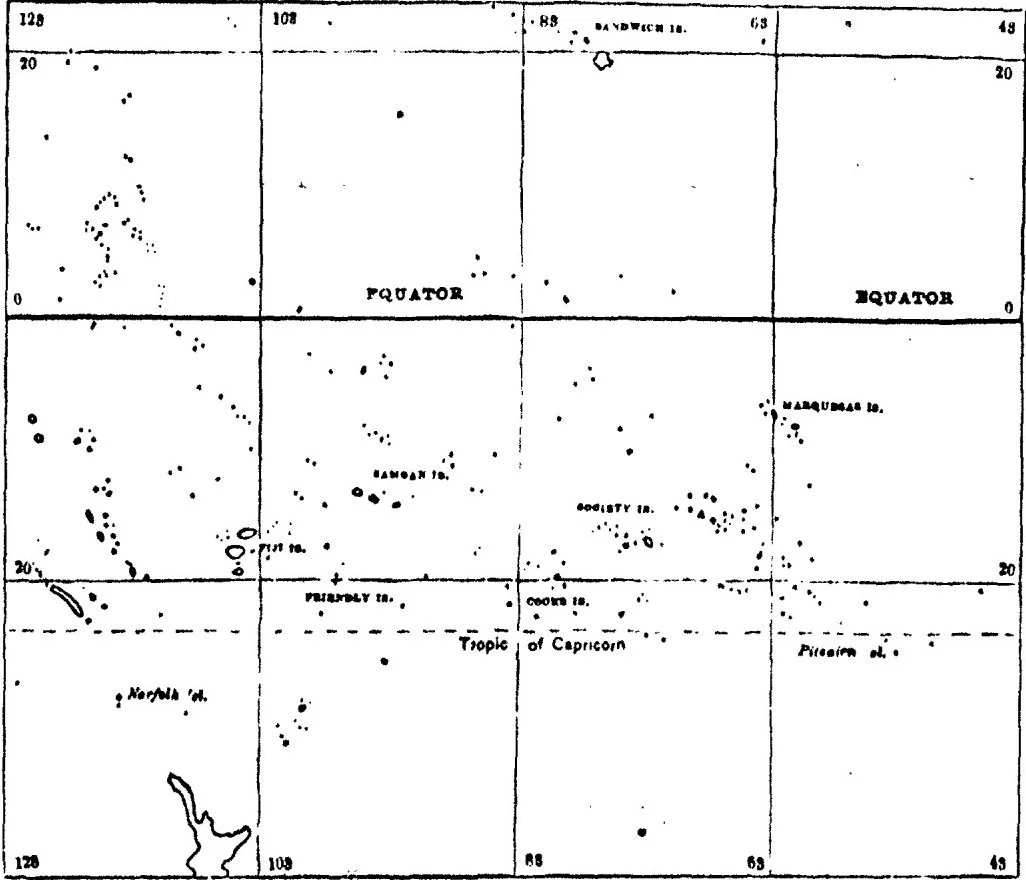
Map Showing Names and Positions of Islands in the Central Pacific Ocean.
Upon communicating his mind to some of the leading brethren, he was somewhat astonished to find them in sympathy with him. Encouraged by their counsels, he took a supply of publications, and set out on his mission. But how was he to reach his destination? There was no regular communication with Pitcairn, and the nearest point at which he could hope to touch was Tahiti. But it would cost too much to go as a passenger on the little packet running from San Francisco to that island. He accordingly engaged a place on board as carpenter, agreeing to work for his passage, provided they would not ask him to work Sabbaths. The bargain being made, he sailed from San Francisco in the barkentine, “Tropic Bird,” July 1, 1886. July 22, they arrived at the Marquesas Islands, where a short stay was made. Here some missionary work was done of an encouraging nature.
Sailing again July 29, the next day he reached Papiti, in the Island of Tahiti, where he met a man who had seen the Signs of the Times at another point in the island, where they had been regularly sent. Here a good many books were disposed of. But finding no more immediate work at that point, Bro. Tay began to inquire about getting to Pitcairn. He was told that he might have to wait a whole year, or even two, before an occasion would offer to go there, as it was only by chance that such an opportunity occurred. And even if such a time did come, it would be useless to go, as no one would be allowed to land and remain on Pitcairn. After remaining at Papiti five weeks, and almost losing hope of reaching Pitcairn, a British ship of war came into the harbor.
Learning that this vessel was on the way to Pitcairn, Bro. Tay resolved to go on it if possible. He accordingly applied to the English consul for permission, but was told by that officer that he had no authority in the matter, as he (Bro. Tay) was an American citizen. He, however, suggested that if the captain of the “Pelican” could be visited, perhaps the desired permission might be obtained.
Losing no time, Bro. Tay saw the captain, and stated his desire to go on his ship to Pitcairn. Upon being questioned as to his motive in desiring to make such a visit, Bro. Tay candidly told him about the message of truth he had for the people there. The captain listened quietly, and then said: “I cannot talk with you on this subject. My first lieutenant is our theologian; talk with him. If he thinks favorably of your project, you can go.” Then requesting Bro. Tay to make his statement and application in writing, he dismissed him.
As there was yet a week before the vessel sailed, Bro. Tay addressed a short note to the captain, stating the object of the International Tract and Missionary Society, of which he was an agent, and that he wished to visit Pitcairn to talk with the people there. At this point an unfavorable influence was brought to bear upon the captain by some on shore, to whom Bro. Tay had talked the truth; and the captain tried to dissuade him from the attempt. When told that there was no likelihood of his being allowed to land at the island, Bro. Tay replied that he would take all chances, and if carried by, would cheerfully stop at the next station at which the ship would touch.
The next ordeal was to talk with the lieutenant to whom the captain had referred. The missionary at the island had talked with the first officer beforehand, to prejudice him for the occasion. Bro. Tay and he talked together more than an hour, when the officer acknowledged the truthfulness of the positions held by us as a people, and finally said that he could go on the ship if he liked, though he felt certain that the people of Pitcairn would not permit him to land.
Going on board, all seemed to try to make Bro. Tay feel at home. His books were carefully stowed away, and on that very day, Sept. 16, the good ship lifted anchor, and bore away for Pitcairn, carrying the Third Angel's Message, toward the people of that isolated spot, who had waited so long for God's law. As soon as the ship was fairly at sea, all desired to talk about the truth every spare moment. On the passage, all the points of truth were canvassed, including our views of health reform, and the time passed away most pleasantly.
Arriving at Raratonga, one of the islands of Cook's Group, a message was sent from the captain to Bro. Tay, saying he could go ashore in the boat, if he wished. This privilege was used to the best advantage. Inquiring for the resident missionary, his house was pointed out, and a pleasant visit was enjoyed with him. Before leaving him, the gentleman purchased a number of our books, including “Great Controversy,” “The Atonement,” and “Thoughts on Daniel and the Revelation.” The next place at which the ship called was Aitutaki (pronounced t-loo-ta-kee), another island of Cook's Group. Here, also, some colportage work was done, and reading on present truth placed in the hands of the people. On this island all of the 1,800 natives have been Christianized, and are strict in keeping what they suppose to be Sunday; but is in reality the seventh day of the week, though they keep midnight time, as Sunday keepers do. This was accounted for when we learned that the missionaries to this island came from New Zealand, and evidently neglected to change their reckoning on crossing the day line.
On Oct. 18, 1886, the ship reached Pitcairn Island. When opposite Bounty Bay, two large boats were seen to come through the breakers. By the vigorous use of the oars, they soon pulled alongside the ship, and fifteen men came on deck. After they had cordially shaken the hands of all on board, arrangements were entered into for a visit on shore. At that moment Captain Hope said: “We have a man with us who would like to remain with you for a time on the island. If you do not want him to remain, I shall be pleased to have him accompany us to Coquimbo.” One of the number, who proved to be the magistrate of the island, said that individually, he had no objection to his remaining with them; but that their laws forbade such a thing. “We consider, however,” said the magistrate, “that the decision of the captain of an English man-of-war is of a higher court.” With these words, the matter was left for future consideration. J. O. CORLISS.