In the extreme southeastern portion of Australia, between Wilson's Promontory and Cape Howe, lies, in crescent form, the most fertile and beautiful district of the entire continent. It is hemmed in by the sea on the east, and by the Australian Alps on the west, and covers an area of about 10,000,000 acres. This territory was named Gippsland, after Governor Gipps, one of the early governors of Victoria, by Count Strzelecki (pronounced Stre-lecki), the explorer of the district.
The climate of Gippsland, unlike that of most of Australia, is cool and refreshing. From the east it receives the breeze from the ocean, which greatly affects that part nearest the coast, while the almost perpetual snows upon the summits of the dividing range on the west, keep the temperature of that part of the country delightfully pleasant. Unfailing streams of clear water, fed from the snow-clad hills, and the numerous beautiful lakes which dot the lowlands, attract thither each season multitudes of tourists from Melbourne and Sydney, who divide their time between hunting, fishing, sailing on the lakes, and playing at popular games. The influence of the sea on the one hand and the mountains on the other, not only protect that district from the hot blasts that wither the verdure of the interior, but also provide it with seasonable rains, which are denied to most other parts of this continent. Here nature revels in her brightest colors throughout the greater part of the year; and flowers in endless variety and of great beauty, are seen in all directions.
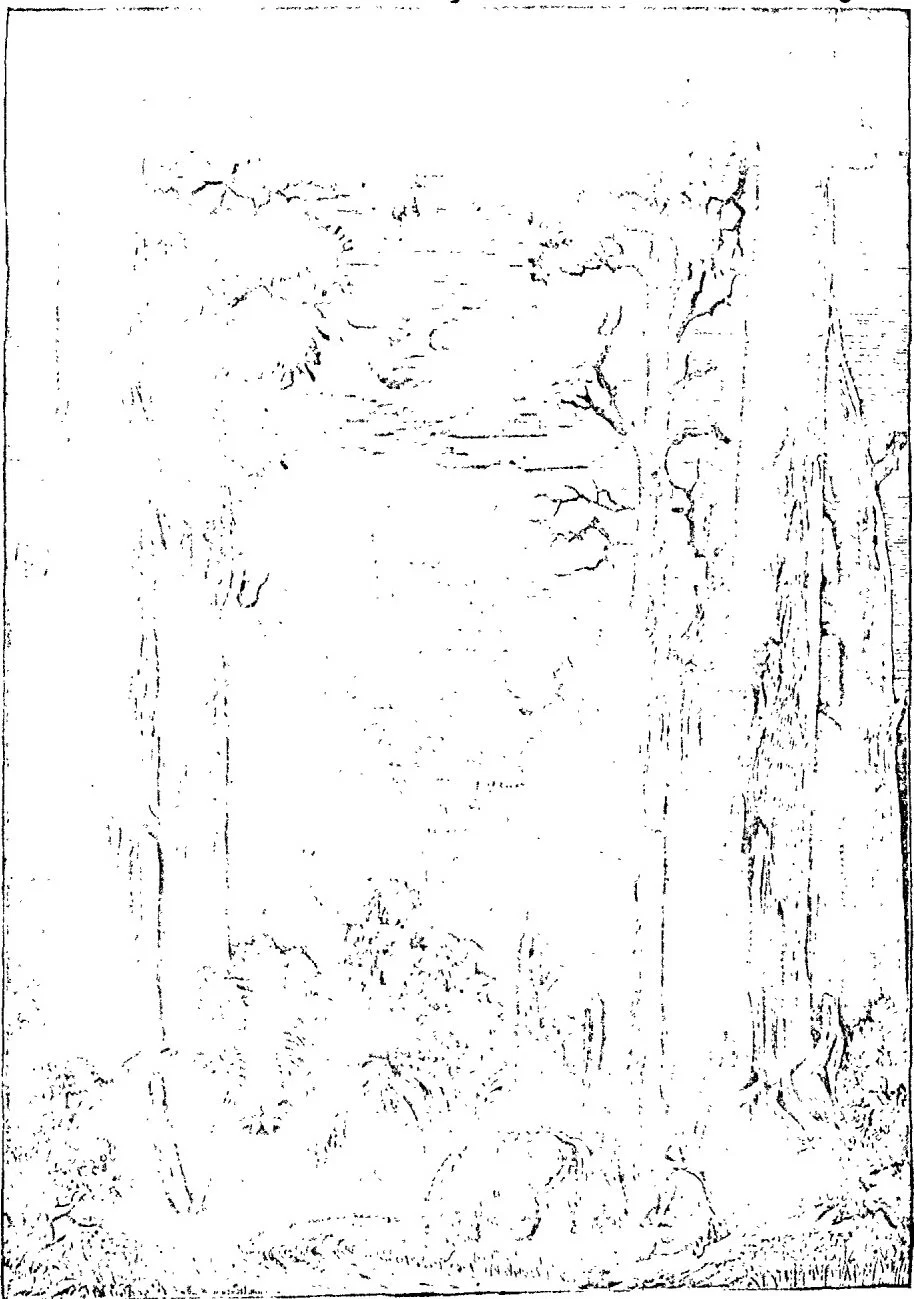
A SCENE IN THE GIPPSLAND COUNTRY.
The accompanying sketch presents a scene near the Tarwin River, in the extreme south of the country. The little strip of light nestling between the trees shows the river, a small stream discharging its waters into Anderson Inlet, an indentation of the coast about forty miles west of Wilson's Promontory. The traveler seated on the log has alighted to rest, and allows his horse to improve the moment in securing what he can of the rich, juicy grass growing so plentifully about his feet. Near him are tree-ferns, the gigantic leaves of which droop into natural bell-shaped tents. Some of these plants attain the hight of twenty-five feet or more, and a diameter of nearly two feet, and have foliage more comely than any other species of Australian flora. But the most common, and in some respects the most remarkable, tree in that country is the gum, or eucalyptus, of which there are many varieties. Some of these reach an enormous size, rivaling the famous “big trees” of California. The red and white gums are sometimes used for building purposes, but more commonly as fuel. The species known as the stringy bark (which derives its name from the old bark's annually peeling off, and hanging in disordered shreds about the tree) furnishes the most useful timber, on account of its splitting more easily than the others.
Walking in a gum forest in the early morning, while the dew is yet on the leaves, one smells a peculiar, yet not unpleasant, odor, bearing the faintest resemblance to that of camphor. The trees of an Australian forest have fewer branches, and spread out far less than those of an American wood; neither do they stand so close together. In the interior of Australia, one frequently finds not more than ten or twelve trees to the acre, but in Gippsland they are more numerous. Both the eucalyptus and acacia trees present their leaves in a vertical instead of a horizontal position, so that both sides are equally exposed to the light of the sun. By this means they also afford less density of shade than do forest trees at home. It will readily be seen that a forest of this nature would have no deep, dark glades—no walks of profound gloom. But while they are comparatively light and airy, yet there prevails a kind of pensiveness, due to the dull, heavy color of the leaves. These are never bright and glossy, and are in great contrast to the fresh green of an early spring forest in other parts of the world. And while it may be said of an Australian forest that it is evergreen, or rather ever brown, some species of the gum, notably the stringy bark, annually strip their bark, instead of the leaves, revealing a new, smooth formation, which, in its turn, grows scraggy, and gradually peels off in unsightly strings, as shown in the illustration.
As compared with Northern countries, Australia is a land of contrasts and novelties. It is the only country in which the writer ever saw a black swan, or a creature combining the quadruped and bird. The last mentioned is an animal called the platypus, of the shape and size of an otter, but having the web feet and bill of a duck. It also lays eggs like a bird. It is covered with a pretty fur, shading from black to silver-gray, and lives in burrows near the water, like the otter. Then there is the kangaroo, which stands erect, and travels by a succession of hops, being propelled by the spring of its huge tail pressed upon the ground. This creature, when pursued, travels at a rapid rate, and at such times, if attended by its young, protects the little creature by receiving and carrying it in a pouch nature has provided in the side of the female. From this place the young traveler looks quietly out at passing objects, as he is carried swiftly along.
Gippsland, especially, boasts of a bear-shaped creature, about the size of a poodle dog, with shaggy, dirty-looking fur. It procures its sustenance by climbing trees, and feeding on the leaves. It becomes so fat that it moves with great difficulty, and is easily captured. No one cares for the flesh, it being strong and unpalatable, though when the natives were there in force, they made much of it as an article of diet.
Nearly all the aborigines now left in Victoria, are cared for by the government, at what are termed “stations,” and on nearly the same principle as the United States cares for the Indians. These stations (one of which is in this territory) are certain lands set apart for the purpose, to which all the natives are gathered, and there fed and clothed from the appropriations of the government. They are also provided with secular and religious instruction, although it cannot be said that this does a great deal to lift them above their natural tendencies, which are not of a very high order.
This section of the country has not been settled so long as some other parts, but it has of late made rapid strides in the way of building and farm improvement. Agriculture is the chief employment, though considerable attention has been given to fruit-raising. Many in the vicinity of the lakes engage largely in fishing. There is very little territory in this part fit for farming, that has not already found an occupant. There have been times when the government proclaimed certain portions of land open for occupation, under certain conditions, similar to those enjoined by the “homestead” laws of America. Those who took land under such proclamations are termed “selectors,” and have known many of the rigors of pioneer life.
In most cases, selectors live isolated; and the only way to bring the truth before them, would be to visit each home, and converse with its inmates. But the living preacher cannot well do this, as it would require more time than he or these families have at command, to devote to such work. There seems to be really but one way in which the majority of these people can be reached by the truth, and that is by their being induced to purchase reading matter at the hands of the self-sacrificing canvasser. But while this work would call for genuine sacrifice, such as is not known in the ordinary modes of canvassing, it would also afford a satisfaction that is not experienced in city work.
In the city one meets rebuffs at nearly every step, from those who are whirling along in the tide of commercial life; while in the country, under a rough exterior, one more commonly meets with sympathetic hearts, which will be touched by the truth, when presented in the proper way. In these secluded regions, where there are no places of amusement to engage the spare time of the settlers, and the advantage of public worship is denied them, the people have more time to read than those living at busy centers of population. Anything of a religious nature that is attractive, they will readily buy. Then, too, in these by-places, where new-comers are rare, one meets hospitable greetings that are not found elsewhere. The canvasser, while toiling harder and for less money, in such places, may reap a far larger harvest for his labor in the end, than as though he had confined his work to those who dress better, and appear more refined. God has precious souls in many of these secluded places; and he who takes upon him the task of bringing to their notice the printed page, laden with precious truth, does a good and a worthy work. Much of the work in Australia will, of necessity, be of this character, owing to the generally scattered condition of those outside of the towns. The truth must needs have started there in the cities, for the purpose of forming general centers from which it could radiate in every direction. It has gained a strong footing in some of the prominent places of that country, and we look for it to move forward now with more haste than ever before.