The capital of Victoria is composed of more than a score of pretty suburbs, of which Melbourne proper is the center. Steam railways extend to all these, with trains leaving the city every twenty minutes during the day, and every half-hour during the evening. These suburbs are so closely connected that in some cases one passes out of one into another by merely crossing a business street. On some of the principal streets, the traffic is simply enormous, and one runs quite a risk of life or limb to cross at some of the busiest corners.
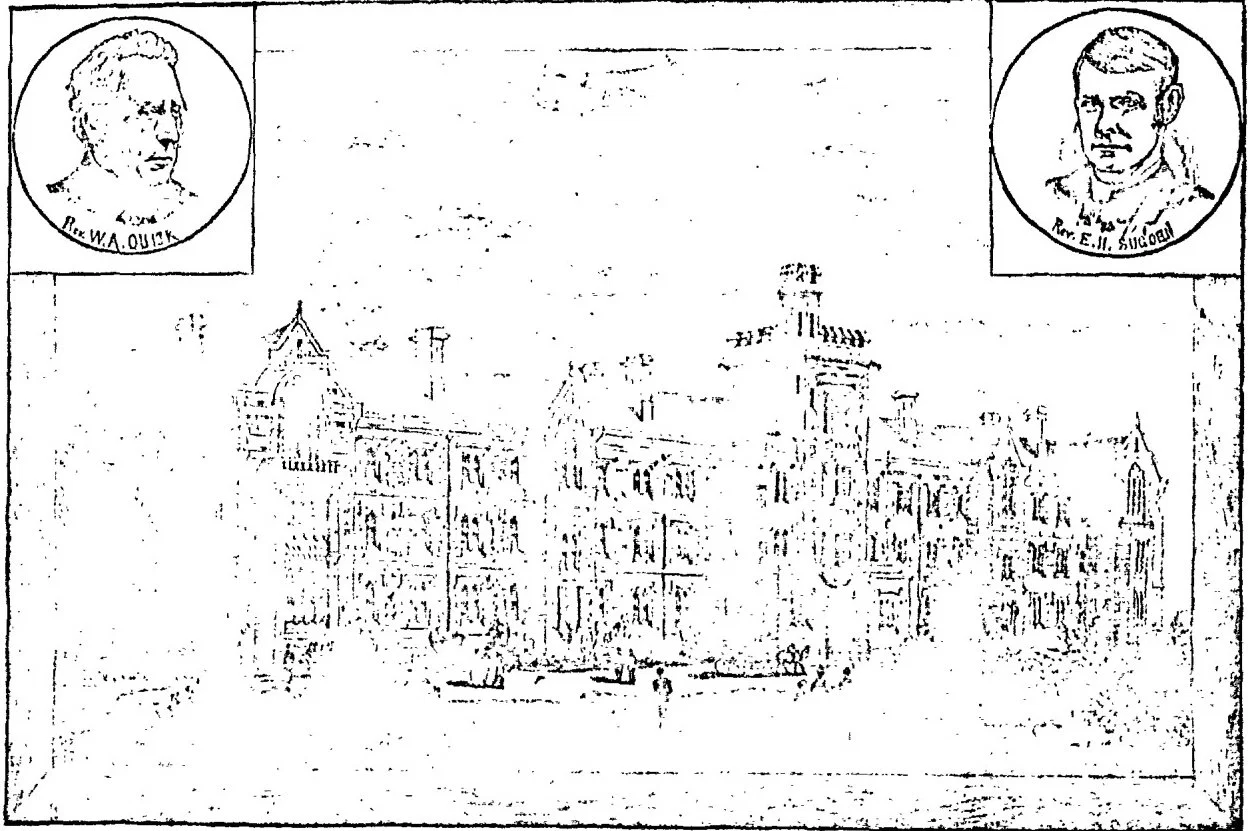
QUEEN'S COLLEGE, SOUTH YARRA, VICTORIA.
The changes of temperature in and around Melbourne, are at times very sudden. A bright, quiet morning is as likely as not to be succeeded by a cloudy, windy afternoon, with the dust almost intolerable. Again the day may be bright, and so intensely hot as to require an umbrella to keep off the sun, until the middle of the afternoon. Suddenly the wind veers round to the south, and blows nearly a gale; soon leaden clouds hang heavily overhead, and the rain pours in torrents, filling the streets with streams of water, which in some cases, rush along like a mountain current seeking its way to the sea.
For a city as large as Melbourne, the drainage system, as compared with that used in our own large cities, is very inferior. It is true that in some parts of the city large drainage sewers are laid along the streets, under the surface, but there are no pipes connecting with these from the houses. All refuse water is turned into a surface sewer in the yard, which carries it under the sidewalk into a gutter running parallel with the walk, and within two feet of the curbstone.
At certain distances from each other, there are iron gratings in the gutters through which the filth of these surface sewers finds its way into the main sewer underground. Even this arrangement for conveying away the refuse water, has been in operation but a short time, in many of the suburbs. Before the “deep drainage” was put in, the water was liable, in many places, to stand in the gutters for a day or two. On certain days men came along, armed with heavy, long-handled scrub-brushes, with which they pushed along the debris in the gutter until the proper amount was collected, when it was thrown just outside, and left to stew in the broiling hot sun, until the offal carts came along to receive, and bear it away. All this time, however, it sent out fumes that were anything but delightful to the inmates of the houses along the way.
With such a system of drainage in use, it is not strange that one's life is put in jeopardy every hot season, by the alarming prevalence of typhoid fever. Everything that can be provided for the relief of those who are attacked with this annual scourge is, however, conscientiously carried out by the authorities. The public hospitals are frequently filled to overflowing, and tents are erected in the adjacent grounds in order to supply the demands upon their resources. Most of the poorer classes avail themselves of hospital benefits when in any way disabled. In this way they manage to have the regular attendance of a physician, which they all would not otherwise be able to procure.
The hospital system in that country is excellent. Any one who in any way becomes disabled can be taken to a hospital for treatment, if he chooses. The expenses are made up by contributions from all the churches. Every year there is one Sunday set apart for this purpose, and designated “Hospital Sunday.” For weeks before the day arrives, large flaming placards greet the eye in every direction: “Remember Hospital Sunday,” and then the date is given. Consequently thousands of pounds are taken up on that day, and placed in the hands of the proper officers, to meet the expenses of the hospitals for the current year. At such times all the churches give cheerfully. Besides this, sections of the Salvation Army parade nearly every street on that day, begging of every one they meet, who they think will not be at some church.
The laws of Victoria require all children in the colony between the ages of six and fifteen to attend some school. If any attend a private or denominational school, and can produce evidence of the fact, that is satisfactory; otherwise, they must attend the State school. All the common branches of education, with military drill for boys, and needle-work for girls, are taught free. No direct religious instruction, whatever, is permitted in the State schools. When a child's name has once been entered on the school roll, he must, unless prevented by sickness, attend the required number of days, or his parents must pay a fine. Each teacher is supposed to report all delinquents to the court once in three months, when the parents or guardians of these are summoned before the magistrate to show cause for their ward's absence. For the first offense, five shillings ($1.25) is the fine; for the second ten, the third twenty, etc.
Some of the State school buildings are imposing-looking structures. In fact, all public buildings in that country are of the finest character, and are built to stand a thousand years, if necessary. As they appear when finished, so they will be found twenty, fifty, or a hundred years afterward. There is this difference of operation between the English and the Americans, in the matter of building. The Englishman takes plenty of time to mature his plans, and when he is ready to build, every contingency has been thought of and provided for; hence when the house is erected, it is completed. Not so with an American. He conceives an idea of building, and in an incredibly short space of time, his structure is reared; but just as likely as not, he immediately sees where an improvement might be made, and the next year he makes an alteration here and an addition there, and thus continues indefinitely.
The sketch accompanying this paper is a fair sample of the public buildings of Melbourne. This is a Wesleyan College, completed only a few months ago, and is located in South Yarra, one of Melbourne's prettiest suburbs. It is of cut stone, and situated in the midst of large and most beautifully laid-out grounds. The likenesses presented471are those of the two leading men in the enterprise, the older one being the president of the college.
Nearly every religious body represented in Victoria has its own schools, connected with the individual churches belonging to them. The school-building is usually erected on the same lot with the church, but in the rear of it. These are either supported by a general fund from the church, or upon the plan of private schools, each pupil paying so much per week for his tuition. While this is an advantage to all the churches adopting the course, the disadvantage is proportionately great to all those outside these circles; for it leaves the attendance at the State schools to be largely made up of children of questionable character. For a child whose mind is comparatively pure, to associate in school with this class, is but to quickly fill his mind with those things that are impure and wicked, and in a measure to destroy the child's chances for happiness here and hereafter.
Our own people there have seen the necessity for a school, whose interests they themselves might control. Some things have hindered such an enterprise. While they are generally poor, and scarcely able to maintain a school, yet there is no doubt in my mind that, had they the right man to take the responsibility,—a sound Christian, and a good teacher,—the entire membership of our people there would unite to give him their sympathies and support. Such a school is needed there, not only for the younger children of our people, but as a training-school for those who would, if they could have the opportunity, learn to canvass for our books and do missionary work.
There are some millions of people in that great country, and thousands are emigrating there every year from the Old World. There is not half being done for them that should be, for lack of facilities. Moreover, a large part of the population cannot be reached by public congregations, on account of the isolation of the farmers and stock raisers. These should have the truth, and scores of young people in Australia should now be in course of training, for the service of the Master.
There is no country in the world where larger results may be obtained by the canvasser and colporter than in Australia, and for this reason: From the highest to the lowest they are a reading people. They are especially fond of religious reading. Their decided taste for literature is seen in the public libraries in every town, where one may go and use the books freely. In Melbourne, the public library contains 125,000 books, covering nearly every subject ever written upon. Besides this, each suburb has its own library, with several thousand books in each.
Generosity prevails generally among the Australian people. They will give to the cause of God, in some instances when in actual need of the amount donated, to keep themselves comfortable. There are, of course, some exceptions to the general rule, but these, we are glad to say, are not very numerous. In the matter of purchasing books, their liberality is specially noticeable. This is particularly so among the country people, who are shut away from the great avenues of commerce and intelligence. These people, too, have time to study, that is not usually afforded to those in the cities. Their evenings are their own, and are generally improved in reading.
There are large opportunities for labor in that country in behalf of the truth. The work started there under great difficulties, some of which will be spoken of in the next of these articles; but there is now a prospect of its pushing ahead faster than it has ever done before. But there are yet large and populous districts in that country which have not even heard the sound of the third angel's message; and to extend the work to those, which should be done as rapidly as possible, will require greatly enlarged facilities. J. O. COLLINS.