ITS INTRODUCTION IN SOUTH AUSTRALIA.
After a week's anxious inquiry, and much negotiating with those in charge of public halls, the town-hall of Norwood, one of the largest suburbs of Adelaide, was secured, at a rental of ten shillings ($2.40) per night, and meetings were begun Sunday evening, Sept. 5, 1886, with a fair audience. The expense of hiring the hall was quite a study for a time, as it could not then be told where the funds to meet such expense would come from. The entire country was in a state of great depression, owing to a two years' drought that still hung over it, and which had driven thousands to seek employment in other colonies. The exodus had been so great, that in some streets hardly a house was occupied; and hundreds of others who had been out of employment for months would have gone, could they have commanded the means with which to do so.
Under the circumstances, it seemed almost folly to depend upon the people to meet the expenses of the meetings; but from night to night all contributed as they felt inclined; and when the first week's rent was due, it was found that the free-will offerings of a sacrificing people had just met the account. This brought encouragement enough to warrant engaging the hall for another week, when the same thing was repeated. Thus the meetings continued for five weeks, and twenty-seven signed a covenant to keep all of God's commandments, and the faith of Jesus. But none of these took their stand without a struggle. Many said, “What am I to do; here I have been out of employment for months, and am now sustaining my family only by virtue of the grocer's credit. If I obey what I now know to be truth, my chance for employment will be diminished still more, and my prospect of regaining what I have lost through inactivity, will be entirely gone.” It was indeed a gloomy outlook to many, but some stepped firmly forth, declaring they would trust the goodness of God to open the way before them.
Just as soon as it became generally known that some were deeply interested in the meetings, a united and persistent effort of opposition was begun, and kept up until all had decided whether they would obey or not. Some for whom strong hopes were entertained yielded to the opposition, and settled back into their former ways, while others sacrificed their old social ties to follow the rugged path of truth. The faith of some of these was for a time severely tried, but the God of Israel, who changes not, watched over and cared for them, and to-day they are firmly fixed, not only in the faith of the third angel's message, but in their determinations to live the truth every day.
Experience has taught that it is worse than useless simply to bring people to see the truth, and then leave them to care for themselves. It was therefore decided to begin another series of meetings in Stepney, about one mile from the former place of meetings; and while new ones were being brought in, those who had already accepted the truth could be built up in these things they had so lately learned to love. But as no suitable hall could be procured, the tent was ordered from Melbourne, and the work of putting it up on a hired lot was begun as usual. About an hour afterward, a policeman came around, and forbade further work in that direction, as it was contrary to law to erect a tent in the town without a special permit. All work then ceased till after the mayor had been visited, who would only give permission for the tent to stand until the meeting of the Council, which was to be held nearly two weeks later. Here was a dilemma. In that time prejudice would perhaps run high with some who were already enemies to the truth, and the Council might vote against the tent's remaining, just when some would be getting interested. There was but one thing to do—go ahead, trusting that God would control the whole matter to his own glory.
The first meeting in the tent was held Sabbath afternoon, Oct. 16. After a discourse, a good social meeting followed, and four more came forward to signify their determination to obey the message. As the meetings progressed, two of the councilmen became regular attendants, and in the meeting of the town-board, at which was discussed the propriety of granting a permit for the tent-meetings to be continued, these men pleaded in the favor of our cause, and the desired permission was granted. The meetings continued until Dec. 2, resulting in twenty persons' taking their stand for the truth. A church of thirty-four members was organized, a flourishing Sabbath-school was started, and a tract society was formed. To these there have been, since that time, quite large accessions, and not more than two or three have given up the truth. A letter recently received from there states that the church is doing well, and others are becoming interested in the truth. The prosperity of the work there has not been because of ministerial help; for very little of that has been afforded them. The secret of their success lies in the fact that just as soon as the regular meetings closed, the members of the church went to work. They distributed reading matter, and held Bible readings in families. In this way an interest was created sufficient to demand Sunday evening meetings in a hall. At first these were confined to Bible readings, but the call was soon made for a public exposition of the points of faith held by our people. What could they do? No minister was to be had, and it seemed too bad to lose those who had pleaded for meetings, so the Sunday evening meeting finally came to be devoted to expositions of the prophecies, and kindred points, by one of their own members. And although this has now continued for months, the interest still is good, and great need is now felt there for more experienced help.
But how has it been financially with those who stepped out in the truth, trusting that God would care for them? Not one of them suffered any inconvenience from the move. Some of them, indeed, who were well nigh in despair before the truth came to them, had work offered to them, and have gotten along comfortably ever since. One man especially, who lost a position as traveling salesman, has since gone into business for himself; and in a recent letter he says it is wonderful how the Lord has prospered him since he has tried to walk in the truth. It is not always thus, but it almost seems as if God specially favored these people because of the sacrifice it cost them to obey, and as a reward for their simple faith. There is not a more promising field in which to sow the seeds of truth than that about Adelaide. There are a number of its suburbs in which has not been struck a single blow, in behalf of the third angel's message. Then there is Gawler, a large manufacturing town, twenty miles north of there; Kapunda, fifty miles; and Port Augusta, 150 miles in the same direction, with numberless smaller places interspersed. All through that country there is becoming manifest a desire to know more of the doctrines which they have heard were being preached in the capital of that colony.
During certain seasons of the year the landscape scenery in the vicinity of Adelaide is beautiful. The climate there is warm, and in the summer months very dry. But during the winter and that part of spring covering the time from the first of June to the last of September, everything in nature is clothed in brightest green, and the hills in the distance, with their grazing flocks and herds, remind one of the grassy slopes of old New England after a bountiful spring shower. But after the rainy season closes, and the sun brings to bear its scorching rays upon the earth for a few days, these hillsides present a crisp and scorched appearance.
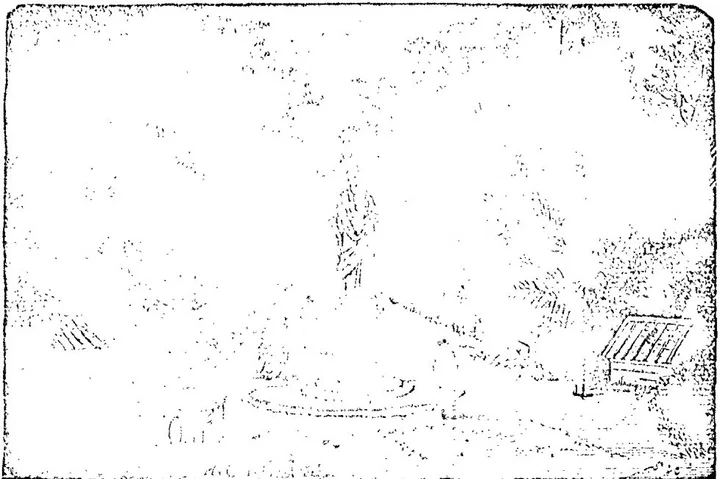
There is, however, one public resort in Adelaide, as in all large Australian cities, where the delights of continual spring are enjoyed. This is the Botanical Gardens, which are located just east of the governor's mansion. The sketch given on this page presents but a partial view of them,—that part of the grounds nearest the entrance to the inclosure. One can see in the distance, partly hidden from sight by the statuary, a large fountain, which is one of the attractive spots of the gardens. There are, however, walks tastefully laid out, threading among the trees in various directions, some of them leading over little rustic bridges, which span the artificial stream that meanders through the grounds.
In the several miniature lakes into which this stream widens at intervals, may be seen many varieties of water-fowl, some of which have been imported from distant countries. In the little wire-covered cages are birds from every clime, and of every hue. In the spacious buildings set apart for that purpose, are preserved specimens of fruit, and the products of the field and garden from every part of the world,—from continents, and from the islands of the sea.
Besides the footpaths, being everywhere lined with rare specimens of flora, whole acres in various parts of the grounds are devoted to the cultivation of the choicest and most beautiful plants to be found in the world.
The broad walk near the main entrance to the gardens was at one time a favorite place for open-air preaching; and each Sunday afternoon witnessed large assemblies gathered there to hear upon some theme not usually treated upon in the pulpits of the city. But it is somewhat doubtful whether these gatherings continue at the present or not, as Adelaide's favorite street preacher of earlier days went to Sydney two years ago, to superintend some popular movement in that city.
J. O. Corliss.