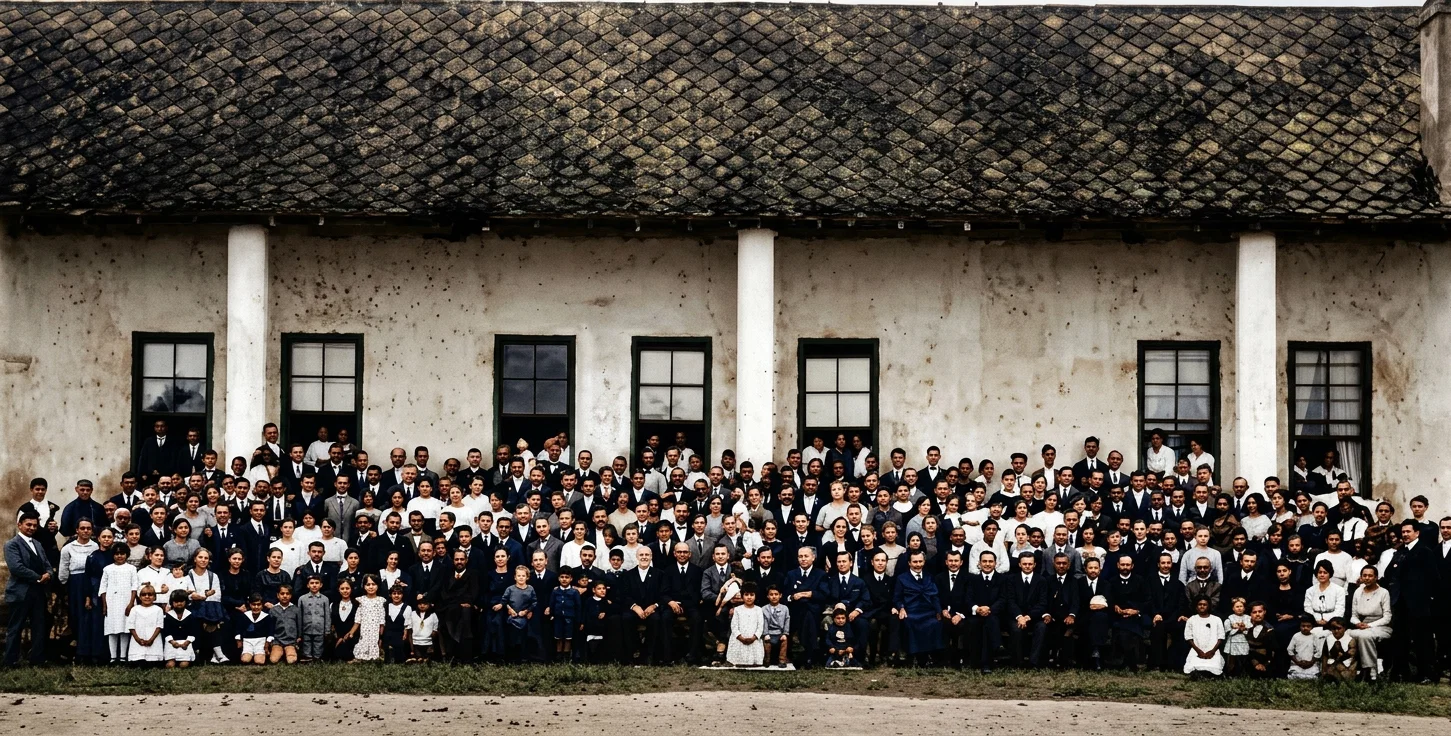
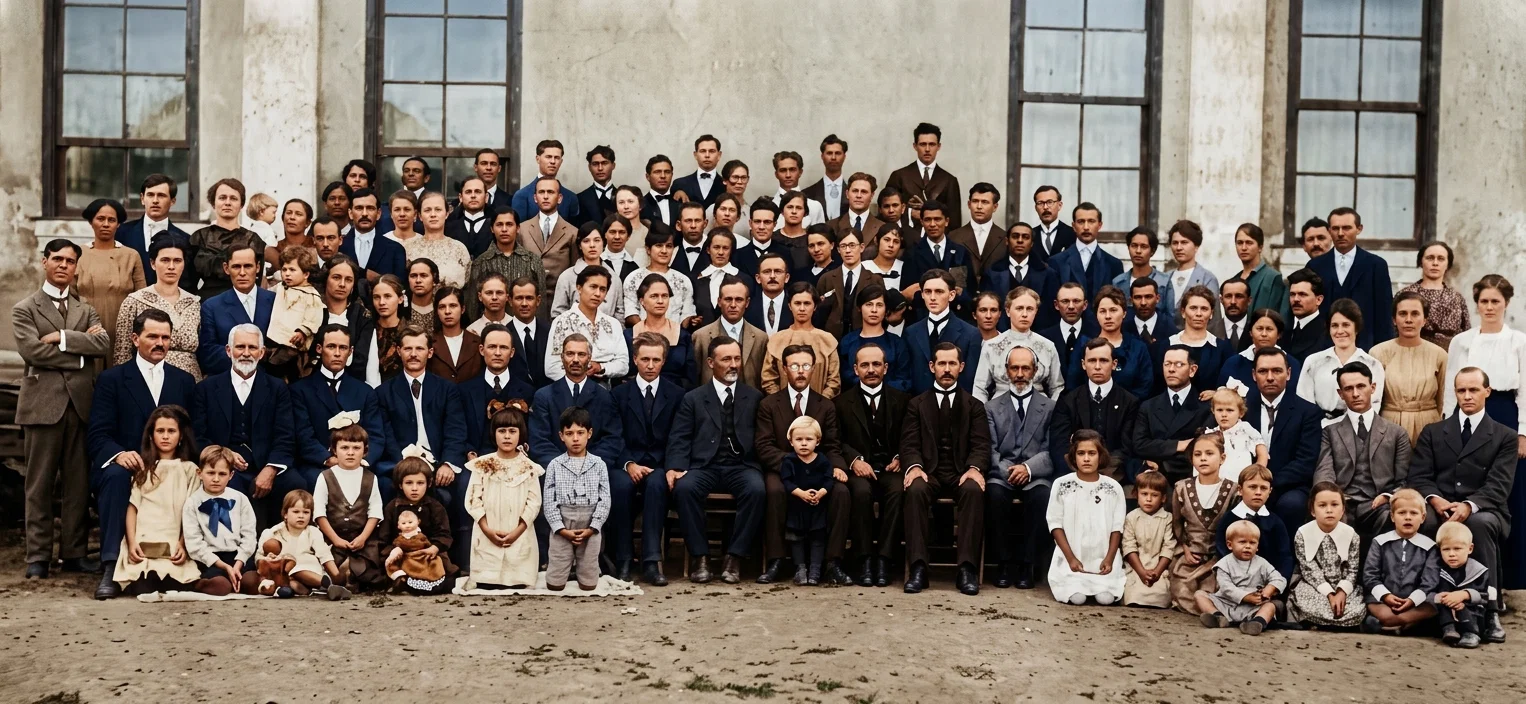
WORKERS IN ATTENDANCE AT THE JOINT SESSION OF THE BRAZILIAN CONFERENCE AND MISSION
It seems a long time since our last union session, four years ago, and considering that these union occasions have a strong molding value and influence in harmonizing and unifying the work, it is a long time, when we contemplate our rapidly developing cause, and realize the fact that but few, relatively, of our workers have had an opportunity to be in touch with our organized work outside our own union, and many, perhaps, not even outside their own local fields. It is therefore in a special sense an important gathering, and we feel deeply grateful to our kind heavenly Father that so many are privileged to assemble at this time from all parts of the great republic, to study the needs of our work, the best methods of advancing it, and of getting a better preparation to complete our task.
Last month (March) it was twenty-six years since the first minister of the third angel’s message set foot on Brazilian soil. Elder and Mrs. W. H. Thurston arrived in Rio de Janeiro in March, 1894, as self-supporting missionaries. Several colporteurs, who had been sent from the homeland to South America two years before, had begun circulating our good literature in different Brazilian states.
In September, 1895, Elder H. F. Graf and family arrived on the Brazilian shore, he being the second ordained minister sent to this republic. The following year the speaker was sent to Brazil, and for several years he and Elder Graf were the only ordained ministers in this vast country to look after the interests and work of the third angel’s message, which even at that early stage extended from Theophilo Ottoni (Northern Minas), to Rio Grande do Sul. As we look back to those days of small beginnings, and remember our long, difficult journeys, requiring from five to six months’ travel on muleback, at times sleeping out on the open prairie and at others hardly able to obtain anything to eat, even though we would gladly have paid for it—I say, as we look back to those days, and compare the work as it was then with what we see today—the cause well established in at least seven states, with a good beginning made in others, with over three thousand believers who are supporting this work with their personal influence and means—we feel to exclaim, Behold what God hath wrought!
Again, looking back to 1902, when Elder J. W. Westphal and family arrived in South America, and the various fields, which up to that time had been independent fragments, were organized into the South American Union Conference, thus uniting the entire South American continent, except Colombia, in a bond of sympathetic union, we felt that we were taking a long step in advance, and we thanked the Lord and took courage. When again in December, 1910, at the time of Elder L. R. Conradi’s visit to South America, the Brazilian Union Conference was organized and started on its career, it indicated another important move in the onward march of the message in Brazil. And when, in 1919, it was possible definitely to divide the Brazilian field, setting apart the North Brazil Union Mission, we saw in this action a further leading of Providence and an evidence that the last gospel message would go with still greater rapidity.
Nor have we been disappointed in this our expectation, as the reports from that northern union will abundantly prove.
Although Brazil contains a little less than 2 per cent of the world’s population, it embraces about one fourteenth of the earth’s habitable surface. At the time of the organization of the Brazilian Union Conference in 1911, there were reported in the entire field 1,367 members. At the close of 1918, or the time when the North Brazil Union Mission was separated from our union, the membership had increased to 2,866, of whom 1,961 remained as the membership of the Brazilian Union Conference, and the remainder constituted the membership with which the new North Brazil Union Mission started on its career. From this point I will limit27my remarks to the work of the Brazilian Union Conference.
Since the above-mentioned division of the territory, the Brazilian Union Conference comprises the following local fields:
The Rio Grande do Sul and the Santa Catharina Conferences; the Paraná, São Paulo, and West Minas Missions; and the states of Matto Grosso and Goyaz. For a year or more there has been a small company of Sabbath keepers in Matto Grosso. We have not been able to send a worker even to visit them. Quite recently a colporteur has gone into this state to begin work. So far as we are aware there is no representative of the message in Goyaz. Inasmuch as we expect to receive a detailed report from each of the other fields through its leader, I shall limit my remarks to general interests.
Publishing Work
Since our last union conference session, in 1916, a number of difficulties have confronted this branch of the work. Especially was the outlook rather dark when in 1917 war conditions compelled many of our colporteurs to leave the field. Yet in spite of all drawbacks, this department has made steady progress, so much so, in fact, that, as the report of the manager will reveal, our present facilities and operating capital are altogether inadequate to meet the growing demands which are today four times as great as they were in 1914.
One example may suffice to show this:
In a session of our union committee in January, 1919, it was voted to print during that year a five-thousand edition of “The Great Controversy” in Portuguese. An order from the Pacific Press for two thousand copies of this book will increase the edition to seven thousand. But we failed to get the book printed last year, and at present it looks as if this year will also pass without seeing the book placed on the market, as the increased demands of the field will evidently keep our plant so busy printing additional editions of books already published, that it will be impossible to add new ones.
Restored with AI
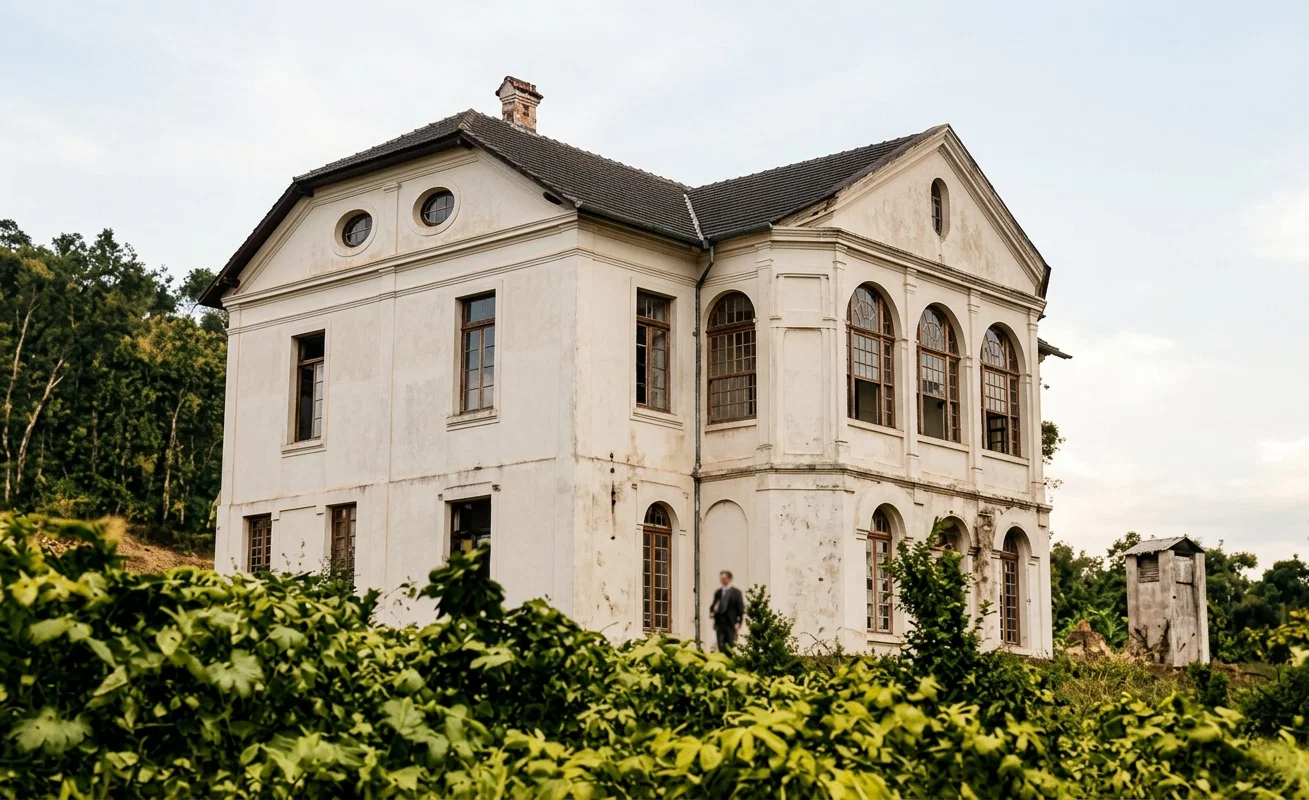
Boys' Dormitory, Brazilian Seminary
Restored with AI
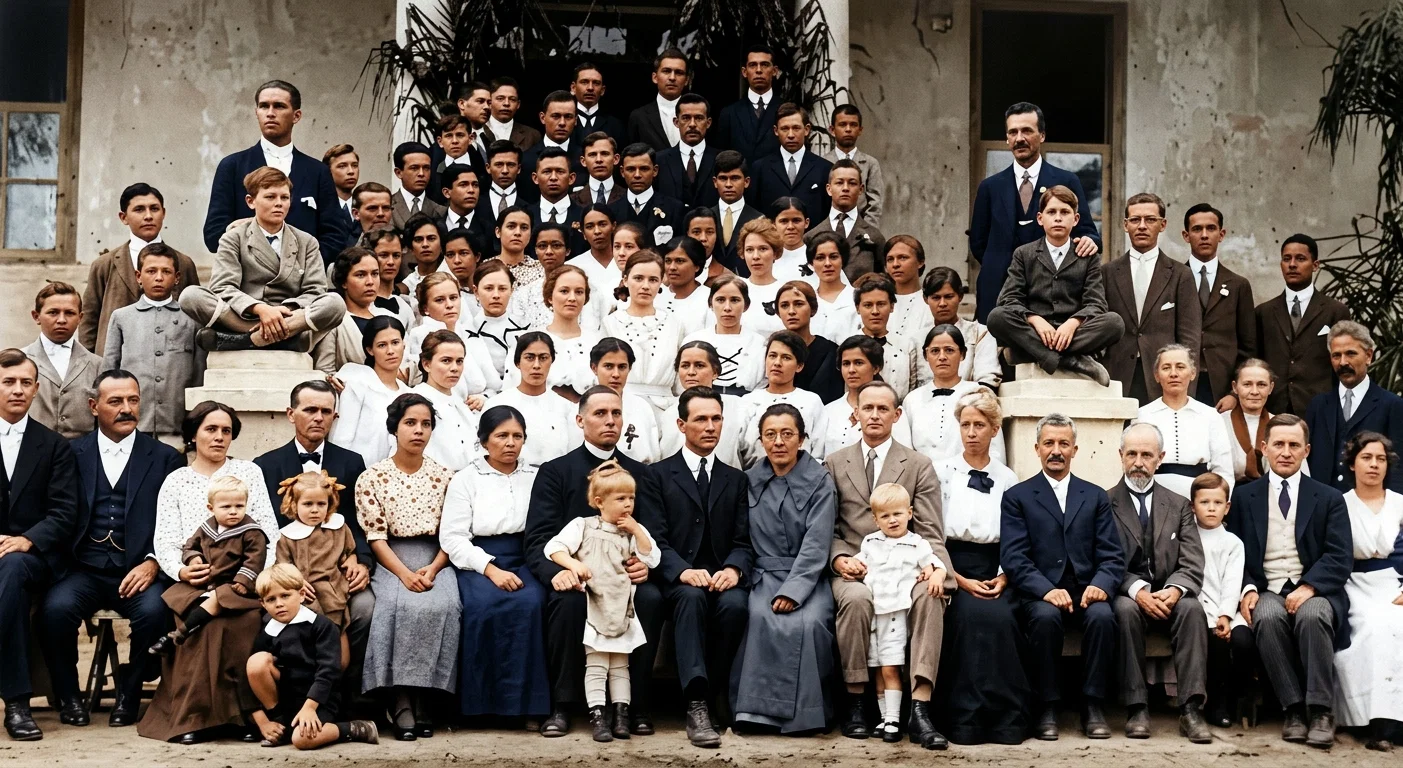
Teachers and Students of the Brazilian Seminary, Sao Paulo
Furthermore, our present operating capital, which has increased only a small per cent, and which, on account of increased cost of raw materials, has only half the purchasing power it had in 1914, does not enable us to add the new and larger books which we very much need, without borrowing more money and thus greatly increasing our liabilities. To place our publishing house in a position where it can properly cope with the demands made upon it, it should have its operating capital increased by $10,000, thus enabling it to publish the two large books, namely, “The Great Controversy” and a health book, which our committee voted to publish a year ago; and a further sum of $10,000 with which to buy a linotype, a new press, and other equipment. Inasmuch as it seems impossible to raise this money in the field, it is the conviction of the speaker that this gathering should present a memorial to the General Conference Committee, respectfully petitioning them to obtain this sum from the surpluses of our larger publishing houses in the homeland, in order to place our printing plant on vantage ground, enabling it to do the work which our growing cause in Brazil demands without bringing upon it the burden which would result if this much-needed money were borrowed, and thus the liabilities of the house be greatly increased. And this is but reasonable, for whereas the Spanish fields can obtain books from the Pacific Press and Barcelona, Brazil is entirely dependent upon its own publishing house to produce the literature needed in this field.
It is also the conviction of the speaker that some well-laid plans should be devised to increase the circulation of our good missionary paper, Signaes dos Tempos, as a larger circulation of this periodical would not only be a help to the publishing house, and bring the precious truth to a larger number of souls, but it would result also in bringing great spiritual blessing to our own people.
Educational Work
The successful onward march of the Lord’s work depends upon consecrated men and consecrated means. The great lack of workers has been the chief reason why we do not today have a larger number of strong self-supporting fields in Brazil. Furthermore, the native can always work to better advantage than the foreigner, since climate, language, customs, and conditions are no barrier to him in reaching his own countrymen, whereas these factors often hinder the workers who have come from other countries.
It was for this reason that a training school, where the Brazilian youth might be trained and prepared for work, was long felt to be a great need; but the way did not seem to open until 1915, when the demand for such a school was so imperative that we began earnestly to consider if the time had not come to start one. The evident need on the one hand, and several encouraging omens, among which was a liberal gift of $2,000 by one of our workers, on the other, convinced us that the time had arrived to take definite steps in this direction.
In April, 1915, the present site, containing approximately three hundred acres of land, was bought, and the following month preparations for the putting up of buildings were begun. Our means being limited, the General Conference, having had our situation placed before them, aided our school enterprise by the generous gift of $10,000. Even during the first year, while the preparations for building were being made, fifteen young people were given instruction. The following year, 1916, thirty-six students attended the school, when tents, the barn, small buildings intended as poultry houses, the workshop, and other buildings had to be utilized as dormitories. But students and teachers and builders were all of good courage, and the work went on until early in 1917 the main building was finally finished.
As the time for the opening of the school approached in 1917, the query was often raised, “How many students will come this year?” When the opening day arrived, all were agreeably surprised to find fifty-five of the young people presenting themselves for enrollment. Considering the hard times and the difficulties caused by war conditions, this was indeed a marvel to us, far beyond anything we had expected.
Again we were crowded for room, and were obliged to use as dormitories the rooms which were intended for the hospital.28
As the day for the opening of the school in 1918 drew near, we were asking ourselves what we could do in case a much larger number came this year. When the school did open, sixty-five students enrolled, and if we felt cramped the year before, we were more so during this year. Fortunately, the General Conference in session in San Francisco, considering our need and earnest request, kindly voted us another $10,000 for a girls’ dormitory and $1,500 for a teacher’s cottage.
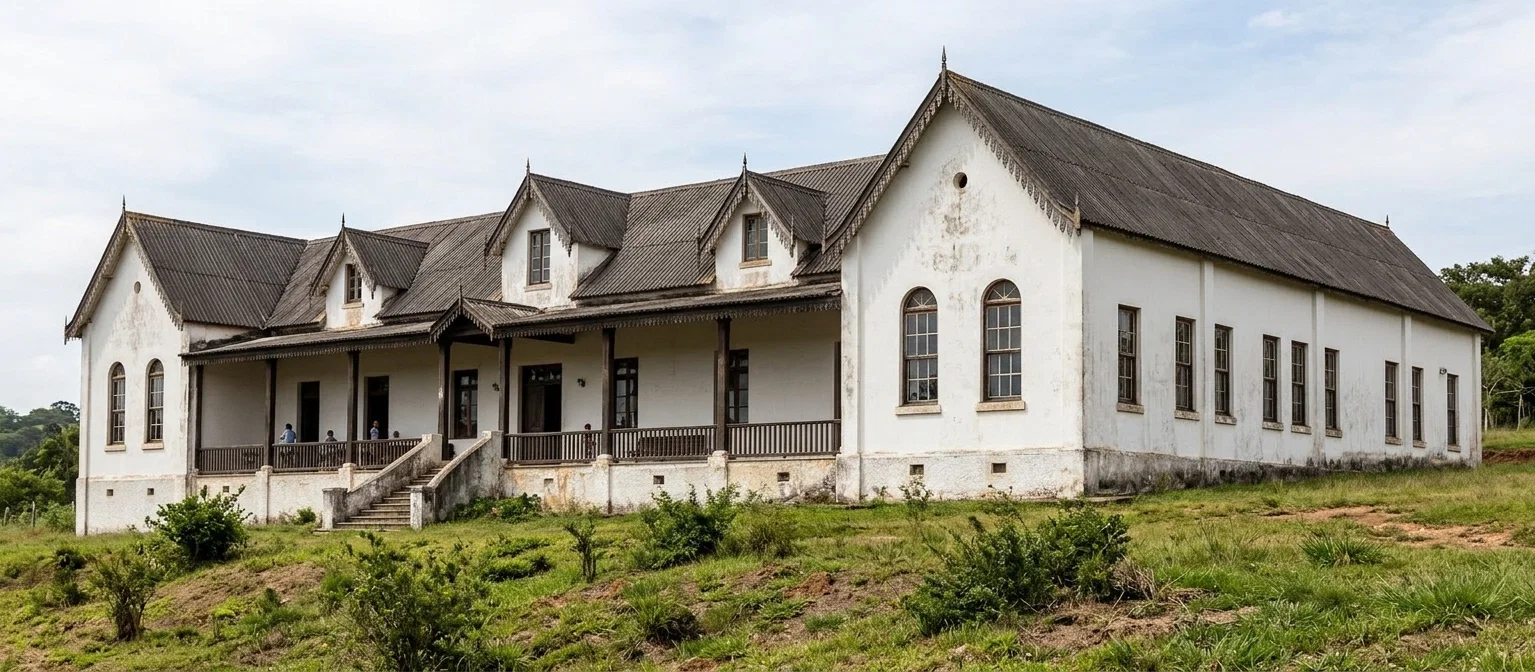
As soon as we had received this financial assistance from the General Conference, we at once set to work laying plans for erecting the girls’ dormitory, deciding to build the center wing and get it ready if possible by the time of the opening of school in 1919. This wing was completed on time, and by crowding, furnished accommodations for forty-two students. Again the student number increased, eighty-six being in attendance during 1919.
Restored with AI
South Brazil Union Workers
We had hoped that the $10,000 appropriated for the new dormitory would be sufficient to complete the building, but the great advance in prices of building materials so rapidly consumed our funds that we could finish only as far as you now see it, and it even became necessary to draw some on our operating funds in order to complete the work begun, and we still lack $5,000.
We should build at an early date at least three more teachers’ cottages, requiring a further outlay of $5,000. An administration school building, costing approximately $15,000, should also be provided in the near future. Then as our growing school plant makes greater demands upon our power plant, $7,000 will be needed to provide for the necessary light and power.
Before leaving this subject, mention should be made of the numerous applications we are receiving from young married people who are desirous of entering our school to prepare themselves for a place in the work. As many of these have one or two children, it is clear that they cannot live in the large dormitories. On the other hand, it seems that we should not disregard the earnest entreaty of such young people, thus denying them the opportunity of a preparation to have a part in this closing work. We should consider at this time what can be done to meet this urgent need in providing small, inexpensive cottages, to afford living places for these young families.
Departments
As we compare the report of the last four years with those of previous years, a gratifying growth is revealed. The home missionary and young people’s departments, as well as the Sabbath school department, show that our people are advancing. The great need is more local help to second the efforts of our union secretaries, and thus to build up the work more solidly. We are glad that we now have a young people’s and educational secretary, who can give special study to the needs in these branches of our work.
The different fields are loudly calling for more workers, and these must come from our own native people. But this means education,—progressive education,—an education that begins in the home, that is continued in the church school, and that is finished in our seminary. And this educational program must include every Seventh-day Adventist boy and girl in Brazil. To study and lead out in such a program is certainly a worthy life-goal.
Finances
The Lord has greatly blessed in increasing our finances. The tithe in 1915 for all Brazil amounted to $19,510.55. In 1919 for the Brazilian Union only, it was $28,709.73, an increase of 47 per cent over 1915. The missionary offerings for 1915 for all Brazil were $3,331.44. In 1919 the Brazilian Union Conference alone raised $7,175.45, an increase of 115 per cent over 1915.
We have three fields that are entirely self-supporting,—Rio Grande do Sul, Santa Catharina, and São Paulo. Paraná is supporting the workers it has, but it should have at least one more worker. The entire income of our union more than supports the work we are doing in it, but we should not relax our efforts. We should rather bend every energy to increase our income to the point where the tithe alone will support the work of our entire union, and where, aside from this, we can pass on the whole amount of mission funds to the great world field to help finish the work so that Jesus may soon come.
In closing I wish to call attention to our special need. After considering general needs, there remains to mention yet a special and main need. As this conference convenes, we may say that we are living in a different or new world. The war has changed conditions. New ideals and aspirations are taking hold of the people; and while the terrible upheaval of the four years’ war has softened a few hearts and made them more susceptible to the last gospel message, the great majority of the people are being drawn in another direction. Material things—wealth, honor, pleasure, the enjoyment of what the world regards as the things of this life—engross and benumb the world at large. It is thus becoming a greater task to arrest and gain the attention of the people.
But this must be done; and in order to do it, God’s messengers need a special preparation and power from on high. Both the Bible and the spirit of prophecy assure us that we have come to the time when the power of the Holy Spirit awaits our demand and reception. The Lord instructs us to ask for rain in the time of the latter rain (Zech. 10:1); and the promise is that if we ask, he will send abundant showers. May this gathering result in that earnest seeking for purity of heart which will bring the Holy Spirit in its fulness, and thus provide for our greatest need for bringing to a finish this last work of mercy. F. W. SPIES.