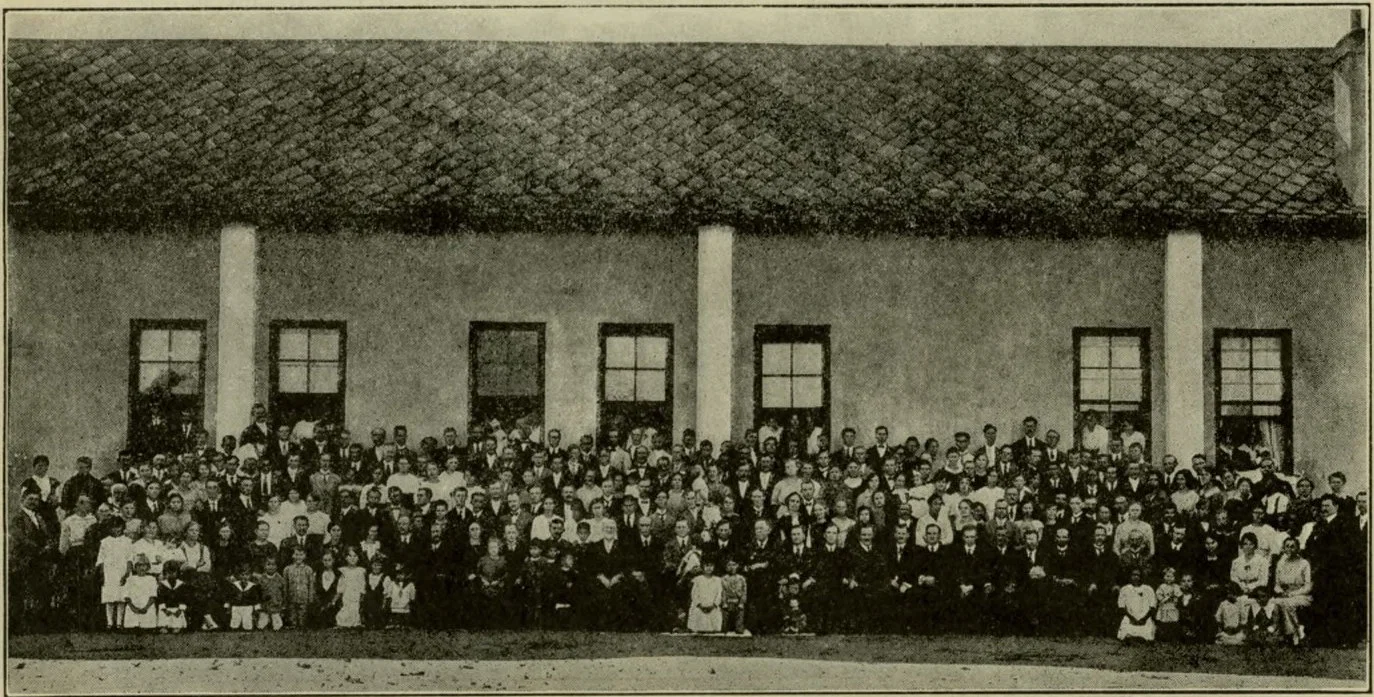
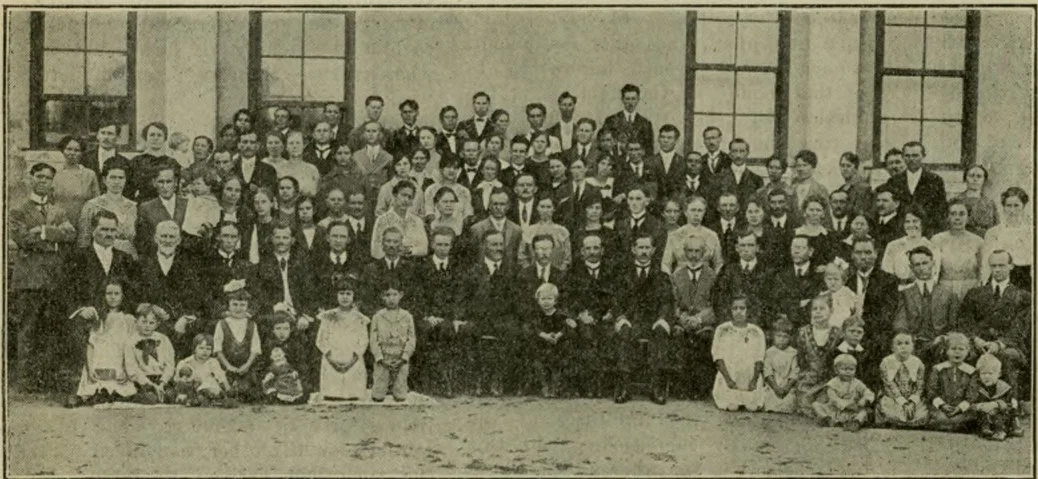
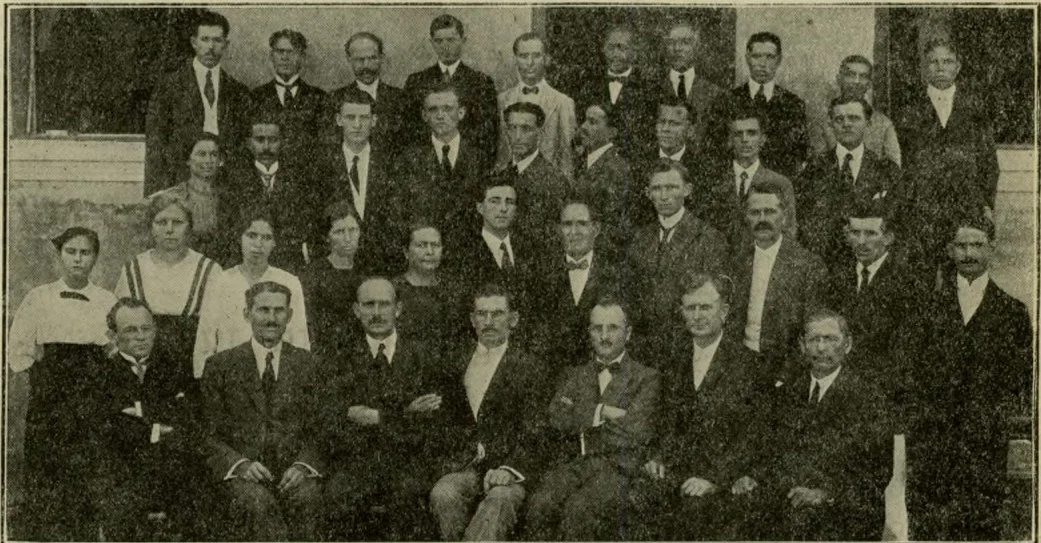
WORKERS IN ATTENDANCE AT THE JOINT SESSION OF THE BRAZILIAN CONFERENCE AND MISSION
It seems a long time since our last union session, four years ago, and considering that these union occasions have a strong molding value and influence in harmonizing and unifying the work, it is a long time, when we contemplate our rapidly developing cause, and realize the fact that but few, relatively, of our workers have had an opportunity to be in touch with our organized work outside our own union, and many, perhaps, not even outside their own local fields. It is therefore in a special sense an important gathering, and we feel deeply grateful to our kind heavenly Father that so many are privileged to assemble at this time from all parts of the great republic, to study the needs of our work, the best methods of advancing it, and of getting a better preparation to complete our task.
Last month (March) it was twenty-six years since the first minister of the third angel’s message set foot on Brazilian soil. Elder and Mrs. W. H. Thurston arrived in Rio de Janeiro in March, 1894, as self-supporting missionaries. Several colporteurs, who had been sent from the homeland to South America two years before, had begun circulating our good literature in different Brazilian states.
In September, 1895, Elder H. F. Graf and family arrived on the Brazilian shore, he being the second ordained minister sent to this republic. The following year the speaker was sent to Brazil, and for several years he and Elder Graf were the only ordained ministers in this vast country to look after the interests and work of the third angel’s message, which even at that early stage extended from Theophilo Ottoni (Northern Minas), to Rio Grande do Sul. As we look back to those days of small beginnings, and remember our long, difficult journeys, requiring from five to six months’ travel on muleback, at times sleeping out on the open prairie and at others hardly able to obtain anything to eat, even though we would gladly have paid for it—I say, as we look back to those days, and compare the work as it was then with what we see today—the cause well established in at least seven states, with a good beginning made in others, with over three thousand believers who are supporting this work with their personal influence and means—we feel to exclaim, Behold what God hath wrought!
Again, looking back to 1902, when Elder J. W. Westphal and family arrived in South America, and the various fields, which up to that time had been independent fragments, were organized into the South American Union Conference, thus uniting the entire South American continent, except Colombia, in a bond of sympathetic union, we felt that we were taking a long step in advance, and we thanked the Lord and took courage. When again in December, 1910, at the time of Elder L. R. Conradi’s visit to South America, the Brazilian Union Conference was organized and started on its career, it indicated another important move in the onward march of the message in Brazil. And when, in 1919, it was possible definitely to divide the Brazilian field, setting apart the North Brazil Union Mission, we saw in this action a further leading of Providence and an evidence that the last gospel message would go with still greater rapidity.
Nor have we been disappointed in this our expectation, as the reports from that northern union will abundantly prove.
Although Brazil contains a little less than 2 per cent of the world’s population, it embraces about one fourteenth of the earth’s habitable surface. At the time of the organization of the Brazilian Union Conference in 1911, there were reported in the entire field 1,367 members. At the close of 1918, or the time when the North Brazil Union Mission was separated from our union, the membership had increased to 2,866, of whom 1,961 remained as the membership of the Brazilian Union Conference, and the remainder constituted the membership with which the new North Brazil Union Mission started on its career. From this point I will limit27my remarks to the work of the Brazilian Union Conference.
Since the above-mentioned division of the territory, the Brazilian Union Conference comprises the following local fields:
The Rio Grande do Sul and the Santa Catharina Conferences; the Paraná, São Paulo, and West Minas Missions; and the states of Matto Grosso and Goyaz. For a year or more there has been a small company of Sabbath keepers in Matto Grosso. We have not been able to send a worker even to visit them. Quite recently a colporteur has gone into this state to begin work. So far as we are aware there is no representative of the message in Goyaz. Inasmuch as we expect to receive a detailed report from each of the other fields through its leader, I shall limit my remarks to general interests.
Publishing Work
Since our last union conference session, in 1916, a number of difficulties have confronted this branch of the work. Especially was the outlook rather dark when in 1917 war conditions compelled many of our colporteurs to leave the field. Yet in spite of all drawbacks, this department has made steady progress, so much so, in fact, that, as the report of the manager will reveal, our present facilities and operating capital are altogether inadequate to meet the growing demands which are today four times as great as they were in 1914.
One example may suffice to show this:
In a session of our union committee in January, 1919, it was voted to print during that year a five-thousand edition of “The Great Controversy” in Portuguese. An order from the Pacific Press for two thousand copies of this book will increase the edition to seven thousand. But we failed to get the book printed last year, and at present it looks as if this year will also pass without seeing the book placed on the market, as the increased demands of the field will evidently keep our plant so busy printing additional editions of books already published, that it will be impossible to add new ones.
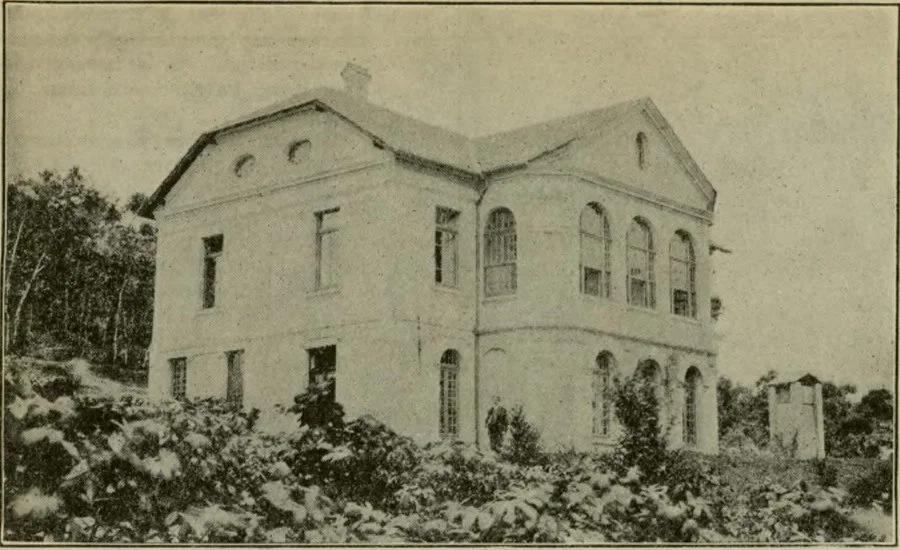
Boys' Dormitory, Brazilian Seminary
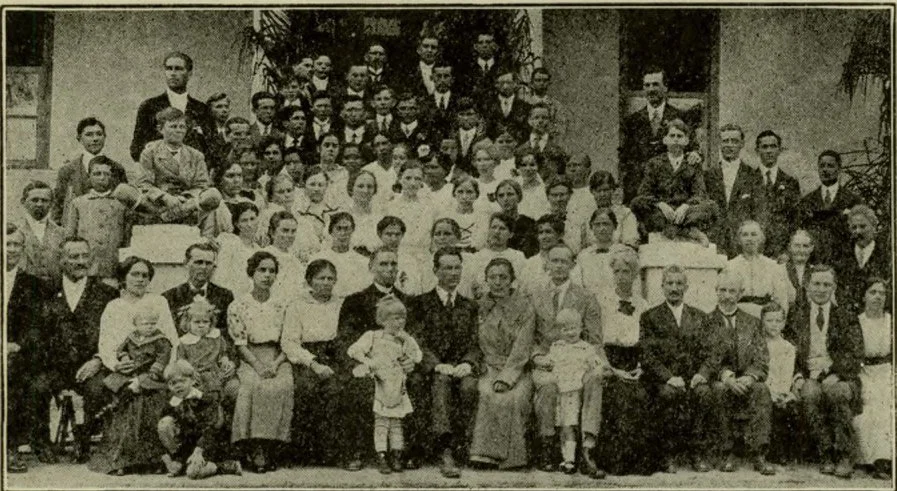
Teachers and Students of the Brazilian Seminary, Sao Paulo
Furthermore, our present operating capital, which has increased only a small per cent, and which, on account of increased cost of raw materials, has only half the purchasing power it had in 1914, does not enable us to add the new and larger books which we very much need, without borrowing more money and thus greatly increasing our liabilities. To place our publishing house in a position where it can properly cope with the demands made upon it, it should have its operating capital increased by $10,000, thus enabling it to publish the two large books, namely, “The Great Controversy” and a health book, which our committee voted to publish a year ago; and a further sum of $10,000 with which to buy a linotype, a new press, and other equipment. Inasmuch as it seems impossible to raise this money in the field, it is the conviction of the speaker that this gathering should present a memorial to the General Conference Committee, respectfully petitioning them to obtain this sum from the surpluses of our larger publishing houses in the homeland, in order to place our printing plant on vantage ground, enabling it to do the work which our growing cause in Brazil demands without bringing upon it the burden which would result if this much-needed money were borrowed, and thus the liabilities of the house be greatly increased. And this is but reasonable, for whereas the Spanish fields can obtain books from the Pacific Press and Barcelona, Brazil is entirely dependent upon its own publishing house to produce the literature needed in this field.
It is also the conviction of the speaker that some well-laid plans should be devised to increase the circulation of our good missionary paper, Signaes dos Tempos, as a larger circulation of this periodical would not only be a help to the publishing house, and bring the precious truth to a larger number of souls, but it would result also in bringing great spiritual blessing to our own people.
Educational Work
The successful onward march of the Lord’s work depends upon consecrated men and consecrated means. The great lack of workers has been the chief reason why we do not today have a larger number of strong self-supporting fields in Brazil. Furthermore, the native can always work to better advantage than the foreigner, since climate, language, customs, and conditions are no barrier to him in reaching his own countrymen, whereas these factors often hinder the workers who have come from other countries.
It was for this reason that a training school, where the Brazilian youth might be trained and prepared for work, was long felt to be a great need; but the way did not seem to open until 1915, when the demand for such a school was so imperative that we began earnestly to consider if the time had not come to start one. The evident need on the one hand, and several encouraging omens, among which was a liberal gift of $2,000 by one of our workers, on the other, convinced us that the time had arrived to take definite steps in this direction.
In April, 1915, the present site, containing approximately three hundred acres of land, was bought, and the following month preparations for the putting up of buildings were begun. Our means being limited, the General Conference, having had our situation placed before them, aided our school enterprise by the generous gift of $10,000. Even during the first year, while the preparations for building were being made, fifteen young people were given instruction. The following year, 1916, thirty-six students attended the school, when tents, the barn, small buildings intended as poultry houses, the workshop, and other buildings had to be utilized as dormitories. But students and teachers and builders were all of good courage, and the work went on until early in 1917 the main building was finally finished.
As the time for the opening of the school approached in 1917, the query was often raised, “How many students will come this year?” When the opening day arrived, all were agreeably surprised to find fifty-five of the young people presenting themselves for enrollment. Considering the hard times and the difficulties caused by war conditions, this was indeed a marvel to us, far beyond anything we had expected.
Again we were crowded for room, and were obliged to use as dormitories the rooms which were intended for the hospital.28
As the day for the opening of the school in 1918 drew near, we were asking ourselves what we could do in case a much larger number came this year. When the school did open, sixty-five students enrolled, and if we felt cramped the year before, we were more so during this year. Fortunately, the General Conference in session in San Francisco, considering our need and earnest request, kindly voted us another $10,000 for a girls’ dormitory and $1,500 for a teacher’s cottage.
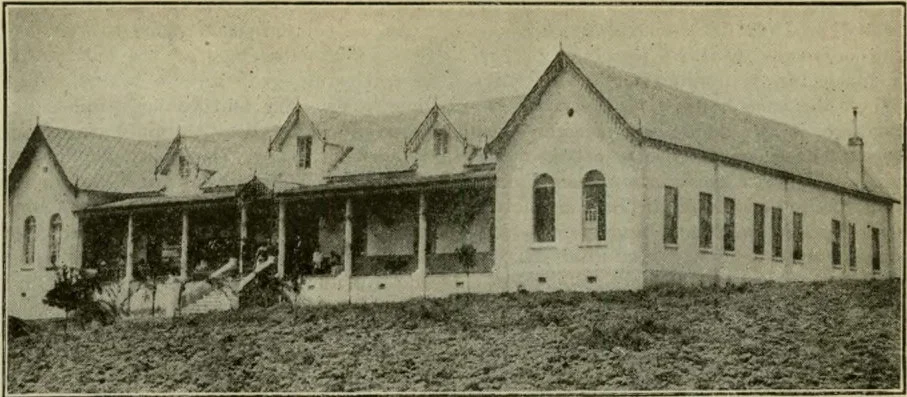
As soon as we had received this financial assistance from the General Conference, we at once set to work laying plans for erecting the girls’ dormitory, deciding to build the center wing and get it ready if possible by the time of the opening of school in 1919. This wing was completed on time, and by crowding, furnished accommodations for forty-two students. Again the student number increased, eighty-six being in attendance during 1919.
South Brazil Union Workers
We had hoped that the $10,000 appropriated for the new dormitory would be sufficient to complete the building, but the great advance in prices of building materials so rapidly consumed our funds that we could finish only as far as you now see it, and it even became necessary to draw some on our operating funds in order to complete the work begun, and we still lack $5,000.
We should build at an early date at least three more teachers’ cottages, requiring a further outlay of $5,000. An administration school building, costing approximately $15,000, should also be provided in the near future. Then as our growing school plant makes greater demands upon our power plant, $7,000 will be needed to provide for the necessary light and power.
Before leaving this subject, mention should be made of the numerous applications we are receiving from young married people who are desirous of entering our school to prepare themselves for a place in the work. As many of these have one or two children, it is clear that they cannot live in the large dormitories. On the other hand, it seems that we should not disregard the earnest entreaty of such young people, thus denying them the opportunity of a preparation to have a part in this closing work. We should consider at this time what can be done to meet this urgent need in providing small, inexpensive cottages, to afford living places for these young families.
Departments
As we compare the report of the last four years with those of previous years, a gratifying growth is revealed. The home missionary and young people’s departments, as well as the Sabbath school department, show that our people are advancing. The great need is more local help to second the efforts of our union secretaries, and thus to build up the work more solidly. We are glad that we now have a young people’s and educational secretary, who can give special study to the needs in these branches of our work.
The different fields are loudly calling for more workers, and these must come from our own native people. But this means education,—progressive education,—an education that begins in the home, that is continued in the church school, and that is finished in our seminary. And this educational program must include every Seventh-day Adventist boy and girl in Brazil. To study and lead out in such a program is certainly a worthy life-goal.
Finances
The Lord has greatly blessed in increasing our finances. The tithe in 1915 for all Brazil amounted to $19,510.55. In 1919 for the Brazilian Union only, it was $28,709.73, an increase of 47 per cent over 1915. The missionary offerings for 1915 for all Brazil were $3,331.44. In 1919 the Brazilian Union Conference alone raised $7,175.45, an increase of 115 per cent over 1915.
We have three fields that are entirely self-supporting,—Rio Grande do Sul, Santa Catharina, and São Paulo. Paraná is supporting the workers it has, but it should have at least one more worker. The entire income of our union more than supports the work we are doing in it, but we should not relax our efforts. We should rather bend every energy to increase our income to the point where the tithe alone will support the work of our entire union, and where, aside from this, we can pass on the whole amount of mission funds to the great world field to help finish the work so that Jesus may soon come.
In closing I wish to call attention to our special need. After considering general needs, there remains to mention yet a special and main need. As this conference convenes, we may say that we are living in a different or new world. The war has changed conditions. New ideals and aspirations are taking hold of the people; and while the terrible upheaval of the four years’ war has softened a few hearts and made them more susceptible to the last gospel message, the great majority of the people are being drawn in another direction. Material things—wealth, honor, pleasure, the enjoyment of what the world regards as the things of this life—engross and benumb the world at large. It is thus becoming a greater task to arrest and gain the attention of the people.
But this must be done; and in order to do it, God’s messengers need a special preparation and power from on high. Both the Bible and the spirit of prophecy assure us that we have come to the time when the power of the Holy Spirit awaits our demand and reception. The Lord instructs us to ask for rain in the time of the latter rain (Zech. 10:1); and the promise is that if we ask, he will send abundant showers. May this gathering result in that earnest seeking for purity of heart which will bring the Holy Spirit in its fulness, and thus provide for our greatest need for bringing to a finish this last work of mercy. F. W. SPIES.
The North Brazil Union Mission
By H. Meyer
THIS union has been organized only a little more than a year. Its territory consists of sixteen states and has a total area of 4,673,213 square kilometers, with a population of 15,409,424, according to the 1910 census, but present estimates put it at about 20,000,000. A large portion of this territory has not as yet been entered, not even by a colporteur. So far there are five organized missions, which include the states along the Atlantic coast from Rio de Janeiro up to the state Rio Grande do Norte. Even in these missions our work is still in its infancy, with the exception of the church in Rio de Janeiro and several German churches in the state of Espirito Santo.
Of this field we can truly say that it is ripe for the harvest. During the last year new interests sprang up in many places, a number of new companies of believers were raised up, and several new churches were organized. Each of the local fields shows decided progress, not only in the number of new members, but also in a marked increase in tithes and offerings. The increase in tithe in 1919 was $5,175.32, and in offerings for missions, $2,892.05. But the greatest increase was made in the book and periodical sales, which advanced from $16,276.38 in 1918 to $35,412.73 in 1919. In the city of Rio de Janeiro our periodical workers sold 43,307 copies of our Portuguese missionary paper, Signaes dos Tempos. Our four Bible workers in that city did not have to spend any time in looking for new families to whom they might give Bible studies, because these29periodical workers supplied them continually with more addresses of interested ones than they could take care of. This has been one of the main sources of strengthening our work in the capital of Brazil. The membership increased to such an extent that we had to divide the church and organize a second one; and a third one will be organized within the next few weeks.
In Recife, the capital of the state of Pernambuco, we had not more than a half dozen members at the beginning of 1919; but Brother R. J. Wilfart, the superintendent of the mission, moved there in the early part of the year, and in April another worker was sent there. The work soon grew, and a church was organized in September, which at the end of the year had a membership of fifty-five. In the city of Bahia, the great Catholic stronghold in Brazil, a number of new members have been added, and a church will be organized there this year.
In many places we have been handicapped on account of the great lack of workers. In the large Bahia Mission, which takes in the states of Bahia and Sergipe, we have only one Bible worker, and two of the local fields have no superintendent. We are still awaiting the arrival of a union bookman; and for the home missionary, young people's, and Sabbath school departments, we have as yet not one man to act as secretary, either in the union or in any of the local fields. We earnestly hope and pray that the Lord will move upon the hearts of some consecrated workers to enter these important branches of our work in this part of the great world-wide field.
Recently we were made glad by being able to send a field missionary secretary with four experienced colporteurs to the Bahia Mission, which to our colporteurs is nearly all virgin territory. And besides these we also sent two more of our best colporteurs farther north to São Luiz do Maranhão, a place where none of our workers have ever been before. This step really means the starting of a new mission, because we are sure that only a short time from now these colporteurs will report many interested ones, and this will make it necessary to send a minister to that part of the field to develop the work.
Another encouraging feature is the development of our young people. There are about fifty from this union in our seminary near São Paulo, and nearly all of them are there with a desire to prepare themselves for a place in the Lord's vineyard. Several have earned their scholarships by canvassing during the last vacation period, and it is our plan to start a number of them in various branches of the work at the end of this school year.
Our needs are many and our problems are not few; but the workers are all of good courage, and our intention is to center our interests in the finishing of the work, trusting that the Lord will provide the means and the strength for the speedy advance of the message in Brazil, and in the whole of South America, which has so often and rightly been called “the Neglected Continent.” The doors are wide open for the gospel messenger in every part of this great field, and many hearts are hungering and thirsting for the truth. May the prayers of all join with ours that the final efforts to finish the work may hasten the coming of the King. H. MEYER.
Missionary Volunteer Department
By H. U. Stevens
North Brazil Union Mission Workers
It was in Australia, Dec. 19, 1892, that the first Testimony appeared calling upon workers to do something definite for our young people. Other messages followed, outlining more definitely the organization which has now been fully established as a regular branch of the cause. These messages have been the guiding star of those who have promoted the Missionary Volunteer organization, and are today the inspiration and the argument of all Missionary Volunteer workers. They are as applicable to South America as to any other part of the world, and will guide us safely in the development and the more perfect organization of this branch of the department.
Some of these passages are golden, and glow with new light at each repetition. The following have universal application, and may be applied directly to South America:
“We have an army of youth today who can do much if they are properly directed and encouraged.”—General Conference Bulletin, Jan. 29, 30, 1893.
“Will the young men and young women who really love Jesus organize themselves as workers, not only for those who profess to be Sabbath keepers, but for those who are not of our faith?”—Signs of the Times, May 29, 1893.
“Even though pastors, evangelists, and teachers should neglect the seeking of the lost, let not the children and youth neglect to be doers of the word. . . . Let young men and women and children go to work in the name of Jesus. Let them unite together upon some plan and order of action. Cannot you form a band of workers, and have set times to pray together and ask the Lord to give you his grace, and put forth united action? You should consult with men who love and fear God, and who have experience in the work, that under the movings of the Spirit of God you may form plans and develop methods by which you may work in earnest and for certain results.”—Youth’s Instructor, Aug. 9, 1894.
So much has been said in the conventions in regard to the importance of the young people’s work that it will be unnecessary to dwell upon it here. Rather, it is my purpose to look over our task and to touch some general principles which may be a help in directing our efforts in the future.
Missionary Volunteer work began in South America before 1907, but it was not till 1912 that reports from this field made their appearance in the General Conference summaries. The growth in this department has been rapid. Forty-nine societies were reported in 1917, with a membership of 662. In 1919 there were sixty-three societies, with 948 members, an increase of 43 per cent in membership. There has been a corresponding increase in the various lines of work reported, as will be seen in the statistics which have been presented by the secretary. These are encouraging results, but we have not yet reached all the youth.
Our Youth
Few of us have fully realized the power for growth and progress which is latent in the large army of children and youth in our churches. They are like a vein of metal precious as gold, hidden from view, but cropping out here and there to reveal the treasure which awaits the miner’s pick and the refiner’s fire,—like a cataract with limitless power, pouring its volume of energy over the precipice to be wasted on the rocks below, while waiting for the skilful hand of the engineer to turn that energy into useful channels and harness it to run hundreds of industries and bring heat and light to thousands of30homes. Thus it is with our great army of youth; they constitute a boundless source of energy which is waiting for the skilful hand of the gospel worker to turn it into useful channels and harness it to run the intricate machinery of the third angel’s message and bring warmth to the heart and light to the life in thousands of homes throughout this broad land.
The stock is good, strong, potential. It is capable of receiving a high degree of culture. Christian education, if given a chance, can produce as strong characters and as efficient workers in South America as in any part of the earth. There are in South America large companies of Germans, Russians, Swiss, and Italians among whom the truth has already found a firm footing. Many of the children have been born and reared in the truth; and while large losses have been sustained for lack of fostering care when the lambs of the flock were susceptible to it, many are predisposed to a full acceptance of present truth, and are ready to yield to the Christian care and education that would preserve them to this message and train them for service in it.
The Missionary Volunteer department is primarily an evangelistic organization. The Missionary Volunteer worker should be first of all an evangelist. The young people in our churches constitute his parish, and for their souls he labors and prays. This chief function should never be lost sight of. All other functions are secondary, and contribute to the accomplishment of this one end—the saving of our young people to this message and their final salvation in the kingdom of God.
Next to his work as an evangelist, the Missionary Volunteer worker is a recruiting officer. His objective is to train all the youth for service. He inspires them with a holy ambition; he fosters in them the devotional spirit; he organizes them into prayer bands; he furnishes them wholesome reading matter; he directs them in real soul-saving work. Whenever possible he leads the youth to our training schools, that they may have the benefit of a Christian education. During their school days he does not leave them. The Missionary Volunteer work has a very definite and important place in our training schools. The Missionary Volunteer worker follows the youth and cares for their spiritual welfare till they are definitely enlisted in the army of the cross.
When we become thoroughly convinced of the value of our young people to this cause, and deal with them accordingly, the youth of South America are destined to play an increasing part in the finishing of this work. The youth are responding to the call of the Master. Many are preparing themselves for service; and under the influence of the Spirit of God working through the consecrated Missionary Volunteer workers, their numbers will increase.
May God bless the youth and those who have dedicated their lives to the Missionary Volunteer service, that the youth may be saved to this cause, and be prepared to carry this message to the ends of the earth. H. U. STEVENS.