“SURELY,” says the prophet herdsman, “the Lord God will do nothing, but he revealeth his secret unto his servants the prophets.” Amos 3:7. It is in this way chiefly that God has sent messages of warning, reproof and consolation to his people and the world through the ages of the past. Each prophet prophesied and taught for the age in which he lived, but he wrote for the future ages. “For whatsoever things were written aforetime were written for our learning, that we through patience and comfort of the Scriptures might have hope.” Rom. 15:4.
Among the many faithful, solemn warnings found in the word of God none is more comprehensive, none more important, than the great threefold message of Rev. 14:6–12, which reads as follows:—
“And I saw another angel fly in the midst of heaven, having the everlasting Gospel to preach unto them that dwell on the earth, and to every nation, and kindred, and tongue, and people, saying with a loud voice, Fear God, and give glory to him; for the hour of his judgment is come; and worship him that made heaven, and earth, and the sea, and the fountains of waters.”
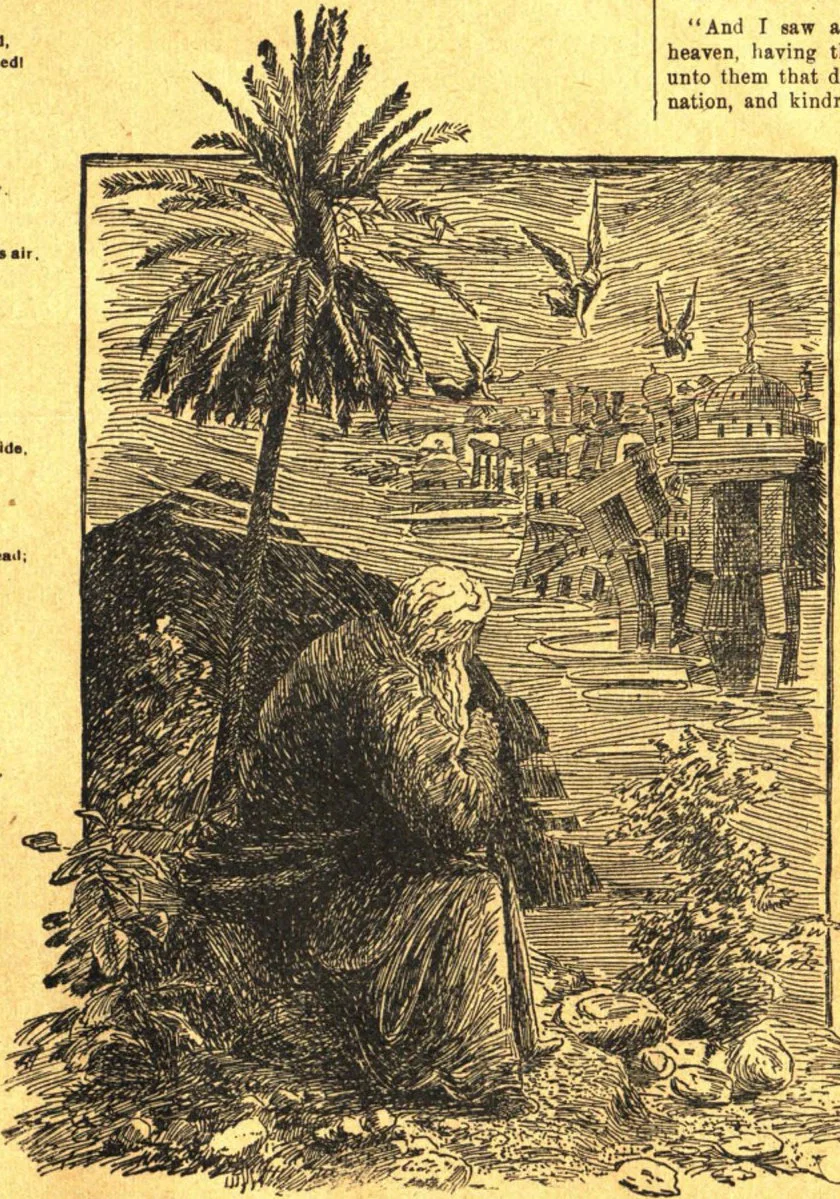
THE SEER OF PATMOS.
“And there followed another angel, saying, Babylon is fallen, is fallen, that great city, because she made all nations drink of the wine of the wrath of her fornication.”
“And the third angel followed them, saying with a loud voice, If any man worship the beast and his image, and receive his mark in his forehead, or in his hand, the same shall drink of the wine of the wrath of God, which is poured out without mixture into the cup of his indignation; and he shall be tormented with fire and brimstone in the presence of the holy angels, and in the presence of the Lamb; and the smoke of their torment ascendeth up forever and ever; and they have no rest day nor night, who worship the beast and his image, and whosoever receiveth the mark of his name. Here is the patience of the saints; here are they that keep the commandments of God, and the faith of Jesus.”
Note that it is one message, having three phases. The angels symbolize religious teachers. The first bears the everlasting Gospel to all the world. Every positive truth of God is comprehended in this message. The second message follows, or goes with, the first, showing the effect of its rejection. The same word, “follows,” is used repeatedly of Christ’s disciples following him, that is, going with him. The one leads out, the others follow. The last message is a decided protest2against false worship, while verse 12 reveals to us the character of those developed by the soul-stirring truths of the entire message. While the beginning of the first precedes the other two, and the first and second the third, yet when the latter begins, the message becomes one—God’s great threefold message to the world.
The Time of the Message.
The time of the message, that is, the age to which it applies, is indicated by the language of the message itself, and by the context.
1. “The hour of his judgment is come.” Paul, speaking for his time, declared that God “hath appointed a day, in the which he will judge the world in righteousness.” Acts 17:31. But the judgment was then future. He therefore spoke of “judgment to come.” Chap. 24:25. But the message under consideration proclaims the judgment already come. It is pending when the message, in God’s providence, goes forth; the Court is then in session, the Judge is on the throne, the cases are called. Every probationary work closes with the examination of the cases of those who have been on trial and the rendering of decisions in respect to each one; and the Gospel is no exception to this. It closes with the judgment. This message is, therefore, the last phase of Gospel work to prepare men to stand in the judgment.
2. The unmixed wrath of God in the message of the third angel. In all ages of the past when special judgments have visited the earth, God’s wrath has been mingled with mercy, extended even to those of imperfect character. Thus it was with the sons of Noah; thus it was with Lot. But in that great day, though Noah, Daniel, and Job are in the land, they shall deliver only themselves by their righteousness. Eze. 14:19, 20. Now “in the hand of the Lord there is a cup, and the wine is red; it is full of mixture; and he poureth out of the same” (Ps. 75:8); but then the wicked will have rejected every manifestation of God’s mercy, and there will be nothing left them but that which they have chosen, the “dregs” of wrath; and “all the wicked of the earth shall wring them out, and drink them” (Id.). This will be the unmingled wrath of God, the time when “the Lord shall rise up . . . that he may do his work, his strange work, and bring to pass his act, his strange act. Now therefore be ye not mockers.” Isa. 28:21, 22. This is not because God would not save the wicked, but the wicked will not be saved. They have identified themselves with sin, and the inevitable fruitage of sin is death. James 1:15. All this will take place when men have fixed their characters by accepting or rejecting this last great message, and the declaration goes forth from God that it is so. “Quickly” afterward is the coming of Christ. “The time is at hand. He that is unjust, let him be unjust still; and he which is filthy, let him be filthy still; and he that is righteous, let him be righteous still; and he that is holy, let him be holy still. And, behold, I come quickly; and my reward is with me, to give every man according as his work shall be.” Rev. 22:10–12. This shows that the judgment has determined the cases of all just before Christ comes. The great threefold message is therefore the last message of mercy; for upon those who reject it will fall the unmixed wrath, which by rejecting the message they choose.
3. That this message immediately precedes the Lord’s coming is shown by the verses which follow the message quoted above. The next event the prophet sees is thus depicted:—
“And I looked, and behold a white cloud, and upon the cloud one sat like unto the Son of man, having on his head a golden crown, and in his hand a sharp sickle. And another angel came out of the temple, crying with a loud voice to him that sat on the cloud, Thrust in thy sickle, and reap; for the time is come for thee to reap; for the harvest of the earth is ripe.” Rev. 14:14, 15.
“The harvest is the end of the world” or age. Matt. 13:39. Thus is it demonstrated that the great threefold message of Rev. 14:6–12 has application in the very close of the Gospel dispensation, just before the coming of Christ; it is the last message of mercy to fallen man. It will be seen by other articles, and by our Sabbath school lesson on page 13, that we are living in that period of time when this message is due.
The Importance of the Message.
1. It is a part of the “Revelation of Jesus Christ, which God gave unto him, to show unto his servants things which must shortly come to pass.” Rev. 1:1. Concerning that Revelation the Lord declares: “Blessed is he that readeth and they that hear the words of this prophecy, and keep those things which are written therein; for the time is at hand.” Verse 3. And again, “Blessed is he that keepeth the sayings of the prophecy of this book.” Chap. 22:7. But he can not keep the sayings of the book who does not know them, understand them, and realize their import. And as some of these sayings are great prophecies, relating to the end, or last generation, connected with which are important practical duties, it follows that only the last generation will know these prophecies and have presented before it these duties. Upon the hearing-doers of this generation is, therefore, pronounced the blessings of the Revelation. They will be blessed in the doing, as thousands are now witnessing. On the other hand, those who despise the instruction of the Revelation, despise the blessings.
2. The importance of the message is shown by the message itself. It brings “the everlasting Gospel” of God instead of human tradition; the fear of God, which is wisdom, instead of that of man, which bringeth a snare; the glory and worship of the Creator, which transform, instead of the glory and worship of man, which perish. It reveals the true God, the fallen church, the cause of her fall, the false worship, the solemn and fearful warning, which is death to neglect, the sure refuge, the holy character bestowed of God in the Gospel. Truly the message is tremendously important. Who will dare disregard it? Who will desire to disregard it?