ANTIQUITY OF GOD'S LAW

7%

Seventh-day Adventist Publishing Association · Battle Creek, Mich. · Feb 19, 1889

FromReview and Herald, Vol. 66, No. 8.

Read the full edition

ANTIQUITY OF GOD'S LAW.

How old is the law of God? When was it enacted? and why? Did it exist before man? Was it applicable to the angels?
These are queries which arise in the minds of many, and over some of which the opponents of the Sabbath attempt to wax facetious. “Think of angels,” they say, “killing or stealing? Think of them as having men-servants and maid-servants, to command, and cattle to team about through all the week, except on the Sabbath.”
It looks to us that all trouble over these questions, is unnecessary, and any levity betrays a view of the subject that is painfully superficial. Think a moment. What is God’s law? and how broad is the ground it covers?
1. Expressed in one word, which is applicable to all circumstances, and to all duration, from eternity to eternity, we may say that it is that principle which governs a righteous relationship between all the intelligences of the universe, whenever such relationship exists, wherever it exists, and to whatever extent, and in whatever particulars, it exists. Thus it governs the relation of all created intelligences, including man, to God, the Creator; and the relation of all creatures to each other—as angels with angels, angels with men, and men with men. Such is the law of God—the moral law—and such is the ground it covers, no more, no less. As applied to mankind, it covers our relation to God, and our relation to one another. As applied to any other intelligences, it covers the same ground—their relation to God and to one another.
2. The extent of the relationship governs the extent of the law, and the particulars of the relationship determine its specifications. It stops at the impossible. It expands only as the relation expands. That is to say (by way of illustration), if there were but one created being in the universe besides the Creator, from the very nature of the case there would spring from the relationship between them the law to govern it; for it would be the duty of the creature to render love supreme to the Creator. And if there were no other object which the creature could possibly have as a god before Jehovah, and nothing which could be bowed down to as an idol, the law could not take the form, under those circumstances, of a prohibition of these sins. But potentially those very prohibitions exist in that supreme law of love; and the moment circumstances so change that it becomes possible for the creature to have other gods and bow to graven images, the law shows itself in an aspect to cover that possibility.
And so when two or more creatures exist together, the law governing their relation—that each shall love the other as himself—springs into existence from the very nature of the case. But if it were not possible that they could kill each other, or wrong each other in property, the law could not take the form of a prohibition against murder and stealing. It would take such form just as soon as such sins in their case became possible.
Before sin came into our world, this law of love to God and love to man, held our first parents in its welcome bonds of peace and happiness. How far God had instructed them in regard to the special channels through which this love should manifest itself, we do not know. We do know, however, that God had given special instruction in reference to the Sabbath, and he had probably done so in respect to other matters pertaining to his own worship. If murder, adultery, theft, and other specifications of the second table of the decalogue, they would of course know nothing till, by disobedience, the barrier had been broken down which made these particular forms of transgression possible.
God, as was proper, gave to Adam a test through which he might manifest his disposition to love and obey him,—the prohibition of the tree of knowledge of good and evil,—and this test was so comprehensive that it embraced the principles of nearly every one of the ten precepts of the decalogue. The evil immediately possible was the entrance of sin through disobedience to God in reference to that test; other specific acts were only remotely possible through that; for he would not be liable to fall into any of them as long as he obeyed this. And in so far only were these potentially involved in that law under which Adam stood.
But when man transgressed, and sin came in, then death, adultery, theft, and all other sins, became the immediate possibilities in the prospective development of the race; and through these very circumstances the law immediately adapted itself to cover them. The law against murder was not enacted after Cain slew Abel; but it was there before, and branded upon him the guilt of murder, when he committed the act.

Illustration.

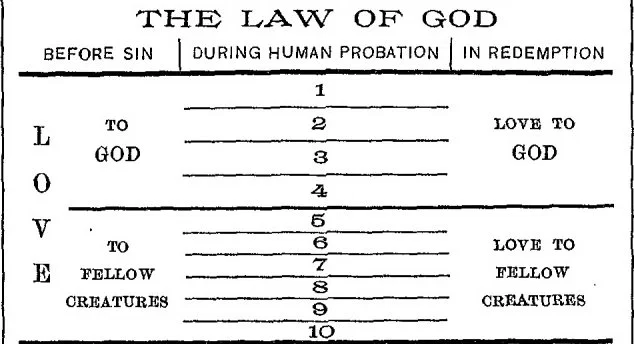
To bring out perhaps more clearly the idea, let us liken the law of God to a river. Its fountain was love, and in one volume of love it began its flow. As soon as God had brought other beings into existence, who were to love each other, as well as himself, the stream took two channels: “Love to God” and “Love to fellow-creatures.”
We at length come to a time when the bed of the river forms itself into ten distinct channels. The water of the river adapts itself to this feature, and immediately flows in and fills them all. But it is the same water and the same river, only flowing now in ten channels instead of two. These correspond to the ten precepts enjoined upon man during the period of his sinful probation. And after probation is ended, and the redeemed enter the kingdom of God, and cannot die, and are beyond the reach of sin, and their circumstances are all changed, the form of the law will change accordingly, and the ten streams will coalesce again into their two great channels, “Love to God,” and “Love to fellow-creatures;” for the positive duty of love will ever remain; and the stream will thus flow on through eternity. But in these two channels there will be all that was ever in the ten; for none of the evils prohibited by the ten can ever exist in that element of love, and every positive service of love will be rendered to its fullest extent.
In this state the prophet (Isa. 66: 22, 23) assures us that the Sabbath will be kept while the new heavens and new earth remain; and that Sabbath we can keep, though the circumstances that exist here, of men-servants and maid-servants and cattle and strangers within our gates, may not attend us there. From month to month, according to the prophecy last quoted, as the tree of life yields her fruit (Rev. 22: 2), will the nations of the redeemed gather at the New Jerusalem to eat thereof, and from Sabbath to Sabbath will all flesh come to worship before the Lord of hosts. All Sabbath-keepers there, praise his name!