The student of American history must early have discovered the fact that our information concerning the discoverer of our continent is in some essential points shrouded in uncertainty. For instance, he must have noticed that the great explorer appears in our various American histories in a variety of entirely different portraits, each one of which is, apparently, as authentic as the others. Nor is this evidently due to that carelessness or elasticity of conscience by means of which in historical compilations, the same battle scene is sometimes made to do duty as a representation of several different battles. The historians really do not know which one of the various portraits of Columbus is correct, or whether any one is more correct than the others. Nor was it known with any greater certainty, until recently, where Columbus first landed in America, or where the bones of the great discoverer now rest.
It was the opportunity of the writer a short time since, to be present at a lecture given by ex-President C. K. Adams of Cornell University, treating upon these topics. Through the efforts mainly of an enterprising German explorer, Mr. Rudolph Kronol, the identity of the first landing-place of Columbus, and also the present whereabouts of his remains, have recently been established beyond the probability of error. A brief outline of the facts presented is as follows:—
1. Concerning the personal appearance of Columbus. Upon this point we have, as stated, no reliable authority. A great many portraits of the admiral (as he was familiarly called) are in existence, but scarcely any two of them would be taken to represent the same individual, and it is certain that their authors, with one or two possible exceptions, never saw the original. The visitor to the Columbian Exhibition at Chicago will be shown some of these portraits, prominent among which will be two owned by citizens of Chicago, and each, no doubt, claiming to be genuine, though entirely dissimilar in appearance. One is the property of Mr. James W. Ellsworth, and the other is owned by Mr. Chas. F. Gunther, the well-known Chicago confectioner. The latter was painted about the year 1570, by Sir Anthony Moore, who lived A. D. 1519–1581, and was perhaps the most celebrated portrait painter of his time. It is said to have hung in the cabin of one of the ships of the Spanish Armada, during the famous sea fight off the English coast. But as Columbus died in 1506, it is certain that he was never seen by the author of this picture. The other, owned by Mr. Ellsworth, is of greater antiquity, and more interesting, from the fact that there is a possibility of its having been taken from life. It is the work of Lorenzo Lotto, a celebrated Venetian painter, who lived A. D. 1476–1556. It represents Columbus as having a rather sober and austere countenance, straight hair, small eyes, and a Roman nose. It is not positively known that Lotto ever saw Columbus, but it is known that he was absent from Venice just prior to Columbus's last voyage to America, and that Dominico Pisani, an intimate friend of the artist, was at that time assiduously cultivating the acquaintance of the explorer, and it is considered not improbable that the three may have been together.
2. Where did Columbus first land? The honor is claimed by five or six islands, and the efforts of different writers to answer the question have produced a library of about twenty volumes. Columbus has, of course, described the landing, but in language which does not suffice to fix the identity of the place. No one disputes, however, that he landed on one of the West Indies. He himself describes it as a bean-shaped island, with a large body of fresh water in the interior. The only one which answers this description is Watling's Island, lying to the north of Cuba, oval in shape and about twelve miles long by six miles broad. The land is low, and in the center is a fresh-water lake about six miles long and two or three miles wide. A difficulty, however, which had seemed to stand in the way of its claims, lay in the fact that its eastern side is entirely surrounded by a reef of rocks, upon which the waves dash in long lines of violent breakers, making it wholly impossible for any boat to land. The difficulty is obviated, however, by a conclusion which, though novel, seems from the circumstances to be entirely credible.
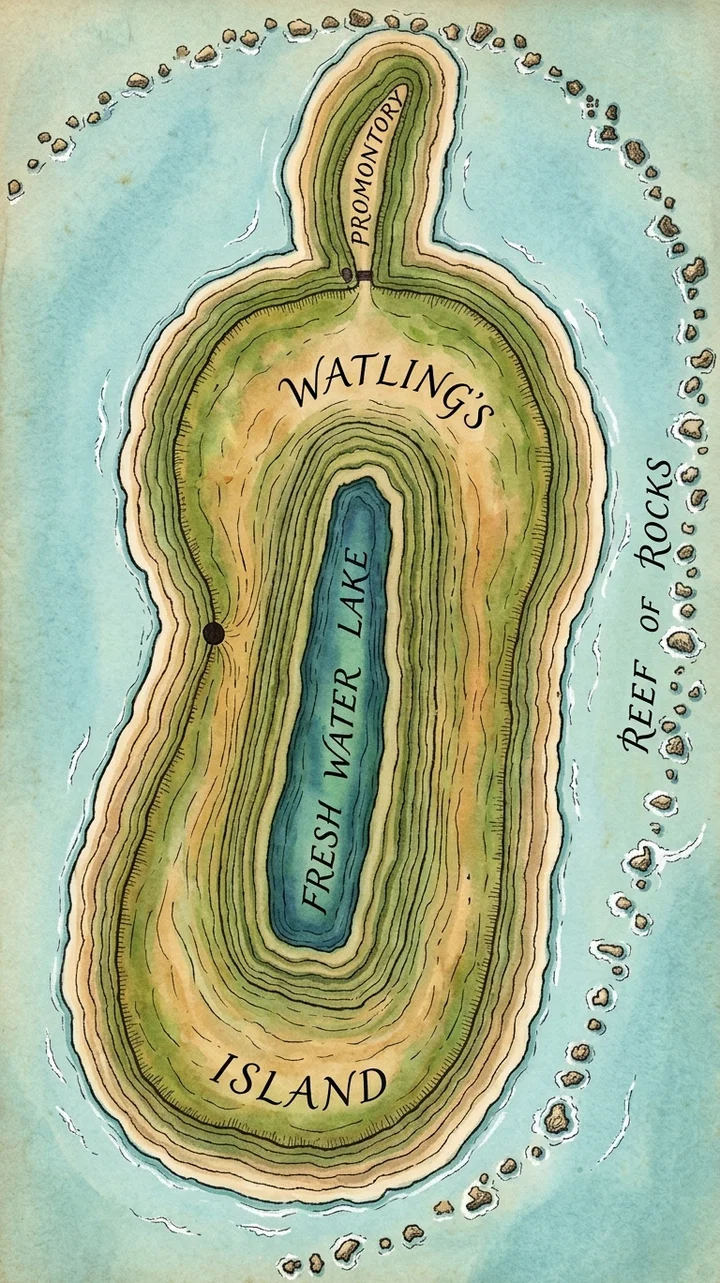
It was at ten o'clock in the evening of the eventful 11th of October, 1492, that Columbus, walking the quarter-deck of the “Santa Maria,” imagined that he saw, far off on the water's edge, a light. Calling to his side several of the crew, one of them confirmed his belief, but the rest affirmed that they saw nothing. There was on this night, as Columbus records, a strong wind blowing, which urged the caravels through the water at an average speed of about ten miles an hour. The admiral having offered a large reward to the person who should first sight the land, a sharp lookout was kept, and at two o'clock in the morning, the “Pinta,” which, being a faster sailer, was in the lead, fired her signal gun in token that the long-sought land was found. It is evident, therefore, that since seeing the light at ten o'clock, the vessels must have advanced about forty miles before the signal from the “Pinta” announced that land was actually discovered; and the land must still have been, in all probability, twenty miles or more away. The inference is very plain, therefore, that Columbus may have sailed past one end of the island in the night and landed the next morning on its western side. And it is a fact that on this side of the island, for the greater part of its length, there are no reefs, and the landing is safe and easy.
The inference is made still stronger by the record which Columbus gives of this part of his voyage. After leaving the landing-place, he says, “We sailed north-northeast, and soon came to a harbor large enough to hold the navies of the world.” Such a harbor exists on the north end of the western side of this island. The discoverer also mentioned a narrow cape or promontory extending several miles out into the sea, having the appearance of a separate island, but not such in reality. This promontory extends from the north end of Watling's Island, as shown in the accompanying outline, and upon it the Spanish have erected fortifications. From all these facts ex-President Adams concluded that it was now fairly well settled that the landfall on this memorable voyage occurred on the western side of Watling's Island.
3. Where is the resting-place of the admiral's remains? It has been supposed until recently that the bones of Columbus reposed in the cathedral of Habana, but the researches of the German explorer before mentioned have quite clearly established the contrary. Columbus died in 1506, and for some time his body was in Seville. But having expressed a wish to be buried in Hispaniola, his remains were afterwards brought thither and placed beneath the floor of the convent of San Domingo. In 1795 the island passed into the possession of the French; and the Spaniards, as would be their natural wish, soon afterwards proceeded to remove the body of Columbus. With great ceremony, they removed from a vault beneath the floor of the convent, a box filled with human bones, transferred it to Cuba, and placed it in a vault in the cathedral of Habana. No question of the identity of the remains seems to have been raised, although the box bore no inscription. In 1877, it was deemed necessary to make some repairs in the floor of the convent, in the course of which two more vaults were discovered. One of these upon being opened, was found to contain a box of bones with the inscription, “Luis Columbus, grandson of the admiral.” In the other was found a similar box and a plate which had evidently been fastened to it and had fallen down, bearing the inscription, “Cristof Colomb, admiral.” Among the remains in this box was found a bullet, which also seemed significant from the fact that, while there is no direct record that Columbus was ever wounded, he had himself, writing from America to the king, once said, “My wound has opened, and is troubling me again.” The box was placed in a glass case, which was then carefully sealed, and was not again disturbed till 1890, when it was opened by Mr. Kronol in the presence of the officials and foreign consuls of the island, and the allegations made upon its first discovery were verified. It seems well settled, therefore, that the bones of the great discoverer were not ceremoniously transported by the Spaniards to the cathedral at Habana, but still rest within the walls of the San Domingan convent. L. A. S.