The Bible often speaks of this people. The kingdoms of Judah and Israel were frequently brought in contact with the Syrians, while Mt. Lebanon, their home, is many times referred to in the poetry of the Old Testament. Their name is believed to be but an abbreviation of the word Assyrian. Like Israel, the Syrians were situated in the midst of the great powers that long ruled the old world,—Assyria, Babylon, Egypt, Persia, and Greece,—and hence were frequently trampled underfoot. Being frequently overrun by, and mixed up with, other nations, the original stock remained less pure than in some other nations; and their literature is more varied, according as one or another of the nations had a leading influence over them.
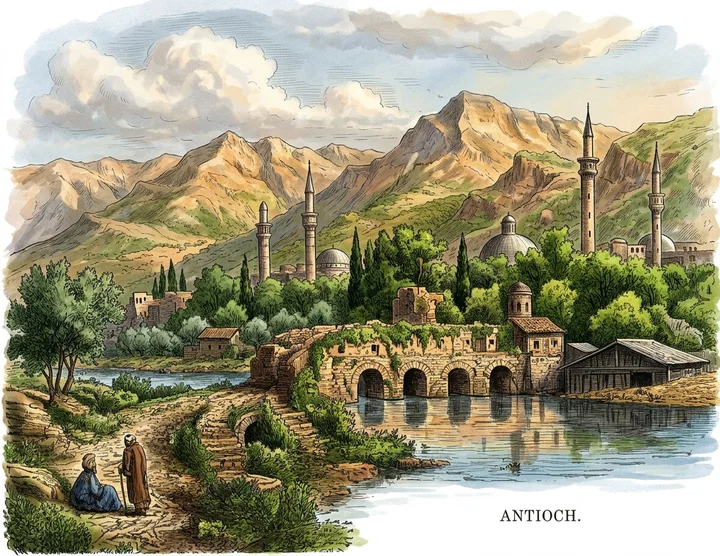
From the time of Alexander the Great, 333 B. C., and especially after the kingdom of the Seleucidæ was established in Syria, the Greek influence became marked; from that time to the present, Greeks have been found in Syria. As soon as Christ began his ministry, “his fame went throughout all Syria.” Matt. 4:24. Soon after Pentecost, there were disciples enough in Damascus to attract the attention of the persecuting Saul; in fact, the first great wave of the gospel swept to the north over Syria, and it was at Antioch, in northern Syria, that the disciples were first called Christians. Acts 11:26.
A great work was done in this country, many miracles were wrought, and a large church was raised up at Antioch. It was among this people that Paul was first called to labor among Christians; and it was from among them that he was sent to the work to which the Lord had called him,—to preach the gospel to the Gentiles. During the first period of his missionary work, Paul made Syria his headquarters.
Christianity continued to prosper among the Syrians till, at the close of the first century after its introduction, the church of Antioch numbered a hundred thousand; at the beginning of the fifth century, the Christians in Syria numbered several million. It was in this century that the great division took place in the Christian church on the doctrine of the nature of Christ, most of the Syrians adhering to the position of the Nestorians, who taught the existence of two distinct persons in Christ, the human with the divine Word indwelling, joined in one only by unity of will and affection. For a time, the Syrians were quite a missionary people; they did much to spread Christianity in Persia, India, and even China.
In 636 the Syrians began to fall under the Mohammedan power; and from that time, their language began to disappear, and finally gave place to the Arabic, which is now the language of Syria. But with some of the Christians, the Syrian language is still preserved in the liturgy of the church, and there are two or three small villages which still speak it.
The present population of Syria is about two million, one fifth being Christian, and the remainder Mohammedan; the Christians are divided into several sects, the chief ones being the Roman Catholics, the Greek Catholics, and the Nestorians. The Roman Catholics are best known as the Maronites of Mt. Lebanon. Besides the Christians and Mohammedans, there is a peculiar class in Syria called the Druses, whose faith is a mixture of Christianity, Mohammedanism, and heathenism. They dwell mostly in Mt. Lebanon, number about 80,000, are noted for their conservatism. In war they are most cruel. In 1860 a most barbarous warfare was carried on between them and the Maronites till Europe was horrified, and a French army was sent to put an end to the war. From that time, the Syrians have had a Christian governor. This, with the backing of the powers of Europe, makes life in this region a little more secure than formerly.
About the time that the first angel’s message began to be preached, the Presbyterians opened a mission among the Syrians, with headquarters and publishing house at Beyrout. Many schools have been established, and the Scriptures quite extensively circulated. There are also a large American college and a German hospital at Beyrout. Present truth has to some extent been represented among this people. Brother La Rue, now in China, spent a short time there, and left some publications. In the north of Syria, some work has been done at Alexandretta, Beilan, and Aleppo. A few have accepted the faith.
But what has been done can scarcely be called a beginning. We should begin at once to print in Arabic, the common language of Syria as well as of Egypt and the north of Africa, and some should be sent to circulate the printed truth and to preach the word. In the days of Solomon, thousands labored in Lebanon to prepare cedars and stones for the Lord’s temple. But a greater than Solomon now commands us to go to this field to prepare living stones for the more glorious temple. If we cannot, like Solomon, send thousands to Lebanon, yet thousands can have a part in the work by furnishing means with which to send laborers to this field, and thus literally have a part in gathering material from Lebanon for the Lord’s temple. May all our Sabbath-schools have a liberal part in furnishing material for this work in Lebanon.
M. P. R.