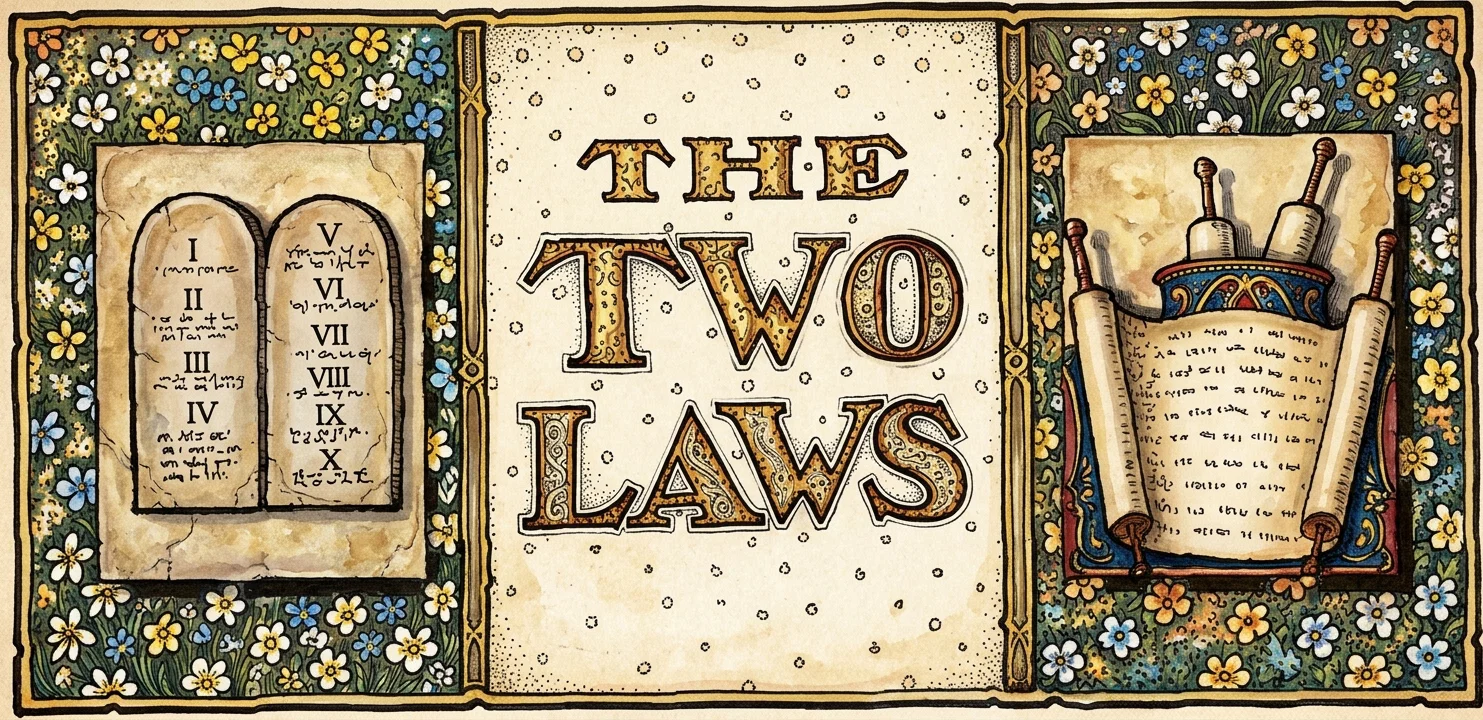
THE TWO LAWS

2%

Seventh-day Adventist Publishing Association · Battle Creek, Mich. · Oct 24, 1899

FromReview and Herald, Vol. 76, No. 43.

Read the full edition

THE TWO LAWS

Restored with AI
In the preceding articles we have seen, in every case, and from every point of view from which this subject can be viewed, that there are two laws in the plan of God, since sin entered our world. We have seen that since sin is the transgression of the law, one of these laws must have existed before sin. After sin entered, came the promise of a Saviour, in the announcement, “It [the seed of the woman] shall bruise thy [the serpent’s] head.” Here sacrifices began; and we find Cain and Abel bringing their gifts to the cherubim-guarded gates of Eden. Thus early was the remedial system established.
Throughout the patriarchal age we find traces of this. Especially do we notice Noah and Abraham erecting altars, and offering thereon sacrifices for sin.
As the inhabitants of the world multiplied, many departed from God; yet even they did not forget to offer sacrifices, although the true significance was forgotten, as they forgot the promise of a Saviour. Like the offering of Cain, the sacrifices were expected to atone for sin, and also to purchase pardon. This is the heathen idea throughout the world.
That the Jews, in the days of Christ’s first advent, had forgotten the true significance of these offerings, is evident, since they did not expect their Messiah to die. Even the twelve disciples could not understand this matter; and his death crushed every hope that they had entertained in him as the One who was to come.
Said Jesus, “O fools, and slow of heart to believe all that the prophets have spoken: ought not Christ to have suffered these things, and to enter upon his glory?” Then, to prove that he “ought to have suffered all these things” (crucifixion) he began “at Moses and all the prophets,” and “expounded unto them in all the scriptures the things concerning himself.” Luke 24:25–27.
Since at that time, the whole Jewish people did not expect the Messiah to die, what possible meaning could their sacrifices have had to them? The fact is, they thought that the sacrifices themselves took away sin. If not, what need was there of saying, in the letter to the Hebrews, “It is not possible that the blood of bulls and of goats should take away sins”?
This false idea of sacrifices caused some to continue offering them while still professing Christ. This fact may be seen by reading Acts 21:18–26. The letter to the Hebrews, written about four years later than the occurrences of Acts 21, was largely for the purpose of showing the true idea of all their typical services.
In the book of Hebrews are contrasted: (1) The earthly and the heavenly sanctuaries; (2) the offerings of each; (3) the earthly and the heavenly priesthoods; (4) the failure of the earthly system to make anything perfect; and the overwhelming sufficiency of the heavenly system to “save them to the uttermost that come unto God by him.”
The blood of Christ was shed on earth; but the whole work of his priesthood is accomplished in heaven. “Now of the things which we have spoken this is the sum: We have such an high priest, who is set on the right hand of the throne of the Majesty in the heavens; a minister of the sanctuary, and of the true tabernacle, which the Lord pitched, and not man. . . . For if he were upon earth, he should not be a priest.” Heb. 8:1–4.
How plain it is, then, that since the priesthood is changed, the whole base of operations is changed—changed from earth to heaven.
With the earthly priesthood abolished, superseded by the one “after the order of Melchisedec;” and with this, the only efficacious one, confined to heaven, I ask in all candor, What authority has any man ON EARTH to claim the title, or act the part, of a priest? Even Christ, “if he were on earth, should not be a priest.” Where, then, is the authority for the papal priesthood? Is not that whole system a usurpation?
“The law maketh men high priests which have infirmity; but the word of the oath, which was since the law, maketh the Son, who is consecrated FOREVERMORE.” Heb. 7:28. “For these [earthly] priests were made without an oath; but this [heavenly priest] with an oath by him that said unto him, The Lord swear and will not repent, Thou art a priest forever after the order of Melchisedec.” Heb. 7:21.
However, “those priests” here referred to, although made priests “without an oath,” were nevertheless appointed by God (Heb. 5:4); but any man now on earth claiming that office, is not only made priest without the oath of God, but without the appointment of God; yea, in direct opposition to God; for, in the priesthood of Christ, God has abolished all need of an earthly priesthood.
“The word of the oath which was since the law.” Since the law ended, or since it entered—which?—Since it entered; for the law here referred to (“the law [which] maketh men high priests”) we have seen to be the law of the Levitical priesthood. This law was given through Moses. “The word of the oath” was given through David. David wrote “since” Moses. Therefore the “word of the oath” was given “since the law” was given. This law of the priesthood did not end until the priesthood was changed; and that was not until type met antitype.
How many persons have we heard—those persons who confuse the two laws—applying this text to the law of righteousness! By them, the expression “since the law” is made to mean since the law ended. The facts, as we have now studied them, show this interpretation to be doubly false,—false as to the law to which the expression refers; and false as to the time when “the word of the oath” was given. The law of righteousness did not even mention a priesthood. How could it, then, MAKE men high priests?
We have found two priesthoods; and they are distinctly defined, and also named. We have found that one supersedes the other. We have found why this is so, and when the change was made.
We have also found two laws; and have seen that they are as distinct, the one from the other, as the two priesthoods. The offices of the two laws are also distinct, and that distinction is clear-cut. One reveals sin to sinners; the other reveals (in type) the remedy for the repentant sinner.
Now the law which reveals sin can not itself be sin. Only perfect righteousness can reveal sin. Hear God, through Paul: “What shall we say then? Is the law sin? God forbid. Nay, I had not known sin, but by the law: for I had not known lust, except the law had said, Thou shalt not covet.” “Wherefore, the law is holy, and the commandment holy, and just, and good.” Rom. 7:7, 12.
What law is it that says, “Thou shalt not covet”?—Every child ought to know; and most children do know. Is it not the law of TEN COMMANDMENTS? Are the ten commandments called a law?—Distinctly so. Read Ex. 24:12 with Deut. 4:12, 13. Here we find that that which God spoke, and that which God wrote, are the same; and that these words of the living God are called “a law, and commandments.”
“And the Lord spake unto you out of the midst of the fire: ye heard the voice of the words, but saw no similitude; only ye heard A VOICE [‘whose voice then shook the earth.’ Heb. 12:26]. And he declared unto you his covenant, which he commanded you to perform, even ten commandments; and he wrote them upon two tables of stone.” Deut. 4:12, 13. Then, after repeating these ten commandments, in Deut. 5:6–21, Moses adds, “These words the Lord spake unto all your assembly in the mount out of the midst of the fire, of the cloud, and of the thick darkness, with a GREAT VOICE; and he added no more. And he wrote them in two tables of stone, and delivered them unto me.” Deut. 5:22. “And the Lord said unto Moses, Come up to me into the mount, and be there; and I will give thee tables of stone, and a law, and commandments which I have written; that thou mayest teach them.” Ex. 24:12.
To repeat a little: “I had not known sin, but by this law.” The law here referred to is the one which said, “Thou shalt not covet.” This is the only law which Jehovah ever spoke and wrote. These are the only words directly spoken by God to man since man left his Eden home. They were spoken with an audible voice,—so audible that it “shook the earth,” not merely Mt. Sinai. At that time the earth was shaken as it has not been shaken since, and will not be until the same voice shakes both earth and heaven. Paul wrote of both these times, saying: “Whose voice then shook the earth; but now he hath promised, saying, Yet once more I shake not the earth only, but also heaven.” Heb. 12:26.
“I spake not unto your fathers, nor commanded them in the day that I brought them out of the land of Egypt, CONCERNING BURNT OFFERINGS OR SACRIFICES: but this thing commanded I them, saying, OBEY MY VOICE.” Jer. 7:22, 23.
When the fathers heard his voice, in the time already referred to, they heard THE TEN COMMANDMENTS, and no more, for “he added no more.”
God is holy. Rev. 15:4. The law is holy. Rom. 7:12.
God is perfect. Matt. 5:48. The law is perfect. Ps. 19:7.
God is a Spirit. John 4:24. The law is spiritual. Rom. 7:14.
God is righteous. John 17:25. All his commandments are righteousness. Ps. 119:172.
God is just. Isa. 45:21. The law is just. Rom. 7:12.
God changes not. Mal. 3:6. The law changes not. Luke 16:17.
Why should God change when he is holy, perfect, righteous, and just? For such a God to change would be to become unholy, unrighteous, imperfect, unjust.
The law, being identical, can be only an expression of his character. Therefore everything not in harmony with God’s law is not in harmony with God. Ah, more than that, that which is not subject to God’s law is “enmity against God.” Rom. 8:7.
The object of Christ’s sacrifice, therefore, is not to license sin (transgression of the law), but to purge out sin, and through the Holy Spirit to enable us to “fulfil the righteousness of the law.” Rom. 8:1–4.
The “cross of Christ” avails for all who believe. 1 Cor. 1:23, 24. “Do we then make void the law through faith? God forbid: yea, we establish the law.” Rom. 3:31.
Morality is defined by Webster to be, “The conformity of an act to the divine law.” And “moral law” is defined by the great Century Dictionary as “that portion of Old Testament law which relates to moral principles, especially the ten commandments.” It is therefore admissible, for convenience, to call the ten commandments—

THE MORAL LAW.

The whole service of the Levitical priesthood, which we have seen was minutely described by a law, “stood only in meats and drinks [meat offerings and drink offerings], and divers washings, and carnal [fleshly] ceremonies.” Heb. 9:10, margin.
A law which stood only in ceremonies is a law of ceremonies. We may therefore call it—

THE CEREMONIAL LAW.

The “ceremonial law” ceased at the death of Christ. The “moral law” is still in force; for it is everlasting.
Editors’ Note: This is the sixth article in E. J. Hibbard’s series on “The Two Laws.” There will be twelve in all. Get your neighbor to subscribe, so he will get these valuable articles. Here is an opportunity for you to do some real missionary work.