HARRY leaned out of the window, watching the postman going on his morning round, slipping letters into the door of one house, and hurrying down the walk to ring the bell at the next house, and leave a package that the letter hole in the door would not take in. So he kept on up the long street, and soon disappeared down the shaded walk leading to Harry’s house. It was a long walk, bordered with purple and white lilacs, and pink weigelias, and white syringa bushes, that made the air sweet through all the spring and early summer.
Presently there came a quick ring at the door bell. Harry jumped down from the chair and ran to answer it. The postman handed him a small package.
“I wonder what it can be,” said Harry, turning it over and over, as he went back to the sitting-room, where his mamma sat sewing. Then he spelled out the address—“M-a-s-t-e-r—Master, H-a-r-r-y—Harry, B-r-o-w-n—Brown; why, mamma, it’s for me,” he cried, “do cut the string quick!”
Mrs. Brown did so, and Harry unrolled a stout brown paper, a softer brown one, then a tissue one, and found inside the very thing he had always wanted—a jackknife, with one shining blade and a spotted brown handle. Folded up inside was a little note, which Mrs. Brown read to him. It said,—
“To my nephew, Harry Brown, in remembrance of his sixth birthday. “Thomas Brown.”
“A jackknife! a jackknife!” Harry shouted, hopping round on one foot, and finally ending in a somersault that brought his heels down on old Rover’s back. Rover started up from his morning nap with a growl, and bounded through the door, while Harry followed at his heels to try his new possession on whatever cuttable thing presented itself. The back yard soon looked like the blazed path of a forest. The old maple-tree showed a huge white H on its bark, the corner of the weather-beaten wood shed turned a bright strip to the sun, and the smooth rind of the old beech-tree, after a continued struggle on the part of the owner of the treacherous knife, bore in letters great and small the word “Harry.”
Harry stood back to view his work, with a satisfied look, when a pair of strong arms caught him, and he was whisked up on Uncle Tom’s broad shoulders.
“So-ho! youngster! into mischief already,” he cried. “What do you suppose your father will say when he sees his trees ornamented after this fashion?”
“Why,” said Harry, “he won’t care, ’cause it will grow right up.”
“No it won’t,” Uncle Tom returned; “there will always be an ugly scar on the tree to show what a thoughtless little boy once did just for fun. The tree will try to mend its jagged coat, but the ridges and uneven bark will be left to tell the story. When you grow up to be a man, you will still see the place where you used your new jackknife.”
“Now,” continued Uncle Tom, “I saw this same little boy making some more scars the other day. I wonder if he knows what they were?”
Harry opened his eyes very wide. More scars? No, he didn’t know what they were. Hadn’t he got his jackknife only that very morning, and papa never would lend him his knife?
“I saw a little boy get angry at his sister,” said Uncle Tom, “and call her a ‘horrid, hateful thing,’ because she didn’t want to leave her sewing to play ball with him; he cried and stamped when mamma combed his hair and washed his face for dinner; and when she asked him at night if he had been over to Jack Benton’s, he said ‘No,’ while he knew he had been playing out in the back alley with Jack all the afternoon.”
“Well,” said Harry, while his face grew very red, “I didn’t go over there. Jack said I daren’t come out in the alley to play, an’ so I did. An’ I didn’t go over to Jack’s house, an’ Jack didn’t come over here.”
“But you knew your mamma didn’t want you to play with Jack.”
Harry grew restless; he thought Uncle Tom knew most too much about his affairs. So he said, uneasily, “I don’t see what that has to do about scars.”
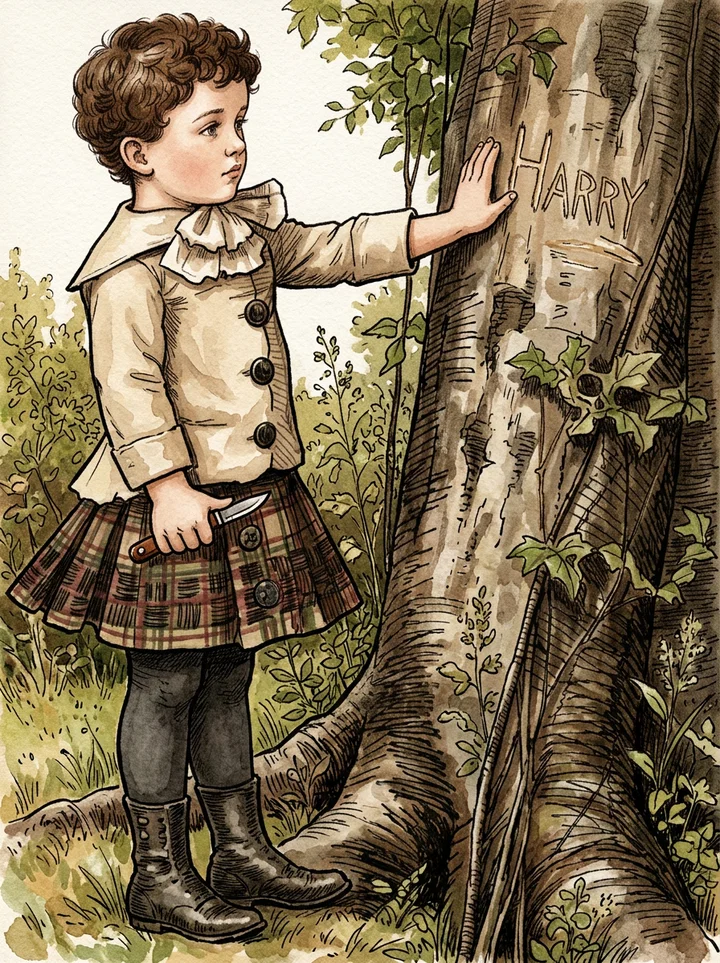
“Why, it’s just like this,” replied Uncle Tom; “every time a boy does anything naughty, it makes a scar on his character, just as your jackknife did on the smooth bark of the tree. May be the boy can’t see it; but God always sees it, and sometimes his friends see it too. You would like to be a perfect man, wouldn’t you?”
“Yes, sir,” said Harry, straightening up, “I should like to be a pretty good man.”
“Well, then, you must try hard to mind mamma, and tell the truth, and be kind to everybody,” said Uncle Tom, as he gave Harry a swing on to the dining-room steps, and they went in to dinner.
W. E. L.