The study of that interesting class of animals known as birds, suggests these beautiful lines of Eliza Cook:—
“Birds, birds! ye are beautiful things, With your earth-treading feet and your cloud-cleaving wings; Where shall man wander, and where shall he dwell, Beautiful birds, that ye come not as well? Ye have nests on the mountain all rugged and stark, Ye have nests in the forest all tangled and dark: Ye build and ye brood 'neath the cottager's eaves, And ye sleep on the sod 'mid the bonnie green leaves: Ye hide in the heather, ye lurk in the brake, Ye dive in the sweet-flagged streams that shadow the lake: Ye skim where the stream parts the orchard-decked land, Ye dance where the foam sweeps the desolate strand.
“Beautiful birds! ye come thickly around When the bud's on the branch and the snow's on the ground: Ye come when the richest of roses flush out, And ye come when the yellow leaf eddies about.
“Beautiful creatures of freedom and light! Oh! where is the eye that groweth not bright As it watches you trimming your soft, glossy coats, Swelling your bosoms, and ruffling your throats? Oh! I would not ask, as the old ditties sing, To be happy as 'sand-boy,' or 'happy as king;' For the joy is more blissful that birds me declare, 'I'm as happy as all the wild birds of the air.'”
With strict propriety, birds may be ranked among earth's most beautiful creatures; and nowhere is God's wisdom more strikingly displayed than in the adaptability of the bird's formation to the element in which it moves. Even in its smallest parts, it is perfectly conformed to its natural habits of life, and to its different necessities.
To give it lightness and elasticity, its feathers and many of its bones are hollow receptacles, filled with air; usually its head is small and pointed, that its weight need not hinder its wings, which serve as balances and to carry it forward. Its tail also helps to preserve its balance, and to aid it in its ascending and descending flight. To increase its size, without adding materially to its weight, thus enabling it to float with greater ease and gracefulness in the air, different parts of the body are provided with bladder-like cavities which it can fill with warm air whenever occasion requires. And so, as noticed above, the most minute member of the bird is formed with a wise distinction to the office it has to fill.
Birds are divided into orders, formed according to the manner in which they procure their living. The most prominent division is into land and water birds. Of the former, there are five general divisions,—birds of prey; perchers, or sparrow-like birds; climbers, as parrots, woodpeckers, etc.; scratchers, or poultry birds; and runners, which includes the ostrich. Of the water birds, the chief division is into waders and swimmers. All are again divided and subdivided according to some marked characteristic.
One division of the percher family is known as night-jars, or night-hawks, which includes the common goatsucker of Europe, our common night-hawk, chuck-wills-widow, whippoorwill, and also a South American night-hawk. Like the owl, these all seek their food in the night-season.
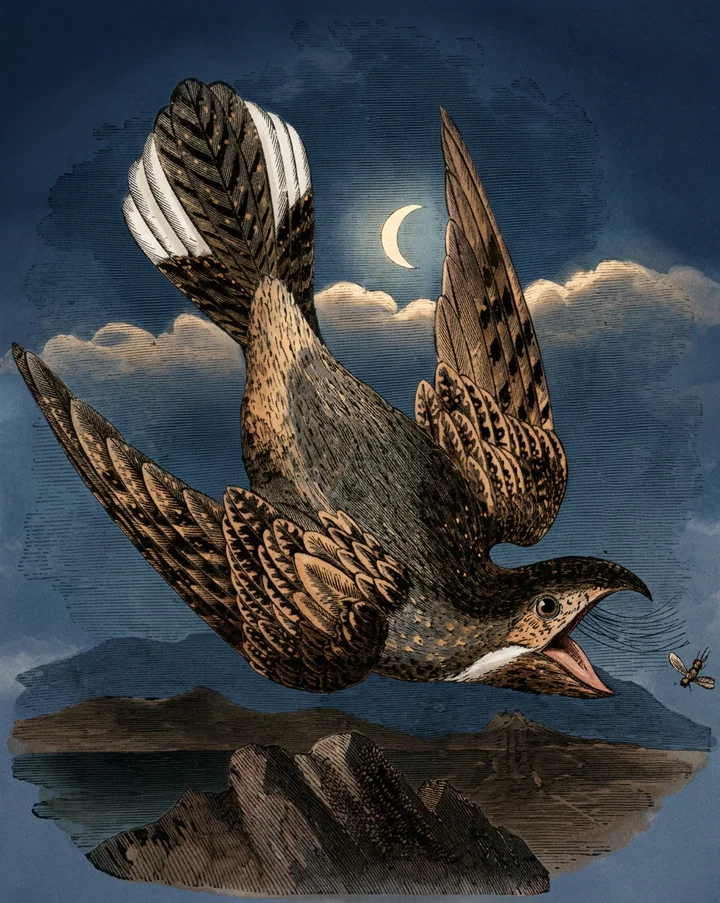
The bird in our engraving represents a family of birds of nocturnal habits, the one known as whippoorwill. It traverses the country from Mexico through the Southern and Atlantic States, into Canada, and west into Missouri, never making its appearance in the North until all traces of winter have entirely disappeared. We are first reminded of its presence among us by its strange voice emerging from the forests after the shades of evening have gathered about us. It can be truthfully said of the whippoorwill that it “loves darkness rather than light;” for it hides itself among the leaves and underbrush of the woods while daylight lasts, and by its manner gives one the idea that it is a stupid bird. But with the setting of the sun and the appearance of nocturnal insects, it comes forth from its hiding places and begins its feasting and merriment, sailing through the air as lightly and swiftly as a balloon afloat.
The whippoorwill has a short, broad bill, with a mouth that opens very wide. This is always open when the bird is on the wing, which enables it to seize the insects with which the air abounds. The mouth, too, is surrounded with a sort of hair-like feathers, enabling the bird to retain its captured prey.
Its eggs are usually laid upon the bare ground or a few leaves. If any nest is made, it is but a slight apology for one. Only two eggs are laid, when the lady-bird in turn with the male sits upon them fourteen or fifteen days. The mother-bird has great affection for her young, and practices many deceptive tricks to keep intruders from them.
One peculiar feature which distinguishes the whippoorwill from the common night-hawk is its rounded tail, whereas the latter has a forked tail.
Its name is given it from the resemblance of its cry to whip-poor-will; but it often repeats its song so fast that it can be variously interpreted. It never sings while on the wing, but only when squatting upon the ground, the fence, or some adjacent object. Neither does it utter its cry by day. Beginning its song in the early evening, it keeps up its tune until midnight, or if a moonshiny night, still farther on; and at early dawn, bursts forth again, gradually diminishing as aurora appears in her gay attire.
Other things of interest might be mentioned of this bird, but we will close with the words of M'Lellan:—
“Lone whippoorwill, There is much sweetness in thy faithful hymn. Heard in the drowsy watches of the night. Ofttimes, when all the village lights are out, And the wide air is still, I hear thee chant Thy hollow dirge, like some recluse who takes His lodgings in the wilderness of woods, And lifts his anthem when the world is still; And the dim, solemn night, that brings to man And to the herds deep slumbers, and sweet dews To the red roses, and the herbs, doth find No eye, save thine, a watcher in her halls. I hear thee oft at midnight, when the thrush And the green roving linnets are at rest, And the blithe twittering swallows have long ceased Their noisy note and folded up their wings.”
M. A. C.