The name of this African chieftain ought to be known wherever virtue and nobleness of character are reverenced. By common consent he would be regarded as one of the most remarkable Africans of modern times. All travelers, as well as missionaries, speak of him in the highest terms, and the British “Blue Books,” containing the reports of high officials in Africa, are lavish in their praise. One of the best accounts of Khama is that given by the wife of Bishop Knight-Bruce, who visited his former capital of Shoshong. From this and other sources we gather the story of his remarkable life.
Restored with AI
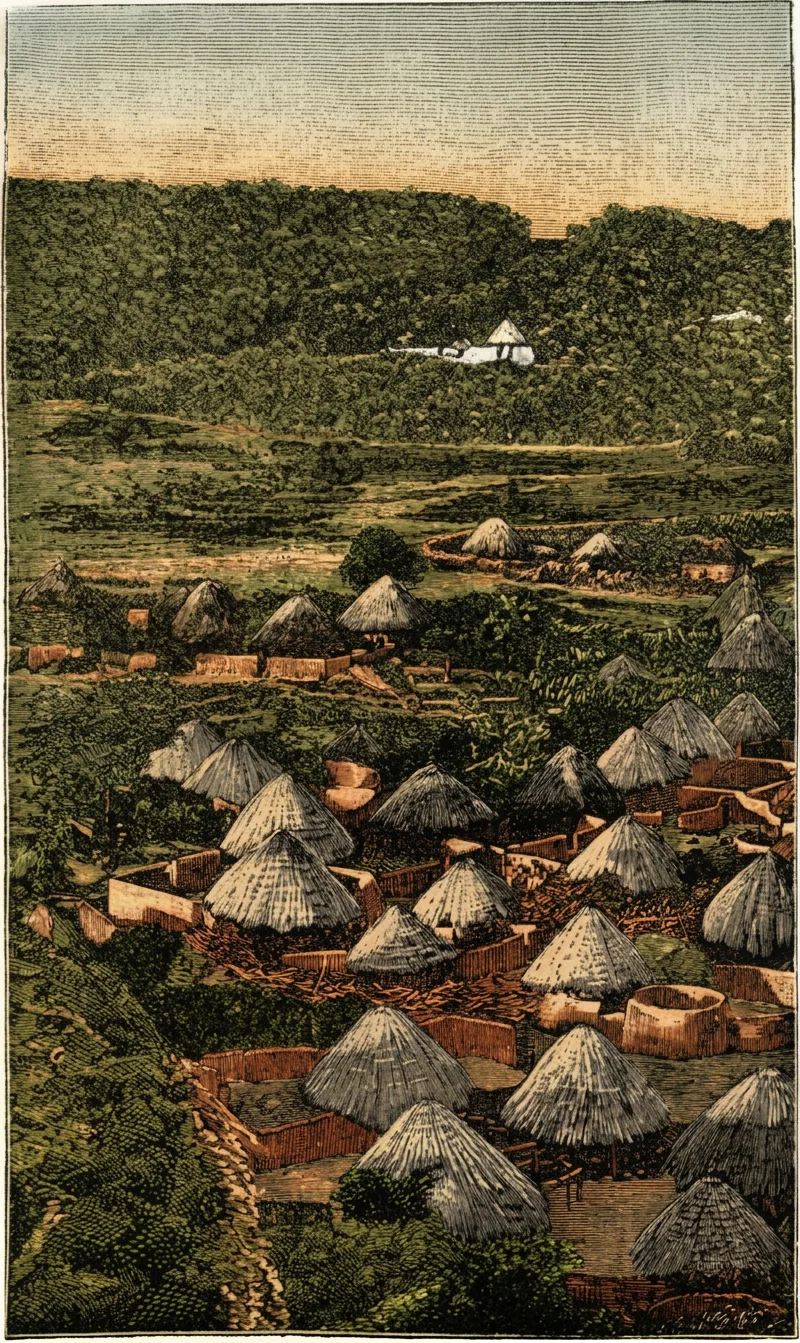
A Matabele Village.
Khama was born about 1830, the son of Sekhome, chief of the Bamangwatos. In early life he came under the influence of missionaries of the London Missionary Society, and he heartily accepted the Christian faith, and was baptized when a boy in his teens. While he was yet a youth, word was brought that the Matabele, that great fighting tribe, were about to make an attack upon Shoshong. These Matabele were always the terror of the Bamangwatos until the recent overthrow of the tribe by the British forces and the death of Lobengula, their chief. At the time of the threatened attack, when Khama was a young man, Sekhome, after sending the wives and children into the caves among the hills, turned for aid to the witch doctors, but Khama would have nothing to do with their incantations. He knelt in prayer with other Christians and asked permission to attack the Matabele. Consent was given, and in the assault he showed such skill and valor that on his return the old warrior chief, Moselekatse, said: “Khama is a man. There is no other man among the Bamangwato.” The people at Shoshong welcomed Khama with a shout, “To-day those who pray to God are our leaders.”
Khama was obliged early to take his stand against many heathen customs of his tribe. He would not join in the customary raids for cattle; neither would he celebrate the heathen rites to which all fathers took their sons. But his special trial with his father was concerning the taking of a second wife. He had married Mabisa, a plain Christian woman, and Sekhome ordered him to take another wife. Khama indignantly refused, and the contest on this matter went on for a number of years. Khama’s answer was: “I refuse on account of the word of God. Lay the hardest tasks upon me as to hunting elephants for ivory, or any service you can think of, as a token of my obedience, but I cannot take another wife.” Sekhome was furious. He devised all manner of plots against his son. At last, taking some men to Khama’s hut, where he was asleep, he ordered the men to kill him. When they refused, Sekhome tried to do the terrible deed himself, but his followers disarmed him. The people arose to the defense of Khama, and Sekhome was obliged to flee from his angry subjects. But Khama sent for him and brought him back, treating him with every mark of respect, and giving him his place as chief.
Later on Sekhome broke all his promises and succeeded in arousing the superstitious fears of the people lest “the spirits” should destroy them, since they had forsaken the customs of their fathers. The result was that Khama was obliged to flee for his life, with a few followers. His experiences were much like those of David as he fled before Saul. Sekhome cut off all food supplies, and poisoned their one spring of water, yet when one of Khama’s followers, thinking to please him, stole a horse belonging to Sekhome, Khama was greatly displeased, and sent back the horse at once, with a message of regret.
At length Sekhome died and Khama succeeded to the chieftaincy. But he was not without trials. One of his brothers plotted against him, and gave him no end of trouble, specially in view of the fact that Khama sought to introduce great reforms among his people. He utterly forbade witchcraft, wholly suppressing the witch doctors. All through Africa there is the strongest faith in the power of these witch doctors, who were believed to be able to detect evil spirits that are dwelling in men, and who profess to “smell out” these spirits. Khama also utterly forbade certain common practices, such as the killing of children born weakly or deformed, the burying of the living baby with its dead mother, destroying one of twin children, leaving the useless old people to starve, and the right of a man to kill his wife in any petty quarrel.
But the greatest reform, and the hardest to bring about, was in the matter of temperance. The Bamangwatos, like most African tribes, are great lovers of beer, and give themselves up to beer parties and drunkenness. Khama entirely forbade the making or drinking of this beer. The people were restless under this restraint. Khama afterward said, “I withstood my people at the risk of my life.” And when some good people suggested to him that his measures were too stringent, he said, “Beer is the source of all quarrels and disputes, and I will stop it.” The greatest difficulty he experienced in carrying out these temperance principles was in connection with the traders. He could control his own people, but the white men were persistent, and his conflict with them was long and fierce. The following extract from a remarkable letter sent by Khama to the English administrator in South Africa, presents his complaints against certain worthless and unscrupulous men, who had, as he says, “come outside of all government, and flood my country with their drink, after all the long struggle I have made against it, withstanding my people at the risk of my life, and just when they have themselves come to see how great a salvation my drink laws have proved to be. It were better for me that I should lose my country than that it should be flooded with drink. . . . I fear Lobengula [the Matebele chief] less than I fear brandy. I fought Lobengula and drove him back, and he never came again, and God, who helped me then, would help me again. Lobengula never gives me a sleepless night. But to fight against drink is to fight against demons and not against men. I dread the white man’s drink more than the assegais of the Matebele, which kill men’s bodies, and is quickly over; but drink puts devils into men, and destroys both souls and bodies forever. Its wounds never heal. I pray your honor never to ask me to open even a little door to the drink.”
Khama is now paramount chief over the whole Bamangwato tribe. Five years ago, after having established his authority, he undertook an enterprise which was one of the most remarkable on the records of Africa. The Bamangwato town of Shoshong was unfortunately situated. It was dirty and ill-built. The land was not good, and the springs had dried up. Khama determined to remove to a better place. They chose a site named Palapye, sixty miles to the northwest of Shoshong, where there was good soil and an ample water supply. Every arrangement was made for moving with the utmost system, and in fifteen months from the time that Khama gave the order to remove, Palapye rose from nothing to a city of 30,000 inhabitants, with broad avenues and a fine central square. A writer who has visited the place says: “If we remember that this marvelous work, the exodus from Shoshong and the rehousing at Palapye, was a work carried out by a native chief himself, without the slightest European assistance, we shall admit that Khama’s fine city of Palapye is one of the most wondrous cities under the sun.”11
There are ten great divisions in the town, each having a large airy schoolroom, and in these schools the Bible is taught by native schoolmasters, trained by the missionaries. The writer just quoted says of the peace, security, and good order of the town, that “Khama as a native ruler is as wonderful as is Palapye as a native town.” The best site was reserved for the church and the missionary, and the people raised $15,000, with which they built a large and handsome sanctuary, which was dedicated Aug. 28, 1892. Before this was completed, they worshiped on the hillside, great congregations, numbering some 2,000, gathering at sunrise every Sunday morning. The missionary, Mr. Hepburn, and his assistants held services in the afternoon, also, in various parts of the town. At the morning service Khama himself often gave sound, practical addresses, telling the people of their duties, and warning them against their sins, pointing out to them in straitest fashion what men and women Christ would have them be.—Missionary Herald.