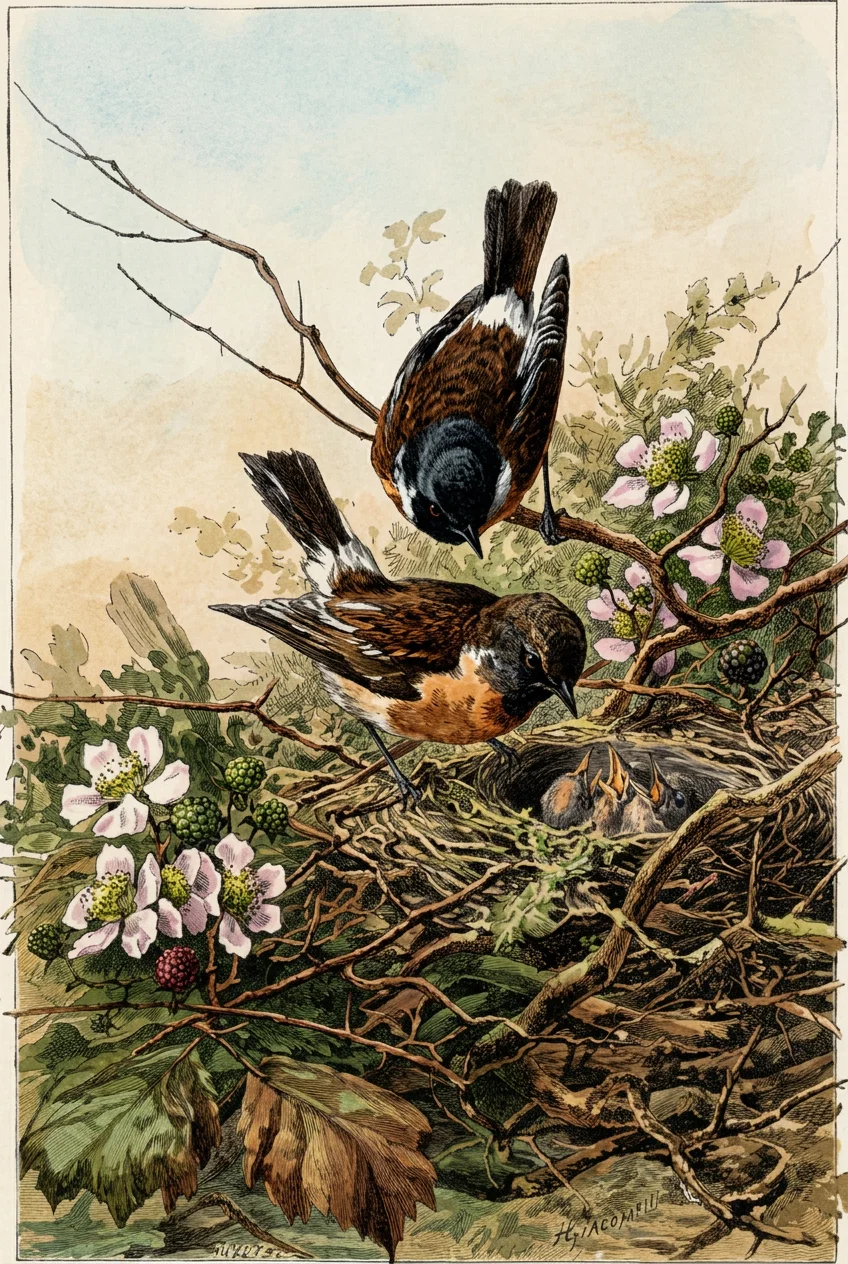
THE STONE-CHAT

8%

S. D. A. Publishing Association · Battle Creek, Mich. · May 29, 1889

FromThe Youth’s Instructor, Vol. 37, No. 22.

Read the full edition

THE STONE-CHAT.

“HAIL, O nation of folks with wings, Cleaving the air with your rapid flight! Men are glad when the season brings Ye to your homes in the branches light.”
Possibly a change of seasons does not usher in a more welcome event than “the time of the singing of birds,” when the great heart of Nature, so long bound by the frosts of winter, begins to beat, causing the plains and hillsides, the valleys and mountains, to blossom as the rose. The landscape, then no more dreary, is enlivened by the rustle of wings and the gay songs of birds, whose habits form one of the most pleasing of studies.
Restored with AI
Of the feathered creation there is almost an endless variety, both in the Old World and the New, with habits adapted to their several localities, and of so much interest to the lover of birds as to awaken in his mind a desire to know more of their ways.
We have in our picture a European bird, the stone-chat, or hammer, as it is sometimes called. It is near kin to the thrush and fly-catcher. It frequents moors and heaths of some foreign countries, where other birds are rare; for this reason and because of its lively ways, it is a great favorite with the shepherd.
The stone-chat is a tiny but showy bird. Its back and tail are black, shaded with a rich brown. Its head is also black, spotted with white upon each side of its neck. Its breast is a beautiful russet brown color, while its black wings are “delicately ruled with white.” From its description I should think it was nearly as restless as the humming bird. One naturalist says of it:—
“You can see it perching on the highest tree-tops, constantly flapping its wings. On account of this unceasing restlessness they call it traquet or mill-clapper; for as the mill-clapper never stops as long as the mill-stone is grinding, so this restless bird is forever flapping its wings.”
Another writer who has observed its ways says:— “The stone-chat represents perpetual motion. Although it never soars high, its black feet never seem to touch the branches; and they appear to belong rather to the air than the ground. While continually dancing upon the flexible stems of the bramble and woodbine, it seems to be perfectly happy, uttering now and again its low cry of ‘Oup! tia, tia! Oup! tia, tia!’”
“Except in pairing time, this bird leads a solitary life, and never flies in company with others. In the fields it is easily approached, and only flies to short distances, without appearing to take any notice of the hunter.”
The stone-chat hides its nest among the roots and branches of entangled bushes, always visiting it stealthily. She lays five or six eggs of a bluish green color, slightly spotted with brown on the larger end. After the birds are hatched, the mother-bird uses the same precaution as at first in the secretion of her nest, always making her way some distance through the adjacent bushes both in going to and leaving her nesting-place, so that to discover it, one has to search diligently a considerable extent of underbrush.
M. J. C.