Wireless Telegraphy — No. 2
Law of Sympathy or Syntony
EACH tone in the musical scale has a different wave length, the higher the tone the shorter the wave length. Two strings or wires on two musical instruments will give forth the same tone if they produce, when touched, the same number of vibrations per second. And it is well known to musicians that if a violin and a piano be in the same room, and if they are tuned to each other, as if about to be used in a duet, a note sounded on the violin will find a response in the piano from the wire that vibrates at the same rate, if the dampers be raised from the wires by putting down the pedal. Get two tuning forks that are in perfect unison, and place them several feet apart. Sound one, and observe its pitch. After a second or two touch the prongs to stop their motion. It will be found that the second fork has been set in motion by the vibrations of the first, and is giving forth a sound of the same pitch as that produced by the first fork. If the forks are not in unison, no such effect will be produced by the sounding of the first. These illustrations give the idea of sympathetic vibrations in music.
It is just as possible to produce illustrations of syntony in the electrical field as in the musical. Two wires of the same caliber and insulation when placed in a parallel position give exhibitions of electrical unison or syntony.
The connection between magnetism and electricity is very close. Electricity will make a magnet of a bar of iron, and a magnet will generate a current of electricity in a wire.
The action of a compass needle brought anywhere near a wire through which a current of electricity is passing, shows that there is a magnetic field surrounding the wire. When the direction of the current is changed, the direction of the lines of force is changed. These lines of force spread out from a wire carrying an increasing current much like the ripples on a pond moving outward from the center of disturbance. These magnetic ripples never return to the conductor that generates them, but continue on through space like the waves of light. If another wire or instrument attuned to the one in use is brought into this field, a current will be induced in it.
Experiments in Syntony
Mr. Tesla led a small cable around the walls of a room forty by eighty feet in size, and connected its ends to the terminals of his electrical machine. In the middle of the room he placed a coil-wound resonator—an instrument for taking up the electrical waves—three or four feet high, and provided with two adjustable condenser plates. These plates stood on edge above the end of the coil and facing each other, much as if they were cymbals resting upon the head of a bass drum. Neither the cable around the room nor the machine connected with it were in any way connected with the resonator containing the electrical plates in the center of the room. But when a current of electricity was sent through the cable, powerful sparks poured in dense streams across the space between the cymbal-like plates of the attuned condenser in the middle of the room.
Electric lights held in the hand unconnected with any wire were lighted from the electrical field caused by the current in the cable.
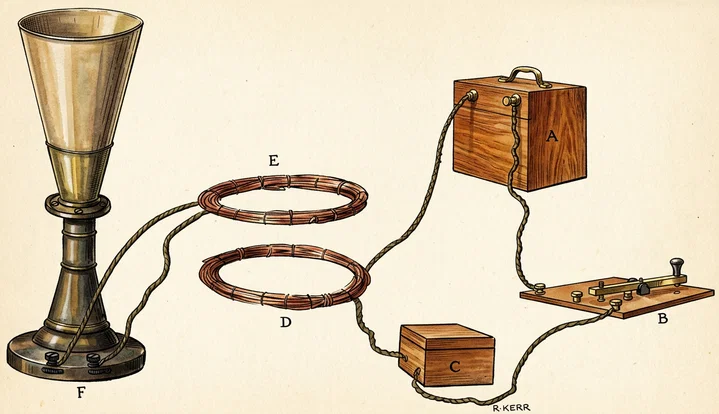
One more illustration will perhaps be sufficient to show that a current in one wire will induce one in another, though they may be separated by considerable distances. Fig. 1 illustrates the idea of induced currents handsomely. A supplies the current; B is a Morse key; C is a buzzer as used in field telegraphy; D is a roll of one hundred and fifty yards of insulated wire. All these are connected, so that when the button of the Morse key is pressed, these instruments and wires are placed in circuit. E is another roll of wire similar to the other in every respect, but not connected with it. This roll is attached to a telephone trumpet F. As the button of B is pressed, the current passes through the wire at D, and so influences the buzzer that it can be heard distinctly for quite a distance. If the buzzer should now be removed from the room, so that it would not be heard, keeping its wire connections intact, the telephone trumpet, if the coil E is held parallel to the other as in the illustration, will give forth the sound of the removed buzzer. This would not be possible if electrical waves had not been produced by coil D, in the space between the two wires, and these had not induced a current in coil E. Here in a nutshell is the principle underlying wireless telegraphy. Electrical waves of such energy are generated at the sending station that they traverse a distance of many miles, finally reaching a receiving station where they are taken up by an instrument attuned to the one that sent them out.
Instead of using, however, in wireless telegraphy the magnetic waves generated in the ether by an electric current flowing in a conductor, the electro-magnetic waves produced by disruptive discharges of static electricity are used. The idea is given by a discharge of a Leyden jar, or an electric machine that gives sparks between metal knobs. Such discharges produce electro-magnetic waves in the ether, which go on and on through space.
One of the first significant demonstrations of the existence and passing of these electric waves in space was made by Prof. Joseph Henry, of the Smithsonian Institution, Washington, D. C., who by means of disruptive spark discharges from a frictional electrostatic machine on an upper floor of his house, succeeded in magnetizing needles in the cellar thirty feet below, in spite of the two floors and ceilings intervening. The definite discovery of these radiations came much later, however, and was made in 1888 by Heinrich Hertz in Germany.
No one has yet been able to limit the distance traversed by these waves. Messages have already successfully journeyed across the Atlantic, and Mr. Marconi hopes to establish communication between England and New Zealand, a distance of ten thousand miles.
Wireless train telegraphy depends also on electro-magnetic or electrostatic induction for the transmission of signals. Special apparatus installed in the signaling station sends currents at a high rate of pulsation over wires paralleling the track along which the train moves. These impulses are transmitted to the passing train by means of either coils of wire wound lengthwise around the car, or, preferably, a metallic roof or side on the car. This metallic surface thus acts as one large plate of a condenser. The signals sent are readily received, and messages can be sent in like manner from the moving train to the parallel circuits along the track. Messages have been sent through the air in this manner between a fixed circuit and a moving train through a distance of six hundred feet.