“GET on your mark! Get set! Go!” Such is the command familiar to the ears of the sprinter. He knows that to win his race he must obey that command quickly and completely. Alacrity is the athlete’s watchword. It is because of his interest and zeal that his body grows stronger with the games.
We have been upon the athletic grounds, and let us say that we have picked our favorite athlete. Very well, the games are over, and we find our young athlete at home. But his training for the day is not yet at an end! There comes to his ears another familiar summons to the mark. To his trained ears this summons has a certain, well-defined meaning; namely, “There’s another chance to give my body some exercise.” Listen! What is that summons? Some of you may laugh when you see it in print:—
“John, some wood, please.”
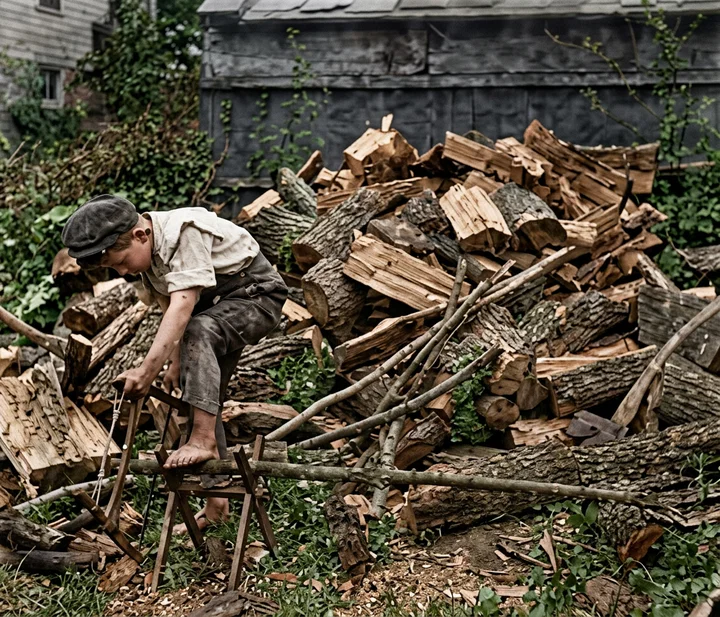
Oh, the dear voice of the starter! How different that request from the deep, gruff command of the referee on the athletic grounds. What an opportunity is offered! It’s on your mark again, John. But there is no need to tell him that. John is an athlete. He is there at the word every time.
See him now at the wood pile! He does not consider that filling the wood box is a task dreadful to think about, and horrible to accomplish. Not he! Why, here is just another exercise for his back, and one of the best known. Every time John raises the ax, the muscles in the small of his back are brought into action. Although John can not fully explain the inside workings of those muscles, he knows by the feeling back there, nevertheless, that something is taking place to awaken them and make them grow. When he raises the ax, he feels those muscles tighten, and pull, and when the ax falls, he knows they relax, as the physiologist would say. By and by a pain, more or less sharp, creeps across the small of John’s back. He straightens up, and looks about him, and lo! he beholds a pile of wood large enough to keep a fire blazing in his mother’s cook-stove for a day or more.
“Oh, my back!”
From what source came this wail? Surely not from the lips of John.
On the other side of the fence lives William, John’s neighbor. William’s people also have a wood pile.
The dusk of evening is now settling down over land and wood piles. John’s work is finished.
From the vicinity of the neighboring wood pile he has heard the wail of William. Hastily climbing to the top of the fence, he views the disconsolate one. He is curious to find out how large a pile of wood his young neighbor is able to split before he, too, begins to feel that ache in his back. But wonder of wonders! he discovers William sitting upon a chunk of wood, his ax by his side, and not a stick split!
“Hello, William! Does your back ache much?” asks John, sympathetically.
“No!” answered William with a snort.
“What’s the matter, then?”
“It ached last night.”
“Oh, that’s nothing!” laughed John. “You keep right on splitting wood and you’ll find out that you can split a lot more wood next week than you can this, without your back getting an ache in it.”
Thereupon John jumped to the ground and helped his neighbor work up as big a pile of wood as his own.
If the truth were told, you would know that William is one who dreads home tasks. On the school ground he is fairly good at play, but he is far from being a good athlete. He takes no enjoyment in the performance of useful bodily feats, such as splitting wood, or running upon errands. John, on the other hand, takes huge delight in mixing up in such affairs, for through them he finds a means of building up his body. Nor should we call John selfish; in the doing of these things he is only too glad to please others. Whether he knows it or not, John is a living definition of the word athlete.
The word athlete has been defined as one who overcomes. We have a right to extend this meaning to cover many things. Thus, we may say that an athlete is one who overcomes bodily weakness; an athlete is one who overcomes bad habits and disease; an athlete is one who overcomes a distaste for a cool sponge bath; an athlete is one who overcomes laziness; an athlete is one who overcomes a wood pile. John is an athlete!
Splitting wood is the king of sports—when you look at it from the right point of view; namely, the athlete’s. After splitting the wood suppose you try this exercise: Bend down and fill your arms with the wood which you have split; now stand erect, take a full breath, and while walking toward the wood box, maintain a good posture, holding the head and body erect, the chest well raised, and the shoulders back. Breathe strongly, filling the lungs completely at each inhalation. Advance boldly toward the wood box, and quietly deposit the wood therein. This simple exercise will tend powerfully to urge the blood into the lungs, and the blood, thereby being charged with oxygen, will flow throughout the body, quickly removing all waste products therefrom.
By the way, John, just tell them how the muscles of your arms and back fairly cry out with joy, when, on a frosty morning, you make the old pump screech in its eagerness to give up its sparkling treasure.
Some day John is going to have a workshop of his own. Already he is in possession of a small tool-chest. He has made a bench for the summer kitchen, a house for his St. Bernard, and a pair of bobs. He will tell you that hisp. 6 biceps have grown an inch since he began using a buck-saw. He has discovered that the mallet and chisel are superb developers of the muscles of the wrist and forearm.
A wonderful effect is produced upon the body by shaking a few rugs every day. Such simple exercises as beating a carpet, or raking leaves, are especially recommended. Just for variety, try pushing a lawn-mower. The body requires an all-round development, you know. Really it would be hard to find a better employment for developing a boy’s calves and thighs than lawn mowing. Do not strive to cover the whole lawn in one swathe, however. Be modest in your endeavors, and do not breathe through your mouth.
Though it is rather late in the year to talk about gardening, it is not too late to become convinced of the value of the hoe and spade as promoters of good shoulder and back muscles.
As to the matter of running errands, the aforesaid John and William have conflicting opinions. William is improving somewhat of late, but it has been his custom, when sent anywhere, to “laze” along with his head and shoulders drooping, as he kicks the pebbles, the while, from his pathway. John, on the other hand, is training his ankles for the high jump, and considers a trip to the corner grocery store as the best time to walk on tiptoe for part of the way, at least. In this way he is also developing a sturdy pair of legs.—Will Tenbrook, in the Friend for Boys and Girls.