Its Origin
“WHAT is the origin of Christmas?” asks one who has come to think the day is almost holy. “Did it not come down from Christ and the apostles?”—No, it did not. We have not even the slightest trace of it in the Scriptures. Its first mention in “Christian” literature is said by Schaff to be in Clement’s “Miscellanies,” written about A. D. 200. But Clement was a half-converted heathen philosopher. Says Neander, in speaking of the second century of the Christian era: “The idea of a birthday festival was foreign to the Christians of this period generally; they regarded the second birth as man’s true birth. . . . It was, in truth, unknown at what definite time the celebration of the remembrance of Christ’s birth should be placed, as nothing definite was ascertained respecting the date of his birth.”—Vol. I, page 301 (“Haughton and Osgood”). The simple fact is that teachers like Clement, Eusebius, and others wished to conform to heathen customs as much as possible the more easily to convert the heathen. For every heathen festival of note they invented a corresponding festival in the Christian church. For the pagan Easter festival the apostatizing church set apart a yearly day in remembrance of our Lord’s resurrection, but retained many pagan customs and the pagan name. For the day or the customs they had no Scripture. Christmas, first called “The Nativity,” was the counterpart of the great day of the Roman Saturnalia, a feast connected with the grossest sun-worship, connected with which was the giving of gifts, feasting, and revelry, and the grossest licentiousness. About December 20 the Saturnalia began, when the days were the shortest, and life in the vegetable world least manifest. Beyond that the days lengthened, the sun seemed to smile with favor upon the world, and the heathen celebrated the lengthening day with the wild orgies and indecencies of nature-worship. The giving of gifts, the Yule-tree and Yule-log, the holly berries and evergreens, are all of pagan origin, and certainly no one can deny but that the day is frequently kept in a purely pagan spirit, ministering only to selfish pleasure.
Not Born on that Day
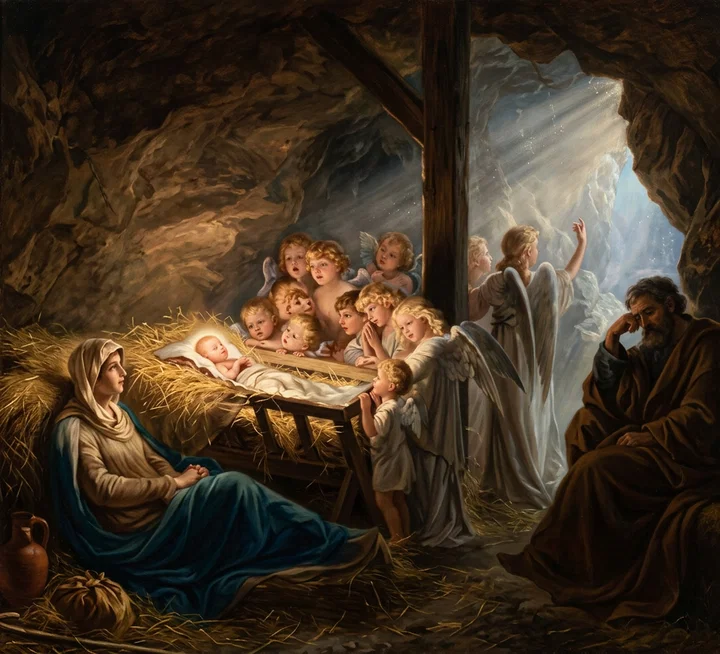
In the first place, Jesus was not born on December 25. This is shown from two facts: (1) The shepherds were watching their flocks in the field (Luke 2:8), which they would not have been doing in the cold days of midwinter; (2) the ministry of Jesus lasted three and one-half years. Dan. 9:25-27. He began his public ministry according to the law when thirty years of age. Luke 3:23. He was crucified at the last passover he attended, in A. D. 31. See Matthew 27, and “Hale’s Chronology,” Vol. I, pages 69, 70; Vol. III, page 230. He therefore began his ministry six months before the first passover he attended. John 2:13. At this time he was thirty years of age. The passover occurred probably about the last of March in the month Abib. Six months previous to this would be at that season of the year indicated by the month Tisri, probably in our September. Christ came in “the fulness of the time,” not only as regards the time of the ages, but the time of the year. His birth was in the season of fruitage, and he the most precious fruit of the earth.—M. C. Wilcox.