BETHLEHEM EPHRATAH, which was once “little to be among the thousands of Judah,” has grown until it is now one of the largest and most prosperous Christian villages in all Palestine.
In that land there is much that is unclean and unhealthful, poor and degrading; and many sites that should be hallowed by the most sacred memories have been profaned by the hands of idolatry and oppression. Bethlehem and Nazareth have not escaped; yet these two have somehow kept a peculiar beauty and dignity; and, indeed, it seems most fitting that the place where our Lord was born, and the place where he made his earthly home, should maintain a certain pre-eminence among the cities of Judea and of Galilee.
A good walker could go from Jerusalem to Bethlehem in a little more than an hour; but it is more pleasant to stroll along leisurely, studying the other wayfarers, and stopping now and then to admire some rugged old olive-tree or to watch the changing colors on the distant hills. As soon as we are fairly started down the Hebron road, we begin to pass little companies of men and women who are coming up from Bethlehem to the holy city with their merchandise.
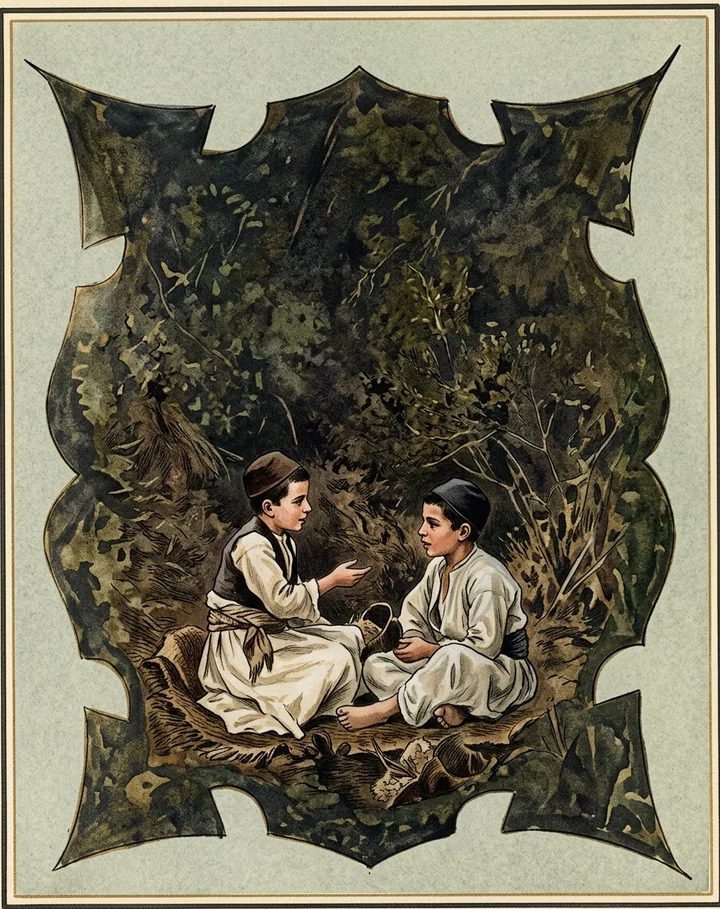
There is a striking difference between the appearance of these people and that of the inhabitants of northern Judea; a difference not only in dress, but in feature. The men wear large yellow turbans, and have full lips, long noses, and high, sloping foreheads, so that they fit in very closely with our common idea of the Hebrew type. The boys we meet are frank and independent, tramping merrily along at the rate of four miles an hour, with little caps on their heads, their one loose garment tucked up into the leather belt, and the brown, bare legs ending in tremendous slippers, which flop clumsily with every step.
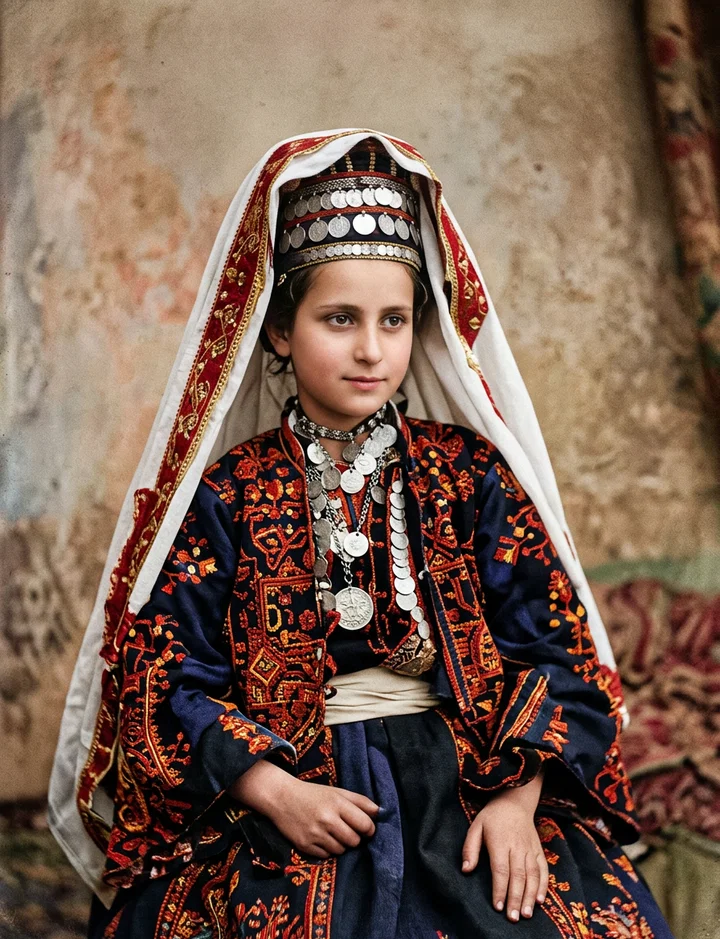
The women of Bethlehem are known throughout Syria by their peculiar head-dress. They wear a high fez on their heads, and over this is thrown an immense white kerchief or veil, which falls behind the shoulders, and often reaches below the waist. Seen from behind, the Bethlemite woman is a square of blue skirt, topped by a tall triangle of white; from the front she looks like a nun of some unfamiliar order. It is a singular costume, but you soon come to like it; and, when the clean, white head-dress is seen in the distance, it is pleasant to be able to recognize its wearer as a woman of Bethlehem.
Half-way along the road from Jerusalem is the little white dome of the tomb of Rachel, beautiful, warm-hearted, impulsive Rachel, wooed seven years, and then seven years again, but at last dying by the roadside and buried here alone, while more fortunate Leah rests beside Abraham and Isaac and beloved Jacob in the cave of Machpelah, twenty miles away. It was somewhere in the fields of corn, pumpkins, squashes, other vegetables, that the Moabitess gleaned for Boaz; and long centuries later it was here in the village khan that womanhood received its highest honor.
As we passed one little company after another, we could not help looking rather closely to see just what kind of women these were who were coming out from the town of Ruth and of Mary. Many of the Bethlehem women are handsome; not with the rich, voluptuous beauty which is usually associated with the East, but with a matronly dignity which appeals more strongly to our Western eyes.
A prosperous self-respect seems characteristic of everything belonging to Bethlehem. The old Hebrews called it Beth Lahm, “The House of Bread;” and its modern Arabic name is no less significant—Beit Lahm, “The House of Meat.” The soil takes on a greater fertility as Jerusalem is left farther and farther behind; but you are hardly prepared for the beautiful greenness that is seen when a sudden turn of the road brings into view the two large Christian villages of Beit Jala and Beit Lahm. One is on a hill to the right of the Hebron road; the other is on a hill to the left; and they both look very clean and white and prosperous, in the midst of their vineyards and olive orchards.
Bethlehem is the larger of the two, and it seems to be still growing; for we found some of its streets almost impassable because of the piles of stone and lumber for the new buildings. The inhabitants number eight or nine thousand, nearly all of whom are nominal adherents of one or other of the Oriental Catholic churches.
One of the most beautiful things in Bethlehem is the church of the German Mission, which is built on a slight elevation in the center of the town, so that its tall white steeple can be seen for miles around. They call it the “Christmas Church.”
The Church of the Nativity is built like a fort, with thick stone walls; and, for fear of the Moslems, the entrance is by a narrow door, so low that one must stoop in passing through. Yet just inside the door are the quarters of a company of Turkish soldiers! It seems strange that these should be allowed within a church; but there is a very good reason for their presence here.
A wall has been built across the middle of the interior, and the nave is simple to the point of barrenness. To the right a door leads to the monastery of the Armenians; to the left is the church of the Franciscans; behind the partition the transepts and choir are mostly under the control of the Greek Church. Here there is no bareness, but an oppressiveness of ornamentation. Bright-colored pictures are on the walls; lamps of gold and silver hang from the ceiling, and tawdry tinsel decorations glitter everywhere.
At each side of the altar a staircase descends to the caves below. There is quite a series of natural caverns here. In one St. Jerome lived; in another he is buried; and in a third is the tomb of St. Eusebius. In other chambers the monks point out the exact spot where Christ was laid in the manger, where the worshiping Magi stood, where a spring miraculously gushed forth from the rocks for the use of the holy family, where the angel appeared and commanded Joseph to go down into Egypt, and where Herod massacred a number of children who had been brought here for refuge. The largest cave is about forty feet long; and at one end there is let into the pavement a silver star, and the inscription, “Hic de Virgine Maria Jesus Christus Natus Est.”
If the inscription is true, this is one of the most sacred spots on earth. The star is in a tiny recess, and above it is an altar, very small, but very richly furnished. The floor of the cavern is of marble; over its walls are marble and rich tapestry, and priceless lamps swing here and there; yet, on coming from the bright transepts above, the first impression is one of deep gloom. The low ceiling can hardly be distinguished, and the back of the cave is lost in impenetrable darkness. The smoking lamps give to the atmosphere a heavy, reddish color. The chanting of the priests in the choir above is heard only as a dull murmur.
We are the only visitors to-day, except that in front of the little altar, there kneel four French nuns, great tears rolling down their pallid faces as they pray in a frightened whisper.
Our eyes are now growing accustomed to the subdued light, and off in one corner of the cave, where the gloom is deepest, a form is slowly coming into view. Dark, indistinct, immovable; it would be possible for a worshiper to come and go, and never see that shape at the end of the altar; but by day and by night it is always there—the Moslem guardian of the Silver Star. This is why there is a garrison in the church above. The soldier is half-fed and paid not at all, and his blue uniform is ragged and dirty; but a modern repeating rifle is in his hand as he stands there by the hour without moving a muscle, yet ready at the word of command to fight like a Spartan at Thermopylae.
He needs to be brave; for, when the Christmas season comes around, Bethlehem is thronged with worshipers. They rush down the narrow stairways that lead to the little cave, and there they crowd and curse and fight for a glimpse of thep. 3 Silver Star, so that sometimes the air grows foul, and the lamps burn even more dimly, while women faint, and strong men fall down, and are trampled to death in the horrible confusion.
And quiet does not come with the passing of Christmas-tide; but through all the year the priests from the convents above quarrel over the possession of the little shrine, and open warfare is not uncommon. Then the rival parties snarl and scratch; they seize heavy lamps and holy candlesticks from the altar, and priestly garments are torn, and priestly heads are broken, until the soldiers of the Turkish garrison come down and club the unruly ones into submission.
We turned in sadness of heart to shake the dust of Bethlehem from our feet. Up out of the cave and out of the transept we hastened; but then we took the wrong door, and found ourselves in the church of the Franciscans, which lies under the same roof. It was the time of the vesper service, and among the shadows of the unlighted nave there stretched long lines of kneeling women. They were all natives of Bethlehem, with the tall white head-dress whose spotless cleanness is in such contrast to the costumes of most Syrian villagers.
It was a service of song, and every woman seemed to be taking part. After the officiating priest had chanted the brief stanza, the loud chorus was taken up by the full volume of women’s sweet voices. As the light died away, and the white-veiled forms of the kneeling women grew indistinct and dreamlike, the music of the oft-repeated chorus sank into our hearts; and we stayed on and on until our indignation against the sham and idolatry in the caves below had been driven away, and there remained only the Bethlehem calm.—Lewis Gaston Leary.