PURE RELIGION

3%

S. D. A. Publishing Association · Battle Creek, Mich. · Oct 22, 1890

FromThe Youth’s Instructor, Vol. 38, No. 43.

Read the full edition

PURE RELIGION.

“I wonder why Mrs. Peters doesn’t come,” said Ethel Brown, looking out of the window. “Here it is eight o’clock, and the clothes are soaking. She never disappointed us before. But if she don’t come, I expect I would better go at the washing myself.”
“I think you will have to, if you expect to get the clothes out,” said Ethel’s sister Mary; “for Willie told me that Johnnie Peters had broken his arm, and of course Mrs. Peters will have to stay at home to nurse him.”
“I wonder if that is the case,” said Ethel. “Willie, come here. Are you sure that Johnnie Peters has broken his arm?”
“Yes, ma’am,” said Willie; “I was over on the common yesterday, and the boys were playing round the livery stable, and Johnnie got knocked down from a high fence, and he fainted away, and the livery man carried him home in his buggy.”
“Poor little boy!” said Ethel, “and poor Mrs. Peters! How much trouble there is in this world! Well, we must hurry and get the washing out, and then, Willie, if you will show me the way, we’ll go over and see Mrs. Peters. Perhaps we can do something to help or comfort her.”
“Dear me,” said Ethel’s aunt, who was visiting them from New York, “why don’t you give up your whole time to looking after washer-women and ragamuffins? No doubt the woman has plenty of friends of her own kind who will do everything for her that she needs. I would not make myself so common, if I were you, Ethel Brown. For my part, I think it very much to her discredit that she didn’t send you word that she couldn’t come, or supply somebody to fill her place. I want you to go with me this afternoon to call on my wealthy friend on the south side. I can tell you friendship with her will be a great advantage to you, Ethel, for she can introduce you to the very best society; so of course you will have to put off visiting your washer-woman to-day.”
Ethel’s aunt swept out of the room with an air that seemed to say, “There, that is settled,” and Ethel gazed after her with a look of pain and surprise. Strange thoughts went through her mind, something like this:—
“Is that my dear dead mother’s sister? How differently she feels and talks from my mother.”
It had only been a few months since Ethel’s mother had been laid in the grave. She was the oldest of the family, and had been nurse and housekeeper, and her young heart had learned to bear sorrow and care. Her face, though young and sweet, wore a shadow that told of those long days of watching and weariness. But Ethel would not have taken anything for her experience, and though it had been. What precious words she had heard her mother speak! What a loving, unselfish spirit she had seen her manifest! What patience in suffering! what faith in trial! what triumph in death! It was in her sick-room she had read the precious words about Jesus and his love for all men,—how there was no difference in his eyes; how he was no respecter of persons, but identified himself with the low and the weak and the sorrowing; and as Ethel had often carried out her mother’s wishes in giving to the poor, in sending messages of comfort to the mourning, she, too, had learned to delight in doing good to all who came within her reach.
Still Ethel thought of her aunt’s words, and wondered if she could put off her visit to Mrs. Peters, and visit the rich friend on the south side.
“I don’t care much about going,” said Ethel, “but I would like to please aunt. Mary can go, though, just as well as I. That friend on the south side does not need me half as much as poor Mrs. Peters, and I have no doubts about her having so many friends. Poor people don’t usually have any too many. Besides I would feel very strange to go over to that rich lady’s simply to have her get me into fashionable society, and I won’t do it. I hate toadyism,” she concluded, giving the towel a vigorous rub.
“What are you grumbling about?” asked Mary, coming into the kitchen.
“O, I was just saying I hated toadyism, and I was thinking about what pure religion is.”
“Ethel, you are always putting the strangest things together. Well, what is pure religion?”
“I’m sure it isn’t visiting a rich woman for the sake of having her influence to help you into society, and for me to-day I think it is to visit the widow and the fatherless in their affliction, and to keep myself unspotted from the world.”
“O you cranky thing! and you won’t go with aunt to the south side? Well, I’ll go; for I want to see her velvet carpets and gorgeous things, and I haven’t any conscience about the widow and the fatherless when you have such a burden for them.”
At noon the washing was out. Ethel was tired, but Mary got dinner ready, and Willie and auntie came in from the store with appreciative appetites, and the question of the afternoon’s doing was decided.
“Whoever goes with me to the south side this afternoon will have no cause for sorrow. I saw a handsome piece of goods this morning that somebody is going to get for a present.”
Auntie looked at Ethel smilingly, but it did not seem to influence her; so at about half-past one auntie and Mary took the hack for the south side, while Ethel and Willie trudged away on foot toward the tenement houses of the poor.
All along the way Ethel saw much that was sad. Saloons were open, drunken men were reeling on the streets, dirty children playing in the alleys, and forlorn-looking women walking along, some carrying heavy burdens, and some wearing cheap finery, and smiling with a smile that made Ethel feel sad.
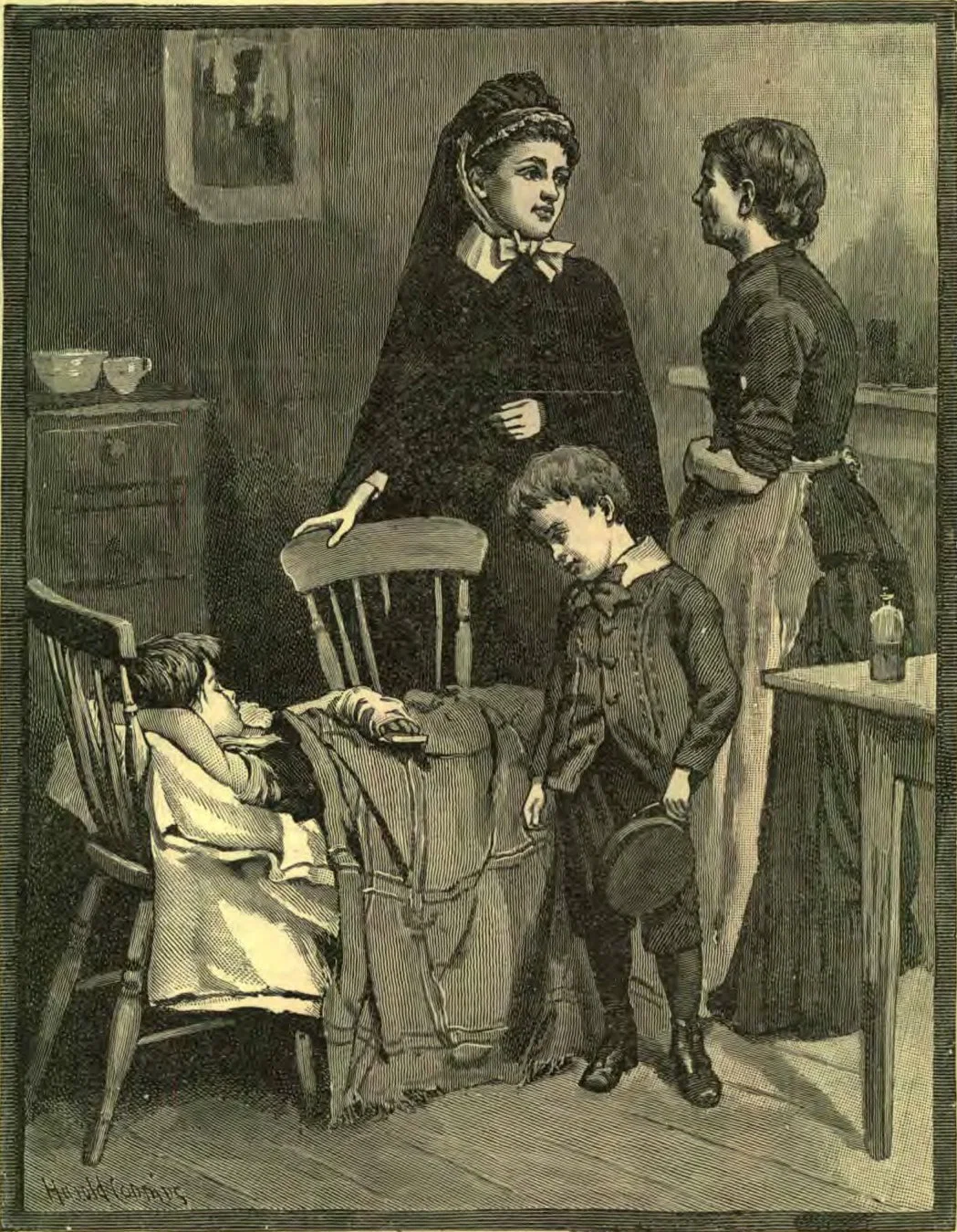
By and by they reached Mrs. Peters’s house. They had to climb up some rickety, dark stairs, and feel around for the door, and when they got in, they saw that Mrs. Peters was very poor. Her little room looked cheerless indeed. In the middle of the room lay Johnnie, on a couple of chairs with a board across them, and some pillows under him, and his poor, broken arm lay on an old shawl that was spread over him.
As Ethel clasped Mrs. Peters’s hand, and said, “I am so sorry for you!” the tears filled Mrs. Peters’s eyes, and rolled down her cheeks. She didn’t have another chair to offer to Ethel and Willie, but Ethel said she would just as soon stand up, and would not mind it.
Mrs. Peters told her all about the accident to Johnnie, and then said, “And now, Miss Ethel, the Lord only knows what will become of us. It’s taken every cent I had raked and scraped together to pay the doctor. I’ve got nothing but my two hands to support me. My husband is dead, and he’d better be dead than living as long as the saloon stares us in the face. If it wasn’t for Johnnie, I would have given up heart long ago, but I want to see him reared up a decent man. Indeed, Miss Ethel, do you think there is a God? And if there is, does he care a bit for us poor creatures that have to live in tenement houses?”
Mrs. Peters’s face looked hard and sad, until Ethel put her arm around her, and began to weep.
Ethel prayed in her heart for words to speak to this poor heart that was weary, and the words came.
They were so full of faith and tenderness that Mrs. Peters’s heart was melted, and the women seemed like two sisters as they wept together.
“Don’t doubt God, dear heart,” said Ethel. “I have had sorrow, too, but it has only worked my good. God wants to save us, and sometimes he has to take just this way. Don’t you know, ‘whom the Lord loveth, he chasteneth’? God does love you. He gave his only begotten Son to die for you, and our great High-priest in heaven is touched with the feeling of our infirmities. He says that not a sparrow falls to the ground without his notice, and that you are of more value than many sparrows. Be brave. It won’t be long, any way, till Jesus will come; for he is coming soon, and then we’ll reach that land where there’ll be no more sorrow.”
“O how sweet that is, Miss Ethel! It sounds just like your dear mother. And I do believe God sent you to-day; for it seemed as if my heart would break.”
Ethel put some money into her friend’s hand as she started away.
“It’s only the wash money for to-day, and I earned it for you. I only wish it were a hundred times more. I am coming back before night.” Ethel kissed Johnnie, and Willie gave him a handful of marbles as he went away.
How glad Ethel’s heart felt as she tripped along the alley, smiling at the children, and speaking to the dogs.
“It seems as though I love everybody in the world,” said Ethel. “I don’t feel a bit tired, but I am just as fresh as a daisy. Now, Willie, what can we get together to make that house more homelike, and Johnnie and Mrs. Peters more comfortable?”
Ethel and Willie thought of a number of things they could spare, and you would have thought them very happy if you could have heard them singing and laughing as they took down a few pictures from their bed-room walls, and packed up some dishes, mats, bedding, and household furniture. Willie got a drayman, and Ethel found strength to go back to the tenement house to see that everything was made cosy for her friends.
Mrs. Peters and Johnnie looked so happy, and thanked her again and again; but Ethel said it was God’s dear love, and no praise belonged to her, but to him.
Ethel went home again in time to get supper for her father, and when she told him all about Mrs. Peters, he gave her a five-dollar bill for her.
When auntie and Mary came home, Ethel was singing and playing.
“You seem happy,” said Mary, “but I guess you’ll get over it when you see my beautiful new dress, and hear that I’m invited to the Atherton’s next party.”
Mary displayed her dress, and Ethel said it certainly was a beauty, but that she knew she was happier than Mary could be; for she had read in the Book of God that it is “more blessed to give than to receive.” FANNIE BOLTON.