ROUND THE WORLD.—33

6%

S. D. A. Publishing Association · Battle Creek, Mich. · Oct 29, 1890

FromThe Youth’s Instructor, Vol. 38, No. 44.

Read the full edition

ROUND THE WORLD.—33.

THE PARSEES.

It is a proverb among travelers that when Arctic explorers discover the North Pole, they will find a Scotchman sitting on top, waving aloft the flag of his country. This adage has arisen from the peculiar propensity of that nation to be found always on the frontier of unsettled territories, battling with the savages, and establishing law and civilization. They are the bona fide pioneers of the British nation. To this adage an Anglo-Indian will invariably add another, “And also a Parsee’s shop.” One might properly designate the Parsees as a race of store-keepers. They do not seem to turn their attention very much to the practice of law, or to becoming physicians, but as a rule enter business as merchants, traders, etc. They are keen in business, but, taken together, are perhaps at the same time more honest than any other race on earth.
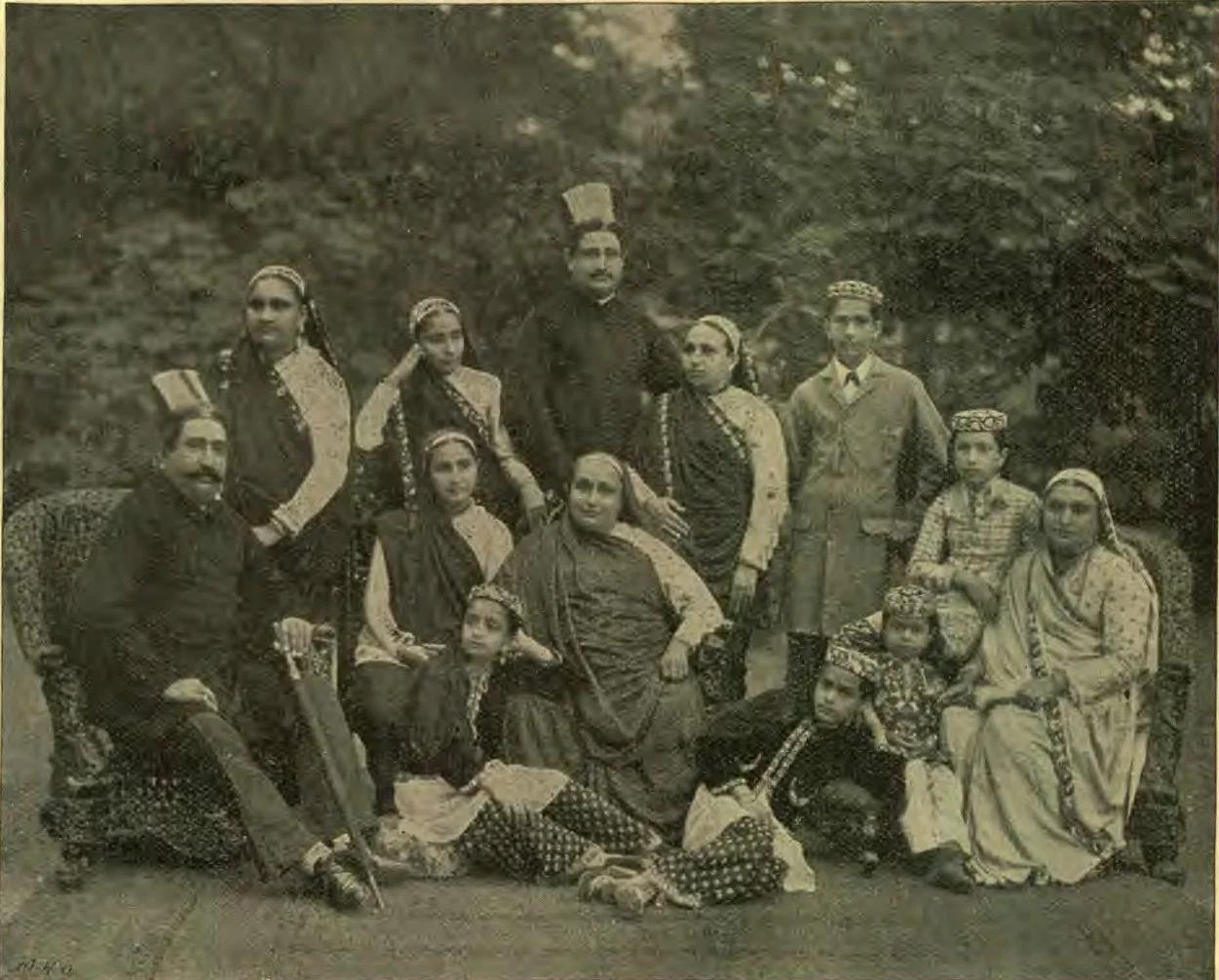
PARSEE GROUP.
PARSEE GROUP.
The native population in Bombay is numbered at between one and two million, and the British at about fifteen thousand, but the Parsees attract the most attention from the visitor. The more their history is studied, the more interesting they become.
Their former home was in Persia, and the founder of the religion which they profess was named Zoroaster, who lived contemporaneously with Confucius, the great Chinese philosopher. After the battle of Thermopylæ, the Persian Empire began to decline, till at last their armies suffered disastrous defeat at the battle of Arbela, in 331 B. C. After this the Mohammedans began to persecute the followers of Zoroaster, slaying them by the thousands. They were indeed given their choice as to whether they would turn Mohammedan or suffer death. Many relinquished their faith, but others preferred to sacrifice their lives rather than to deny the religion they held so dear.
They remained in their native land for a considerable time, but little by little it became evident to them that, in order to exist as a people, it would be necessary for them to go elsewhere. Accordingly, in the year 600 A. D., the remnant of the Parsee people, consisting of about 12,000 souls, men, women, and children, left their native land in small sailing ships for India. The voyage was stormy, and their ships badly foundered, so that six hundred were drowned en route during a gale which wrecked several of the fleet. The remainder finally landed at Sangar, on the western coast of India, and there made a treaty with the Hindoo king. The chief stipulations of this treaty were that,—
  1. They must assist him in time of war.
  2. That they were not to eat beef or pork.
  3. On occasions of marriage or death they were to give alms to the Brahmins.
  4. They were never to take part in any discussion concerning the Hindoo religion.
Shortly after this treaty was effected, four hundred of them were killed while fighting for the Hindoo monarch. This left only two hundred, of whom only ten were women. Tradition says that some of the men intermarried with the Hindoos, and so influenced their wives that they forsook the faith of their fathers, and became devout Parsees.
When a Parsee dies, it is one of the tenets of their creed that his body must remain exposed to the rays of the sun, without touching the soil, or he cannot go to heaven. The outcome of this belief is the “towers of silence,” which were represented in the cut accompanying the last article. At Bombay they are large circular buildings, situated on rising ground. One doorway about half-way up leads into them, and on a level with this inside is a stone floor sloping inwards toward a large hole in the center, from the bottom of which are pipes leading to the sea. On that part of the floor next the outer wall, the corpses of the men are laid, without any coffin, next below them those of the women, and nearest the center the little children. Little drains cut into the stone divide up the whole space into lots just large enough to contain one body. No sooner have the bearers left the towers than the vultures, who are ever to be seen sitting on the wall, come down and pick the flesh till nothing remains but the bones, which are washed down into the well in the center by the rains, and carried off to sea. Thus the tower is being continually rid of the dead, so that other bodies can be put in their places.
They believe in one God as the Creator and all-powerful being, but have no faith in Christ as the world’s Redeemer. Formerly there were twenty-one books setting forth the doctrines of their religion, but at present there is only one, as all the others were burned by the Arabs. No Europeans are permitted to enter their temples, where fire is kept ever burning on the altar. It is frequently stated that they are worshipers of the sun, moon, stars, and water, but this they deny. They say that the sun, moon, stars, sea, etc., are the greatest of God’s creative works, and that when they stand with their faces toward any of them, it is that their minds may be called away from the little things in their own lives to the magnitude of the power of God.
Many times in the evening I have watched them coming down to the sea-shore to pray. They come, men and women, and stand facing the mighty ocean, with their eyes upturned to the sky, praying frequently for half an hour at a time. But before commencing their adorations and supplications, a very curious ceremony is performed. Around the waist every Parsee has a cord, called the “Kusti.” This is made of pure white lamb’s wool, and is composed of seventy-two distinct strands, denoting seventy-two doctrines of religion, while the material and color signify the character of the people professing such a religion.
Their morality and uprightness in deal exceed that of the English-speaking races. Nearly all of them are wealthy. The national love existing between them is very strong, and they never allow one of their own name to come to want. They support a large number of hospitals, homes for the friendless, and other kindred institutions. As a rule, they are well educated, not only speaking their own language, but also English and Hindoo. They mix but little with Europeans except on business, and neither race knows much of the domestic life of the other. To become the theme of public comment or conversation they especially abhor, and it was with difficulty that I obtained the accompanying photograph, as they absolutely forbid the artists to sell their pictures to outsiders. They always marry among themselves, and consider it a disgrace to do otherwise.
Their dress, especially the hats of the men, is peculiar, as will be noticed in the cut. These have something the appearance of what is known in America as a plug hat, with the back sliced obliquely off. The legend is that many years ago one of their high priests was attacked, the would-be murderer making a vigorous blow at the skull. But as soon as the sword struck the hat worn by the priest, it glanced, and instead of cleaving the head, merely cut off the back of the hat.
The gospel of Christ has made little headway among the Parsees, who now number about 100,000 in India. They say that they do not see that the lives of those professing Christianity are as moral or as upright as those of their own people, and therefore they see no need of forsaking the doctrines of Zoroaster and accepting those of the Christian’s Bible. The basis of their reasoning is only too true. Those who profess the name of Christ, who fight, or profess to fight, beneath the blood-stained banner of Calvary, need to have their lives molded more closely after that of the Great Pattern, ere they can hope to convert such a people as the Parsees. This thought should stimulate all who really love their Savior to let their light shine that others may see their good works, and glorify their Father which is in heaven.
P. T. M.