ROUND THE WORLD.—34

5%

S. D. A. Publishing Association · Battle Creek, Mich. · Nov 5, 1890

FromThe Youth’s Instructor, Vol. 38, No. 45.

Read the full edition
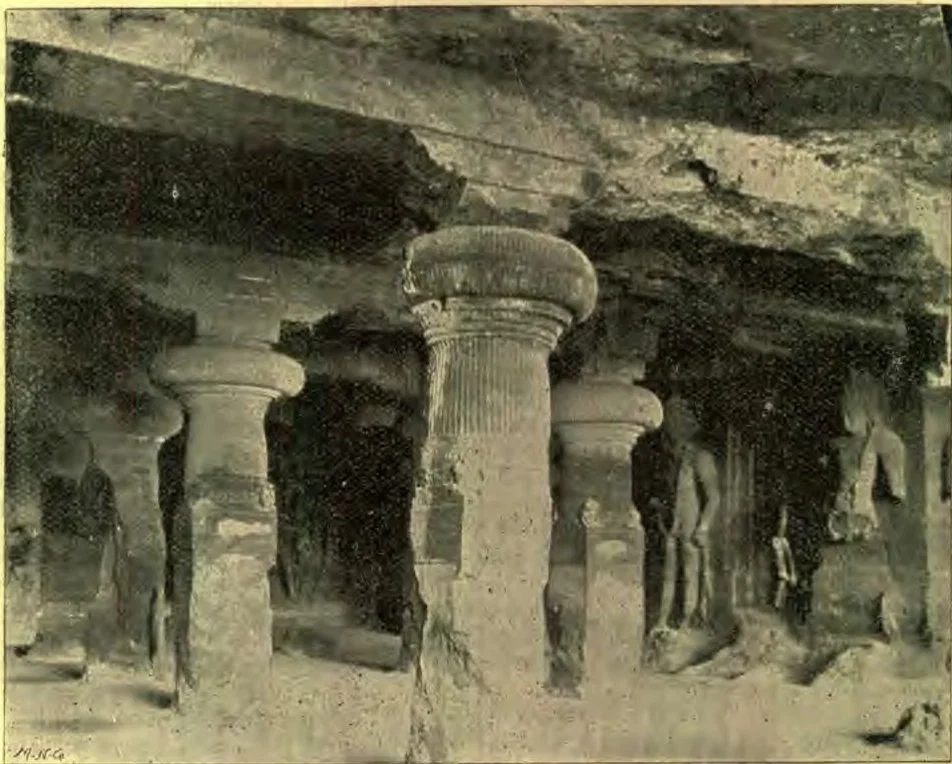
ELEPHANTA CAVES.
ELEPHANTA CAVES.

ROUND THE WORLD.—34.

BOMBAY TO HONG KONG.

At last the time for our sojourn in India is over. The visit had been intensely interesting, but time flies; we are getting anxious to see home again, and feel that we must speed upon our way. So the tenth of April finds us waiting upon the Apollo Bunder for the steam launch which is to take passengers for the steamship Rohilla. After a delay of nearly two hours, she arrived alongside, and all went aboard, while coolies carried on the baggage. The heat was intense, and we longed for the time when we would be away from the shelter of land, and get some of the breeze which we knew must be blowing, by the fluttering of the many flags floating from the halyards of the men-of-war in honor of the arrival of the new governor of Bombay. At last we were off, and oh, it was so delightful! In the cool air, it seemed almost like being in paradise, after the stifling heat we had been subjected to.
The harbor is nearly landlocked, and its area may be estimated at nearly fifty square miles. It is rendered very picturesque by the islands of Karanga, Butcher’s Island, and Elephanta. On the latter are some famous caves. Like many other rock excavations in India, they were originally used as temples. The island is composed of two long hills, with a narrow valley between them, richly covered with trees and plants. About two hundred yards to the right of the landing-place is a clumsy figure cut out of an insulated black rock, now very much defaced. A stone path, with steps, leads up to the temple, which is nearly half a mile from the landing-place. The entrance is supported by two ponderous figures and two pilasters, forming the openings, under a steep rock overhung by brushwood. The great temple is 133 feet broad, 130½ feet long, and 20 feet high. The roof is supported by ranges of massive pillars, with ornamental capitals of various designs, all hewn out of the solid rock. Opposite the entrance is a gigantic bust, with three heads, supposed to represent the Hindoo trinity. There are numerous other carved figures and shrines, and two smaller temples, one on each side of the larger one.
The period and authors of these extraordinary works are unknown, but there seems no ground for assigning them to a very remote antiquity, as the stone is of a soft and moldering nature, and has sustained great injury even during the short time that it has been known to Europeans. Little streams trickle over the floors, in which huge frogs or toads enjoy an easy life. The Fakirs permit no harm to come to them, for they are sacred; and woe to the European who ventures to expel them from the path with his toe!
As the golden sun is setting, the order, “Up anchor!” sounds from the bridge. The “tale-teller” rings out merrily, and its indicator stops at “Stand by, ahead!” It has also recorded the same in the engine-room, and we know that the engineer on watch is now at his post, one hand grasping the lever by which he can move the great leviathan ahead or astern, at half speed or full, as the order may be; with the other he is ready to “log” the next command and the time; for everything moves like well-ordered clock-work at sea. Soon the ringing is heard again, and this time it is for “Full speed, ahead,” and we are standing out to sea. The shades of night draw on, and the shores of India become dim, and are lost in the gathering darkness.
Of all the companies whose vessels brave the ocean, there is none with a more world-wide reputation, or who send better ships to battle with the elements on the deep, than the Peninsular and Oriental. Their motto, “Quis separabit” (Who shall separate us?), is an appropriate one; for they are like great floating iron links joining the mother of colonies to her children. The uniform of these ships is black, with a white line beneath the gunwale, while their house flag is made up of four triangles, one red, one blue, one yellow, and one white. They are built for safety and comfort. The Rohilla was manned by Lascar sailors. They are natives of India, and their trade is the sea. But they are never intrusted with the positions of greatest importance. An English seaman always stands at the wheel, watching the compass before him, and keeping the vessel’s head on to her course.
We had a pleasant company on board, and the calmness of the water seemed only to be outdone by that of the blue sky above. The weather was very warm, but soft, crisping breezes were blowing, which made it pleasant on the spar deck.
At night the scene was novel; cabins and bunks were deserted, and mattresses and robes were spread out on the weather side of the hurricane deck. Every one seemed anxious to secure a good, breezy place. Some were stowed away behind the wheel-house, where there was a through draft, others aft of the signal guns, and still others forward under the main bridge by the nettings, where they would be sure to get all the wind there was blowing. Sometimes they got too much, and a little salt water mingled with it. But nobody minds salt water on deck, although he does object to it in the state-room, whither it sometimes comes, and sends all one’s clothes and possessions floating about the floor, while polite stewards tender the welcome (?) piece of information that you will have to take a bunk in the saloon for that night. Your things are sure to be destroyed, and you feel very happy generally.
But these were beautiful nights, and every one was happy, delighted at the prospect of a “cool sleep.” It was a treat, after city hotels and stuffy country bungalows, to slumber beneath the star-lit canopy of heaven. There is not the din and rattle of carriages and drays hurrying to and fro in the crowded streets, or the screech of the steam whistle announcing the arrival or departure of trains; nothing but the throb of the great vessel’s heart, the engines, as the cylinders move restlessly up and down, each pulsation giving the propeller another revolution, and driving us farther on our way. In the bows stand a Lascar sailor and a quartermaster, keeping watch for other craft, and every half-hour, when the bell rings, the lusty “Coup deeta Hai” (I am keeping a bright look-out) resounds down decks from fore to aft. The voice has hardly died away upon the breeze, when in deep bass the quartermaster by his side is heard, “The light is shining brightly, sir, and all’s well.” Then back to him from the officer on the bridge floats the answer, “All’s well.” Then all is silent once more, save for the throb of the engine and the rippling of the waters, as the great iron mass speeds on her way through the darkness.
On the evening of the third day, the sailors declare that they smell cinnamon, and that the “Pearl of the Seas,” Ceylon, must be near. We awake in the night to find that the sailors are paying out the cables, and making fast to the buoy. Other lights are shining around us, and we gradually arouse to the fact that we are within the breakwater at Colombo, Ceylon.
We took a run ashore while the Rohilla was discharging cargo, which kept her till noon. The town is situated on a peninsula, surrounded on three sides by the sea, and having a moat with draw-bridges on the land side. The view from the water is exceedingly picturesque. From the beach the land is fringed with cocoanut trees, and the country behind is well wooded. The city looks old and dilapidated. One would think that its founder had taken a bucket of water and spilled it on the ground, and according to what courses the little rivulets had taken in the mud, had laid out the streets; for they run in every direction, without any attempt at order. Colombo has a population of 111,942, but they appear to be a sleepy lot.
Soon we are out to sea again, and steaming across the mouth of the Bay of Bengal for Penang on the west coast of the Malay Peninsula. Only two hours, and we are off again, running down the Malacca Straits to Singapore. This is a large English settlement, and is situated in latitude 1° 17′ north of the equator.
There is a dense growth of tropical vegetation, and the climate is very damp. It was here we had our first glimpse of John Chinaman in his native costume, for of late years the Celestials have flocked in great numbers to Singapore.
The residences of the gentry are very fine, and bespeak comfort and wealth, while the public gardens almost fill the mind’s vision of Eden itself. We passed through forests of huge bamboo, which the Chinese manufacture into almost every conceivable article of furniture.
A fruit known as the durin grows in large quantities at Singapore. It has a delicious flavor, but a most offensive odor, so much so that the legend is afloat that it cannot be eaten unless the one who would relish it first decorates his nose with a clothes-pin, so as to imprison the sense of smell.
After a run of five days more, we reach Hong Kong. The weather held fair till the last morning, when the sea commenced to run high, and, as “Jack” expresses it, the rain came down in lumps. It was a great change after having passed only a few days before directly under the sun, and being for the third time in our life without a shadow at midday. The thermometer fell to about 60°, and all commenced to shiver. Higher and higher rose the huge green seas, many of them breaking over the forecastle, and washing down the decks. Many of the passengers seemed suddenly to awake to the fact that they had not yet paid a tribute to the fish in whose domain they had been trespassing so long, and hastened to the side or below, to render homage, and pay their dues. But the rest of us enjoyed old Neptune’s anger, and paddled about the slippery decks, watching for land.
At last it hove in sight, and we entered the roadstead which forms the Hong Kong harbor. Mountains, enveloped in a thick mist, rose majestically on either side, but so heavy was the fog that the signal staff was hidden.
The Rohilla carried the mails, and so must announce their arrival by firing a cannon. The signal gun was loaded, and made ready, and the captain from the bridge gave the order to fire. In true sailor style, bare feet, and pants tucked up to the knees, the gunner seized his lanyard, and gave a vigorous tug. But the knot holding it to the trigger gave way without igniting the fuse, and more than this, the shock was too great for the gunner’s equilibrium, and over he went, measuring his length on the wet deck, amid a roar of laughter. He however picked himself up bravely, and tried his luck again, this time with good success, as the gun went off with a loud report, sending a cotton projectile just astern of the steam launch which had now come alongside.
The harbor is filled with junks, and sandpans, and Chinamen. It is stated that thousands of the last make their homes on the water, eating, drinking, and sleeping in the little cabins of their boats. Mariners say that if it were not that a big cyclone comes now and then and drowns a few thousand of them, the harbor would be overrun. The sandpans crowd around the Rohilla like a swarm of bees, their crews hooking on their bamboo poles and trying to board. The police launch was ordered to make them sheer off, which it did by running its iron bow’s head onto them; it almost seemed as if some must sink, but they cleared wonderfully quick. By this time we are wharfed, and now it is “Shore once more.” P. T. M.