WHATEVER they may know about them now, people used to hold very queer notions concerning Niagara Falls. I read not long ago, in an ancient geography, that the waters of the Great Lakes here plunged over a precipice nearly 800 feet high, with a roar that could be heard at a distance of twenty leagues. Somewhere else I read that the rocky face over which the waters fell was wearing away at the rate of a foot in a year. As a small boy, I was greatly troubled by this statement, and feared that the great Falls would have worn their way back to Lake Erie, and become ordinary rapids, before I had a chance to see them. This fear was only dispelled when I learned that, as they were twenty-two miles from Lake Erie, they could not reach it, even at the rapid rate of a foot a year, under 116,000 years.
Now it is scientifically estimated that the rock is only worn away at the rate of half an inch in every five years. If any of you young people care to work out the problem thus suggested, you will become convinced that there is plenty of time left in which to see Niagara Falls before they disappear in Lake Erie. The answer is almost fourteen millions of years, is it not?
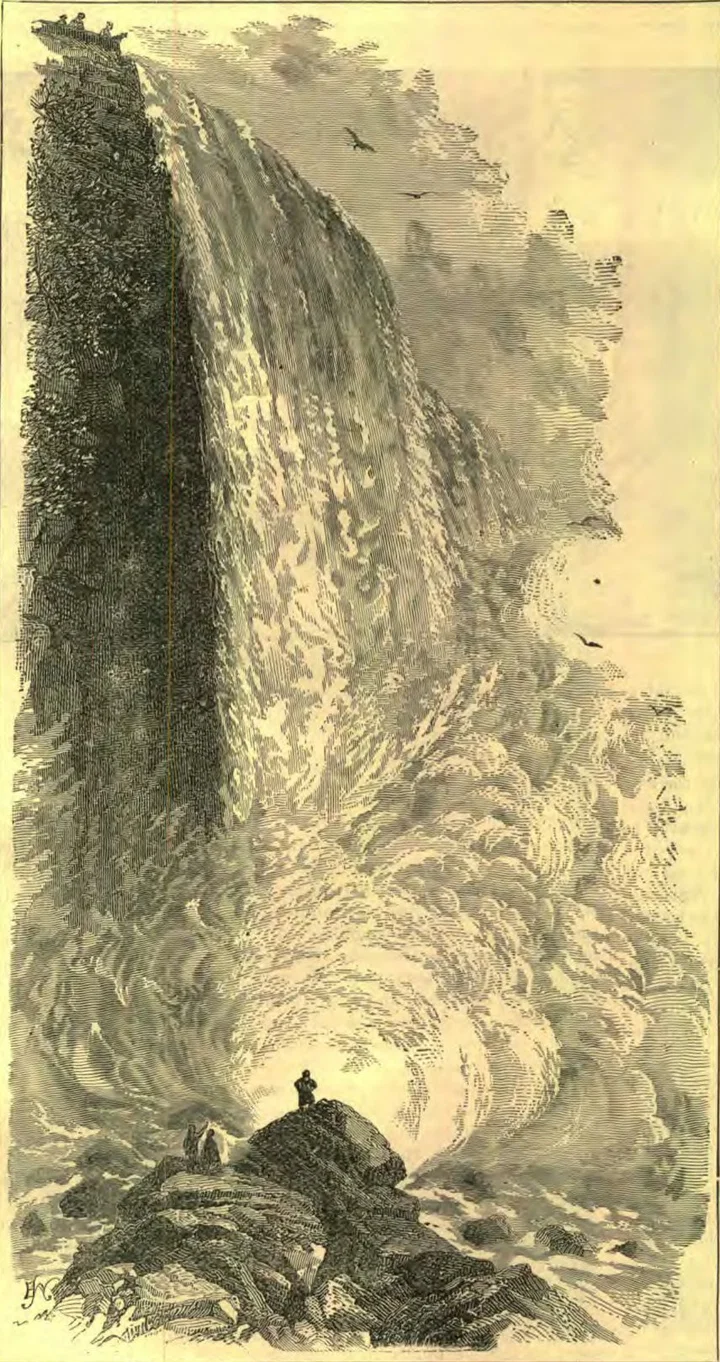
The world-famed cataract is divided into two great bodies of water by Goat Island, which contains about seventy-five acres of land, and hangs on the verge of the awful precipice, in the middle of the Niagara River. Of these the one on the United States side is called the American Fall, while the other, which is much the larger, is called the Horseshoe, or Canadian Fall. In spite of the old geographers, the Horseshoe is but 155 feet high, instead of 800, as they supposed. Still this is twenty feet higher than the almost any church steeple with which you are familiar. Niagara means, in the language of the Indians who named it, “The Thunder of Waters,” and a few years ago it also meant one of the most expensive places to visit and see anything that could be found. Besides being too expensive for any except wealthy people to enjoy, many of the chief beauties of the Falls were hidden behind the mills and factories that lined the river-bank at this point. At length the people of the State of New York awoke to the fact that they were being robbed of this, the greatest of their natural wonders, and they demanded that it be restored to them. So, about five years ago, their Legislature passed a bill appropriating a million and a half of dollars for the purpose of buying out the property owners near the Falls, and creating a State park that should be free to all who chose to visit it. Then the mills and factories were torn down, their sites were sodded, planted with trees, laid out in walks and drives, and bordered, even to the very brink of the roaring cataract, by a massive parapet of masonry.
Now, therefore, all the lands lying in a broad strip for half a mile above and below the Falls, as well as the islands in the river, are public property, over which any one may wander at will. Of course the visitor must still pay to ride down the inclined plane, and take a trip on the staunch little Maid of the Mist into the blinding spray clouds that rise from the foot of the Horseshoe. He must also pay a trifle for the use of the oil-skin suit that protects him from a drenching in the Cave of the Winds, behind the marvelous drop-curtain of tumbling waters. Everywhere else he may wander free of charge. If he prefers to ride, and cannot afford a private carriage, there are comfortable park wagons in which, for fifteen cents, he will be carried to all points of interest in the immediate vicinity of the Falls.
Thus Niagara is no longer an exclusive or expensive place, but has become one of the most popular excursion resorts in the country. Its daily visitors are now numbered by thousands.
The Niagara bridges, of which there are three, are all below the Falls; the nearest, which is a light suspended structure for carriages and foot-passengers only, being but a few hundred yards from them. The great suspension-bridge, bearing the tracks of the Grand-trunk Railway, and the famous cantilever of the Michigan Central, cross side by side nearly two miles below. Still further down stream is the awful Whirlpool, which can be very nearly reached by a five-cent horse-car ride from the Falls. Thus, at an outlay of less than a dollar, the visitor to Niagara may now enjoy all the sights and sensations that a few years ago would have cost him at least ten times that sum and probably more.—Harper’s Young People.