Japan, in what once seemed the far-off Orient, is now our nearest western neighbor. Her people walk our streets; her youth sit peers and rivals of our students in the class-room; her art adorns our homes, and many elaborate designs in use in our factories have been drawn from the empire of the Mikado.
It was at the first centennial of our nation's birth that the wise men out of the West opened their treasuries, and brought forth silk, gold lacquer, bronzes, and porcelain. It was not until that time that we awakened to the fact that the Japanese were a people of refinement and taste.
In order to understand the people and their nationalp. 186 life, it is necessary to understand something about their country, and the physical conditions to which they have been subjected for the past centuries before they came under our immediate observation, as at present. To enjoy thoroughly a beautiful picture, we must study the background.
Dai Nippon is the name that the Japanese have bestowed upon their fairy-like land. It lies in the North Pacific Ocean, in the temperate zone, bending like a crescent off the continent of Asia. The distance from the extreme north of the Island Empire to the mainland is so slight that it has often been crossed in a canoe.
The total area is nearly equal to that of the New England and Middle States of our great Union; and of the 150,000 square miles of surface, two-thirds consists of mountain land.
The picturesqueness of the landscape makes it a second Eden, and there is no place in any other part of the earth that can rival it for beauty and loveliness. All the arable ground is under a high state of cultivation, and has the appearance of a well-ordered garden. Fruit grows in large quantities, but, curious to say, while it thrives as well as anywhere else in the world, it is noted for being the most tasteless of any grown. Pears have the flavor and texture of wood, peaches of rubber. It is the home of the chrysanthemum and camellia, and magnolias flourish everywhere. It is indeed a fairy-land of flowers. Rice, maize, millets, etc., flourish all over the southern parts of the country, but in the far north little is grown.
The good Creator has not only endowed Japan with a fertile soil, but gold, silver, and copper are also found in many places. Yet Japan cannot be said to be a rich country. The people are as a rule exceedingly poor. Rajahs, Nabobs, and Mandarins, such as exist in India and China, are unknown in the realms of the Mikado. If there is a failure in the rice crop, it means starvation to thousands.
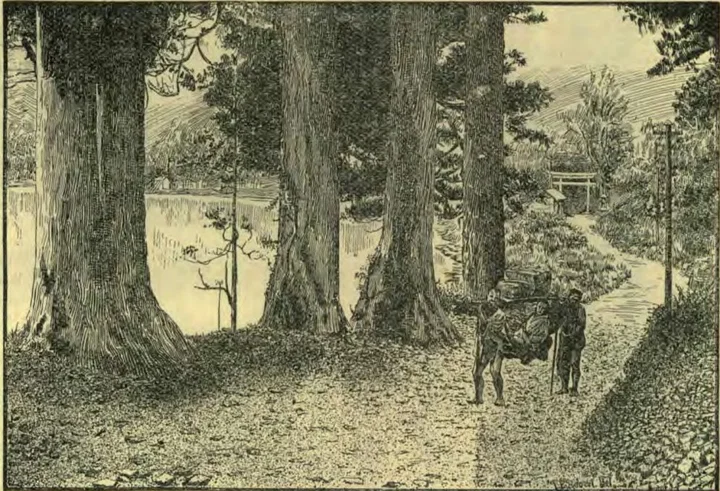
But for beauty of scenery no country can rival it. Chains of mountains rise majestically all over the landscape, and they are clothed with an almost eternal verdure. Grandly irregular in form, they seem to point upward to the clear blue dome of heaven, as if to say, “We are too lovely for earth, we belong above.” Lower down their slopes waves the golden grain on terraced ground, such as we believed could only exist in a fairy-land. The little bamboo houses, with their pretty thatched roofs, nestle cosily in the ravines, and are only exceeded in uniqueness by their inmates.
The climate is delightful and bracing, and the winter months are just cold enough to impart that vigor to the human frame which seems to be essential in order to make a nation enterprising and successful. It is in this country of majestic splendor that the Japanese have lived for centuries upon centuries, with comparatively little intercourse with other nations.
The natives of Japan are divided into two branches. Both of these are of the Mongolian race. There are the Japanese proper and the Ainos. We will here make mention of the latter division only, and in our next tell something about the former.
The Ainos are the aboriginals, and they differ greatly from the modern Japanese.
In stature they are small, but strong and broad-shouldered. Their complexion, although materially influenced by the sun and well-ingrained dirt, has a brownish tint, which tends to pass into the coloring of the North American Indians. The Mongolian type is strongly marked in the face and in the hair. The face is somewhat angular, with projecting cheek-bones and thickish lips. The nose is depressed at the base, with wide nostrils and flatly-rounded end. The eyes are genuine slit-shape. The hair of both sexes has a luxuriant growth. In the case of the men, with their long, flowing beards, which have never been checked by razor or scissors, it imparts an aspect of manly dignity which the rest of their appearance by no means sustains.
Among the Ainos, the women can hardly be said to constitute the “fair sex.” Their appearance produces a less pleasing impression than that of the men, especially as they still further disfigure the heavy face, with the short kept hair, by a blue tattooing on the upper lip. In the distance this has the appearance of a mustache.
We vainly seek among the Ainos that sense of cleanliness so justly applauded among the Japanese. Nay, it is asserted that with many of them the washing of their bodies is unknown. We will not accuse them of being dirty, but would mildly insinuate that they are strangers to soap and water. They hold tenaciously to the old patriarchal habits and practices, and, despite of brilliant temptations, are extremely loth to abandon their simple implements, which serve chiefly for fishing and hunting; for as yet these children of nature have troubled themselves but little with agriculture and the cultivation of vegetables, even when soil and climate have been favorable.
Their simple clothing consists of a coarse smock-frock, with wide sleeves, open in front, and confined around the waist by a girdle. The brownish yellow thread used for these garments is manufactured from the smooth inner rind of a tree, a kind of elm, known to them as the Ohinyo.
The Aino dwelling is of the crudest kind. It is a low hut, supported on posts driven into the ground. The roof is a structure of poles covered over with reeds. There are but two orifices in these edifices,—one for light and the other for a door. The floor in the interior consists of smooth and down-trodden mud. Around the walls run raised benches, covered with coarse mats. These serve as sleeping- places. Heat, smoke, and vermin, as well as bad smells, make it unbearable for a stranger to stay in such habitations during the summer, while sufficient protection is hardly furnished against the cold of winter.
But little is really known of the Aino language and customs, and darkness to a great extent enshrouds their religious rites. Some authors state that they worship the sun and moon as well as the bear. The bear indeed plays a prominent part in the life of the Ainos. When a young cub has been hunted down by dogs in the spring, it is brought home to the village, and here reared by a nursing Aino woman on milk, as if it were a child. When the nursling has become somewhat bigger, it is fed upon fish, and thus by autumn obtains a considerable size. Then a great feast is prepared, at which it is killed in a peculiar fashion, and eaten with numerous ceremonies. The particularly striking and unintelligible part of this proceeding is the fact that while the young bear is being carefully reared, in the end to be sacrificed, its presence in the Aino household has not merely the object of affording reverence as a fetish, but indeed as a sort of higher and spiritual being. A peculiar custom, however, is the mounting upon the stakes of dead hedges or upon posts near the dwelling-house the skulls of bears which are killed in the chase.
Such are the people who dwell in the northern part of the Island Empire. They are not the Japanese about whom we read and hear so much, and do not seem to take so kindly to the civilized ideas of the West as do their brethren in the central and southern parts of the kingdom. They dwell chiefly in little villages along the coast and on the banks of the larger rivers, but not in the mountainous interior.
In character and morals the Ainos are stupid, brave, honest, faithful, and peaceful. Their method of salutation is a curious one. They raise the hand, with the palms upward, and stroke up and down the face, and then, if it be a man, down the beard.
Some authors assert that the Ainos are the ancestors of the modern Japanese, who inhabit the Central and Southern Provinces. They hold that the masses of the Japanese people are substantially of the Aino stock. An infusion of foreign blood, the long effects of the hot baths, and the warm climate of southern Japan, Chinese civilization, and the agriculturist's instead of the hunter's life, have wrought the change between the Aino and the Japanese.
History says that the early Ainos sprung from the Mongolian race, but their own tradition tells a different but rather an interesting story. They say that long ago a certain prince, named Kamui, in one of the kingdoms of Asia, had three daughters. Owing to family troubles, the youngest decided to leave her father's palace. In the middle of the night she fled to the sea-shore, and embarked in a canoe, with only a large dog for a companion. She went on a long journey to the East, and after many months' travel reached an uninhabited place in the mountains. Here she remained, and the gods sent to her a young boy and girl to be her companions in solitude. Their descendants married one with another, and were men of extraordinary valor and nimble hunters. After spending a long time in the land of their birth, they departed for the north, where they still live on the high and inaccessible table-lands above the mountains. Being immortal, they do not die, but direct by magical influences the actions and destinies of men—that is, the Ainos.
P. T. M.