Crossing the Atlantic

6%

S. D. A. Publishing Association · Battle Creek, Mich. · Jun 13, 1895

FromThe Youth’s Instructor, Vol. 43, No. 24.

Read the full edition

Crossing the Atlantic.

Doubtless many Instructor readers will be interested in a brief account of a trip across the Atlantic, especially since so many of our people cross this great body of restless waters in their mission to carry gospel truth to all the world.
When about to make the voyage, the first thing necessary is to select a line of steamers. There are numerous lines running from New York to Liverpool and Southampton in England, to Glasgow, Scotland, to Havre, France, to Antwerp, Belgium, and to Bremen and Hamburg in Germany, etc. These lines usually have one or two first-class fast boats, each trying to beat the records of others in order to “draw.” Having decided on some line, the next point is to choose the steamer; and of course those acquainted with the facts take the best boats. In consequence, these, though higher in price, are usually full, while the poorer boats often go with a light load.
To make sure of a place, it is necessary to engage passage from one to four weeks before the time of sailing. All the berths are numbered. When a ticket is sold, the number of berth is given; and when all places are taken, no more tickets are sold.
The hour for sailing is fixed and made known days in advance. When this hour draws near, the pier where the steamer lies presents a lively scene. Great loads of mail-bags, express wagons of baggage, hacks, carriages, and passengers afoot with numberless pieces of hand-baggage, are pressing toward the ship, and crowding up and down the gangways; while sailors are hustling trunks into the hold.
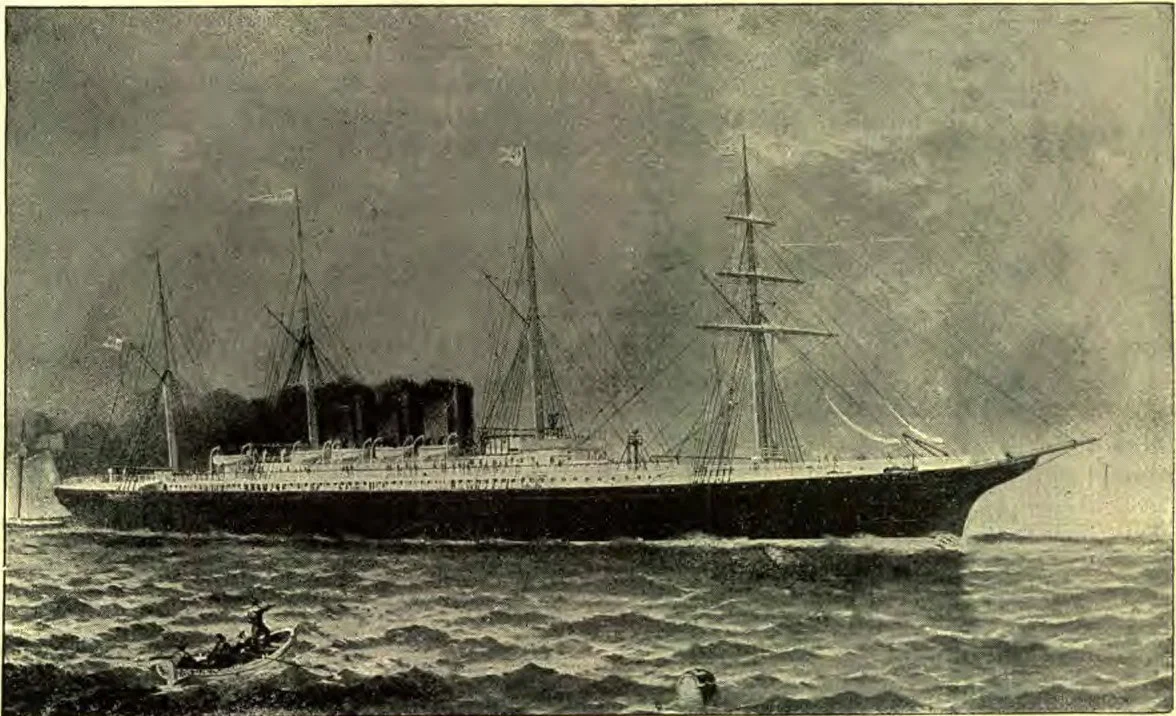
AN OCEAN STEAMER.
AN OCEAN STEAMER.
Usually a large number of relatives and friends accompany the ten or fifteen hundred passengers to the ship, many of them going into the boat, making it extremely crowded just before starting. Before loosing from the pier, a signal is given on board, and all who are not passengers are warned to get off the ship. In the meantime, tug-boats have taken position at the end and sides of the mammoth steamer, and when the ropes are loosed from the pier, these begin puffing and tugging in earnest, but ply for some time before the great mass begins to move. The tugs move the ship away from the dock, where she can work her own engines, and then the steamer handles herself with ease.
The parting moments at the pier present an affecting scene. To many it is in effect a final farewell. Emotions too deep for words find a partial expression in tears and sobs. As the steamer moves slowly away, the pier presents a bank of upturned faces and waving kerchiefs.
Steaming out from the harbor, many an interesting sight is in view. Behind is a fine panorama of the densest business portion of New York; to the left, like a cobweb across the sky, the great Brooklyn bridge; and to the right, on a small island, the gigantic statue of Liberty holding aloft her torch.
The distance down the harbor to Sandy Hook, where the ocean is entered, and whence the time of crossing the Atlantic is reckoned, is twenty-five miles. Soon after leaving Sandy Hook, the steamer slows down, and a little row-boat approaches to receive the harbor pilot, who now leaves the steamer. Now the mammoth engines begin to ply at full speed, the spray flies in front, and the ocean boils behind the steamer, and in a few hours, we are out of sight of land. Many on leaving native land, home, and friends to cross the ocean for the first time, and not knowing whether they will ever see their childhood home and friends again, linger on deck till the last point of land has sunk below the horizon. To many these are moments of sober reflection.
Having left the harbor, let us now give some attention to our floating palace, for such indeed are these marvels of naval skill. Our boat, the “Paris” of the American line, is forty-two feet deep, sixty-three and one fourth feet wide, and five hundred and sixty feet, or over thirty-four rods, long. She is of ten thousand eight hundred tons, and has four engines, aggregating twenty thousand horse-power, and requiring some three hundred tons of coal daily. Her speed is twenty nautical, or twenty-three statute, miles an hour, which is equal to that of the average passenger train. Unless something unusual occurs, the engines never stop night or day till the ocean is crossed.
The passengers are divided into three classes, each being assigned to a definite part of the ship. The first-class rooms and board are the finest that can be provided, the price for each person being from sixty to five hundred dollars, according to location and size of room. The second-class passengers, having the second best portion of the boat, pay thirty-five dollars and upward for the passage; while the third-class, or steerage, passengers have the poorest portion of the boat, with plain fare, and pay at the present time ten dollars. The price in all classes includes board, room, and furnished bed.
When the waves run high, and the boat begins to roll and pitch, many are taken with that unavoidable malady,—sea-sickness. Some soon recover, while others are sick all the way; and some who are not really sick feel so miserably that existence is not worth much to them. It is common for some to resolve that if they ever reach shore, they will never go to sea again.
At sea, passengers are usually free and sociable, not waiting for a formal introduction. There are stewards to care for the sleeping apartments, dining-rooms, and decks. On some ships they are kind and accommodating; while on others, they are less obliging. To pass the time away, passengers play various deck games, smoke, drink, play cards, read, visit with one another, etc. Sometimes the monotony is broken by the appearance of a steamer, and again by a shoal of sporting porpoises, or the spouting of a whale.
Every day the number of miles made by the ship is posted on the track chart. As land is neared, the spirits of the passengers revive; and when nearing port, all are astir, getting ready to embark. The weak begin to feel strong, and the hardships of the voyage give place to pleasant anticipations. Once at the wharf, our floating community of fifteen hundred breaks up, and soon its members are speeding in all directions to the various nations of Europe.
The distance from New York to Southampton or Liverpool, over three thousand miles, is made by the fast boats in seven days, and by the slower ones in nine days; but to many of the passengers these are extremely long days,—days that afford more pleasure when in the past than at the time.
H. P. Holser.