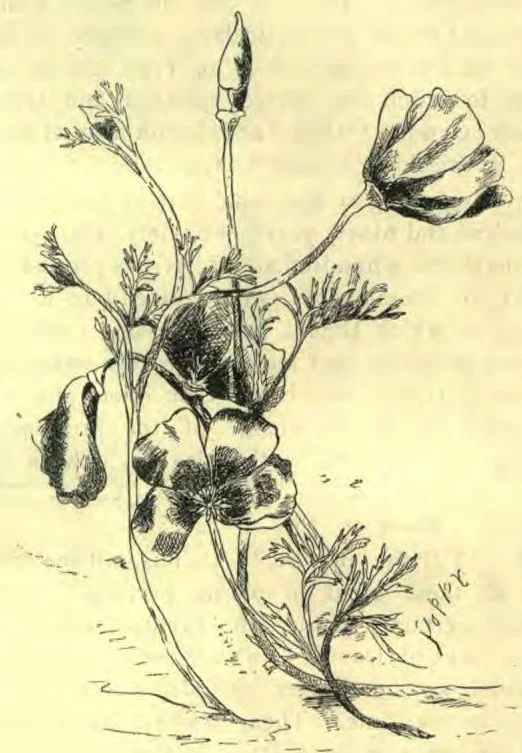
Doubtless the greater number of Instructor readers have heard of the California poppy, even if they know but little or nothing about it. There is no county in the State but can boast of a few of these lovely flowers. The fields of southern and central California are covered with them, but they decrease in number as we go north; so in the extreme northern part the poppy is quite a rarity. The color of the flower changes with the climate, varying from a deep orange to a light lemon. It is of the genus Eschscholtzia. This may seem to be a very awkward name, and hard to remember, yet most of our school-children know and have learned to love it. The Eschscholtzia can be found in some parts of the State any time of year. If the throne of Henry VIII had been erected in a field of our poppies, the field might, in a double sense, have been styled, “The field of the cloth of gold.”
One of the most beautiful summer resorts of southern California is Pasadena. From the eastern side of this city are seen some of our large ranches, at the foot of which are beautiful orange groves. This corner of our extensive garden seems to be especially favored with many of our choicest flowers. Here it is we find the wild peony, wild heliotrope, and many other flowers that are found in our cultivated gardens here and also in the East. The wild peony resembles, in growth, the cultivated peony, being somewhat smaller, yet extremely rich in color. Although Pasadena seems to be especially favored with its presence, this sturdy plant endures a great range of station and climate. While it is found in abundance on the hot plains of southern California, its rugged structure adapts it to the colder regions; for it may also be found in the near confines of perpetual snow.
I have already described some of our early visitors and some that call on us much later; yet there are numberless others. But there is one more which I must mention, lest many who have the privilege of roaming among these flowers will think I have forgotten it. Our Dodecatheon, or shooting-star, with its lavender loveliness, has not been forgotten; but it, like some persons, because of its modesty, has stepped back, and having quietly drooped its beautiful face, listens with pleasure to the words of praise spoken of its companions; and now, after considering many others, I bring it forth.
“The shooting-star may be found growing in a modest sort of way, here and there,—a little bush shooting straight up as if to hold its head above its neighbors before uncovering its handsome face to the gaze of its companions, then modestly looking to the earth, never again daring to raise its pretty face.” The flower grows from four to ten inches high; its inflorescence is umbel, and can be found from three to twelve-flowered. In reality one, and only one, species occurs; but there are several varieties, loosely arranged according to features.
I need but to mention the bluebell, and you will all, no doubt, recognize the name as that of a welcome spring visitor; for its presence graces nature’s garden not only in the “El Dorado of the West,” but also the gardens of the extreme Eastern States. How perfectly it represents a true bell! As we see these dainty flowers growing thickly about us, they seem like bells ringing out a dirge to the departed winter and chiming a welcome to spring.
CALIFORNIA POPPY.
The last I shall add to the collection of wild flowers selected is the white dog-tooth violet. Were it not so familiarly known by that name, we certainly would give it another; for the name lacks so much of expressing its beauty—it rather detracts from it. There is no flower, however carefully nursed it may be, that can, in my opinion, equal it in its simple beauty. It belongs to the Liliaceae family, and is of the order Erythronium. The flowers differ slightly in color, the pure white ones enjoying the deep shade of the wood, where they may hide behind some friendly tree, or, growing bolder, venture to the side of some mountain stream. Its twin sister is a light cream color deepening to yellow at the center. She is quite robust, and prefers to bask in the sunshine, that her cheeks may receive some touches of the great Painter’s brush. In order that she may be thus favored, she is content with but a scanty layer of soil on some friendly rock, or a mere sprinkling of sand among pebbles.