A MALAY VILLAGE

10%

Review and Herald Publishing Company · Battle Creek, Mich. · Jul 13, 1899

FromThe Youth’s Instructor, Vol. 47, No. 28.

Read the full edition

A MALAY VILLAGE.

(Concluded.)
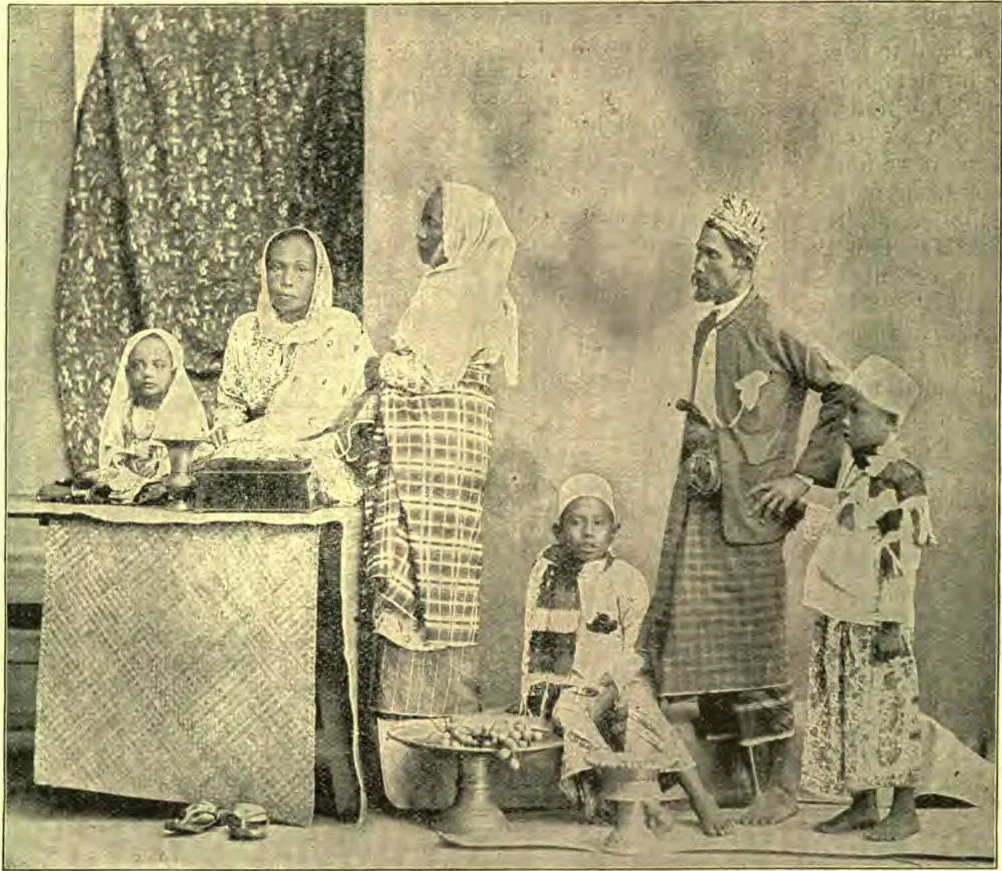
A MALAY FAMILY.
A MALAY FAMILY.
THE Royal Engineers’ Department of the British Army, which has charge of the submarine mines of the harbor at Singapore, muster their recruits entirely from among the Malays, because of their aquatic propensities. They are not only good swimmers, but excellent divers. Every New-year’s day the European athletic associations of Singapore arrange for the New-year’s sports, which always include boat-racing. Entries are made by the captains of the merchant marine, Her Majesty’s ships, and the Malay boatmen. It frequently happens that the Malays carry off the best prizes. As already indicated, their boats are of very graceful form, and present the least amount of resistance by friction with the water, have little or no keel, and can be manipulated with great skill.
I was spending the holidays by the seaside about six years ago, when I witnessed a sight that seems almost incredible, and which I could scarcely have believed had I not, with others whose eyesight was better than mine, watched the event. We had a pair of binoculars, and so could see all the movements of the sailors. A dozen or more boats had passed the goal at the far end, and were on the home stretch, when one of these Malay boats, manned by about a dozen Malays, was capsized by a sudden gust of wind from another quarter. In order to understand what occurred, it will be necessary to explain how they handle their boats. They carry no ballast, in the ordinary sense of the word, but, instead, engage men for that purpose, the advantage being that the eight or nine Malays who serve in this capacity can shift their position at every variation of the wind, thus enabling the boat to carry a much larger spread of canvas than would otherwise be possible. The boatmen further increase their power by adjusting a rope to the top of the mast, and making a loop in the bottom end. One of the men sits in this loop, with his feet against the gunwale on the windward side of the boat; and when the wind blows strong, he throws himself out from the side of the boat, thus keeping it from capsizing. A sudden slack of the wind often catches the man in the rope unprepared, with the result that the boat loses its equilibrium, and having no keel, readily capsizes. This is what actually happened on the occasion referred to, and we saw a dozen men floundering in the water, the boat bottom side up, and no relief at hand. The other boats in the race passed them by, paying no more attention to them than would the scorchers in a bicycle-race to the unfortunate fellow who had come to grief on the race-track . We who were unacquainted with the Malay and his boats, thought the poor fellows were going to drown. I rushed out of the house, and frantically beckoned to a Chinese boatman, who was passing with his sampan, to go to their relief. He seemed very stupid or unwilling; for it was some time before I could induce him to go to their assistance. After he had started out in their direction, I turned my attention again to watching the poor fellows who were struggling in the sea. Imagine my astonishment to behold the boat righted, and the sailors distributed on each side of it, rocking the water out of it. After a few minutes one of them climbed in, and began to bail out the water with one hand and kick it out with one foot. Presently another followed, and then another, until the boat was quite dry. Then they drew in the mast, which had been removed, and placed it in its socket. They gathered in the sail, wrung it out, and ran it up; and in less than twenty minutes from the time they capsized, they were following on in the race.
For ages the Malays have been accused of being bloodthirsty pirates, and the fact is that they have abundantly sustained their reputation until within comparatively recent years. The Spanish in the Philippines, the Dutch in the Netherlands East Indies, and the English on the mainland, have all contributed to the suppression of piracy in this archipelago. The British East India Company, when it was first organized, contemplated trading among these islands; but the capture of one of their vessels, and the massacre of its entire crew, resulted in their abandoning this field of operations, and turning aside to India, as Hindustan is now generally known. The Dutch bitterly resented the invasion of the English, and were glad enough to see them driven out. Within very recent years there have been occasional outbreaks of piracy.
The Malay is a quiet, self-contained, retiring character. He is polite, genteel, and hospitable, and a cursory acquaintance would lead one to think that he was incapable of such atrocities as have been attributed to him. But there slumbers within every Malay a nature which, if circumstances but afford an opportunity, will break forth in the most cruel deeds. A few years before my arrival at Singapore, a Chinese junk, which was passing along the western shore of the Island of Singapore, was suddenly attacked by several Malay canoes, most of the crew were murdered, and what plunder could be carried away was taken. One poor fellow, who lost both arms but escaped with his life, has for years stood at the entrance to one of the popular dining-halls frequented by Europeans, with a large placard hanging about his neck, announcing the fact that he was a victim of Malay piracy, and begging for alms. Five of the principal actors in this crime, four men and one boy, were hanged.
It is said that, until after the days of steam navigation, the Spanish and the Dutch authorities experienced the greatest difficulty in running down and capturing these pirates. They were such skilful sailors that they would run away from the revenue-cutters; and when the wind failed them, they would ship their oars, and run right away in the eye of the wind, making it impossible for the police patrols to run them down. But when steam-gunboats were brought into requisition in later years, they did not find it so easy to escape, notwithstanding they led the respective governments concerned a very hot and a very long chase before they were finally suppressed. The innumerable bayous and arms of the sea and small streams, covered with the densest foliage and tropical jungle, furnished places of hiding and rendezvous that it was practically impossible to discover without the aid of the pirates themselves. It finally became such risky business to carry on piracy that some of the least energetic and courageous Malays found that it paid them better to act as guides for the European governments than it did to participate in the spoil, without any of the attendant dangers; and so it came about that piracy was driven off the high seas.
R. W. MUNSON.