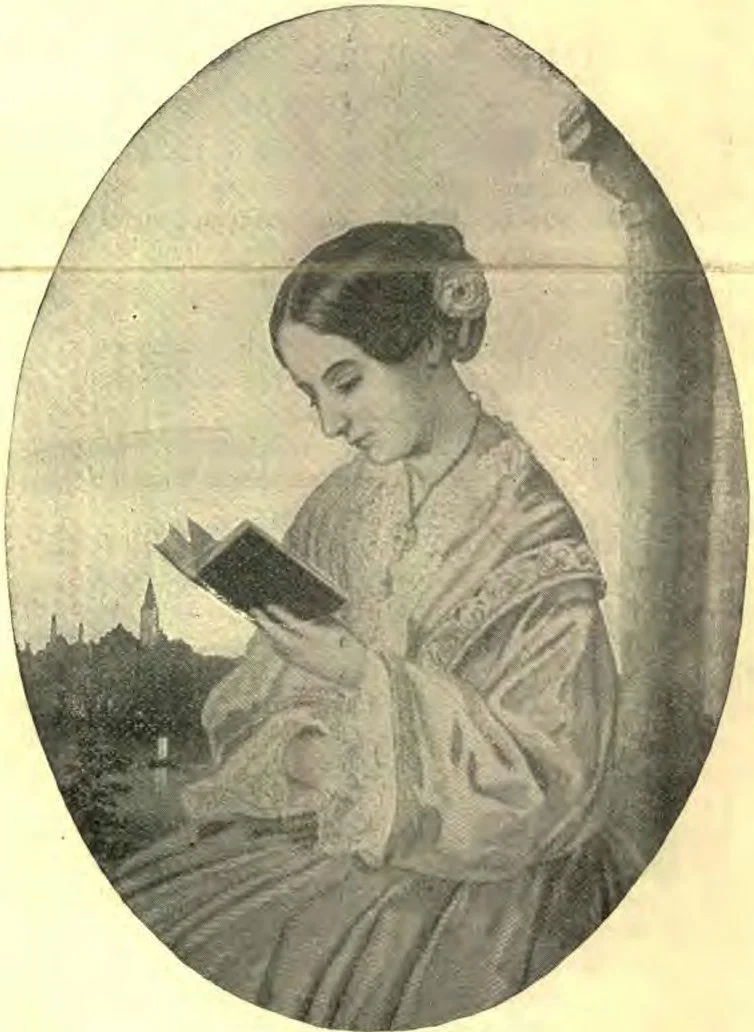
FLORENCE NIGHTINGALE

6%

S. D. A. Publishing Association · Battle Creek, Mich. · May 9, 1895

FromThe Youth’s Instructor, Vol. 43, No. 19.

Read the full edition

FLORENCE NIGHTINGALE.

Nearly two hundred years ago, when Peter the Great went to Holland to learn ship-building, Russia, the “Colossus of the North,” began her “march to the sea.” Shut in by Sweden and Austria on the west, Turkey on the south, and the Ural Mountains on the east, she had no sea-coast except that on the Arctic Ocean, which the loss of many a gallant vessel and her brave crew has proved to be anything but favorable for commercial purposes. Since then, on one pretext or another, she has gone steadily onward toward the coveted possession,—the sea. Every province she has to-day of any value has been gained within a century and a half by conquest and robbery—her very capital stands on stolen ground, and before the death of Nicholas he had selected and educated commanders for the army of India and the army of Constantinople.
FLORENCE NIGHTINGALE.
Until the middle of the present century, “no power had stayed” her in her onward course, or “moved her iron heart to pity.” Then, as the representative of the Greek Church, under pretext of acquiring or protecting the sacred places in Turkey, she invaded the territories of “the sick man” to take him and his under her own domain. This would give her control of the Black Sea and a passage to Constantinople and the Mediterranean; and over the portal of the Crimea is written, “This is the way to Byzantium.” Let her build ships and gather a navy on the Bosphorus and discipline her soldiers on its shores, and she becomes potential in Europe and Asia, holding the helm of the Eastern hemisphere.
It was to be a conflict between civilization and barbarism,—another wave of that dark sea which has more than once swept over Europe from the same direction,—the most disastrous for civilization, freedom, and Christianity. All Europe was paralyzed with fear at her advance. Only the allied powers of France and England dared say to the oncoming tide of Russian greed, “Hitherto shalt thou come, but no further,” and after fruitless negotiations, the Crimean war was begun.
From this war the name of Florence Nightingale will be forever inseparable. Born in 1823, of wealthy and influential English parents, in the city of Florence, from which she derived her name, she received every advantage which money and education could supply, becoming not only thoroughly versed in the ancient languages, an ardent student of the higher mathematics, of literature, and the sciences, but also a proficient in the French, German, and Italian languages, which she spoke as her own tongue. In this way and by constant ministrations to the poor and the sick in her own neighborhood, she laid the foundation of the great work of her life.
From these lowly homes and schools, the highly educated and accomplished Christian girl, graceful, rich, popular, and beloved, with the glory of a soul intent to help a suffering world shining through her face, went forth to her chosen work in the schools, hospitals, and reformatory institutions of Europe. During thirteen years, as stated in her report to the English Army Medical Reform Commission, she devoted her attention to the organization and improvement of hospitals, visiting during that time all the hospitals of London, Edinburgh, and Dublin, the county infirmaries, and military and naval hospitals; all the hospitals of Paris, where she studied with the Sisters of Charity; the Institution of Protestant Deaconesses at Kaiserwerth on the Rhine, where she was twice in training as nurse; the hospitals at Berlin, and others in Germany; at Lyons, Brussels, Rome, Constantinople, and Alexandria, and the war hospitals of the French and Sardinians.
On her return from the Continent, she became interested in a home for sick governesses, which was likely to fail for want of funds and proper management. To this she devoted her time and her fortune, seldom being seen outside of its walls; and here the outbreak of the war found her. She was prepared for her opportunity, and her opportunity had come. War was declared in the spring of 1854, and an English army of twenty-five thousand men sailed for the Crimea.
Until September 20, when the battle of Alma was fought, the troops remained inactive, decimated by cholera and other filth-diseases, by official neglect, and by want of proper food and care, so that the average of deaths for the first seven months of the campaign reached sixty per cent,—a greater rate than that of cholera epidemics or the great plague in London. When the knowledge of this, to which every mail added new horrors, reached England, it aroused the whole nation to sympathy and indignation. The London Times opened a subscription for a relief fund, which in a short time amounted to twenty-five thousand pounds, and by orders from the war department, the work of organizing and equipping a corps of volunteer nurses for immediate service in the field was committed to Miss Nightingale, who was to act as superintendent. In less than a week the first party, consisting of Miss Nightingale, Mr. and Mrs. Bracebridge, ten Roman Catholic nuns of two different orders, eight Sisters of Mercy of the Church of England, six from St. John’s Institute, and fourteen from other hospitals,—forty-one in all,—left England for the Crimea.
Their journey through France was almost an ovation. All classes showed their sympathy and kindly feelings; hotel-keepers made no charge for their services, and servants refused their fees. They reached Scutari on November 4, the night before Inkerman, and were assigned quarters in a tower of the great Turkish barracks on the Bosphorus, which had been lent to the English for a hospital. In this one building there were twenty-three hundred sick and wounded soldiers, and in the adjoining buildings nearly as many more—this number being afterward augmented by the wounded from Inkerman and Balaklava, till, as Miss Nightingale says, “Even regulation space was not adhered to. The wounded and sick men were laid on paillasses on the floor, as close as they could lie. There were two rows of beds in the corridors, where two persons could hardly pass between foot and foot, till in a space allotted for twelve hundred there were two thousand, and in that allotted for sixteen hundred there were twenty-two hundred.”
Aside from this, there was no furniture of any kind,—no lamp or candlestick but an empty wine or beer bottle; and the men packed into these miles of fetid, overcrowded corridors, without proper beds or bedding, with no change of clothing or facilities for washing, without proper food, medicine, or fresh air, were sick and wounded. No wonder that in the six months after the battle of Inkerman four thousand two hundred and forty-six soldiers died in the Scutari hospital alone, the daily deaths amounting, at one time, to seventy.
Into this house of death, with care, sympathy, and consolation, came Florence Nightingale and her nurses. Within a week, by her talent, energy, and devotion, aided by private funds, she had established a temporary kitchen from which, during the next five months, eight hundred patients were furnished daily with nourishing food and beef tea in abundance. Afterward baths, washhouses, and kitchens were built, clothing and other necessaries distributed, the hospital wards purified, and order brought out of confusion. So successful was this work that at the close of the war the death-rate among the wounded was less than that among the well soldiers at home.
She had an utter disregard of contagion, ministering to the worst cases with her own hands, and assisting at the most difficult operations, where the inspiration of her presence would nerve the men to bear their pain.
Amid all these anxieties and responsibilities, Miss Nightingale found time and means to supply books, games, and recreation for the convalescent, establish a library and lectures, write letters for the sick, forward their savings to their families, and take charge of the legacies of the dying; but the poisoned air of Scutari did its work on the overtasked frame, bringing her down also—down into the valley of death, in her turn to be nursed back to life. She refused to go back to England until the war was over, though she was so prostrated that when ordered to take short excursions by sea for her health, she had to be carried to the vessel.
Only when peace was declared did she consent to leave her post, and then, traveling quietly by night to avoid publicity or any demonstration of welcome, she reached her father’s home in old England before it was known that she had left the Crimea.
Yet the death-defying charge at Balaklava had not more stirred the heart of England than the philanthropy and heroism of Florence Nightingale, and the desire of all classes to give some expression of their admiration and gratitude for her services could not be restrained. As she steadily refused any testimonial for herself, a fund of fifty thousand pounds, to be called the Nightingale fund, to which all classes eagerly contributed,—every soldier in the army giving a day’s pay,—was raised by the women of England, and placed at her disposal, to establish and maintain an institution for the training of nurses and hospital attendants.
Since her return from the Crimea, though a confirmed invalid, “our good Saint Florence” has not ceased her work. In labors more abundant she has devoted her time, pen, and fortune to carrying forward her life work for the hospitals of England, India, and the colonies,—for all that concerns the health, comfort, and efficiency of the soldier. There is no one thing an army or a soldier needs that is not noted in her voluminous books. To her work we owe the trained nurses who have almost revolutionized the care of the sick room, and who rendered such efficient service in our own Civil war. By her continued labor she has made it impossible that the army of Great Britain can ever again suffer as in those dreadful corridors at Scutari, that terrible winter after Inkerman. “Wherever a British soldier treads, her influence is felt, and will be eternal.” Miss Nightingale recently celebrated her seventy-sixth birthday; but between the living and the dead, as in the hospitals of the Crimea, still stands “the lady with the lamp.”—Harriet E. Banning, in Chautauquan.