THE NEW SOUTH

20%

S. D. A. Publishing Association · Battle Creek, Mich. · Jun 6, 1895

FromThe Youth’s Instructor, Vol. 43, No. 23.

Read the full edition

THE NEW SOUTH.

It is now more than thirty years since the Confederacy of the Southern States was laid prostrate in the dust by the terrible devastations of the great civil war. The southern people were then left in a most deplorable condition. Nearly every available man and boy from the age of fifteen to that of sixty had been pressed into service, and they had fought through privations and sufferings for a cause which they thought to be just, until the resources of the country were completely exhausted; and when the remnant of the defeated army came home from the fruitless struggle, they were weary and worn, without food, poorly clad, and their money worthless. None but those who passed through that experience can fully realize the desolate condition of the South at the close of that terrible war.
Then it was that the new South began the work of reconstruction and development. It was not long after the smoke of the last battle had cleared away before the hum of industry and the sweet songs of peace began to be heard in the land, and the signs of new life and enterprise began to appear. Cities and towns that had been laid waste began to be rebuilt, great plantations were cut up into smaller farms, and cottages are gradually taking the place of the mansions of the rich and the cabins of the slave.
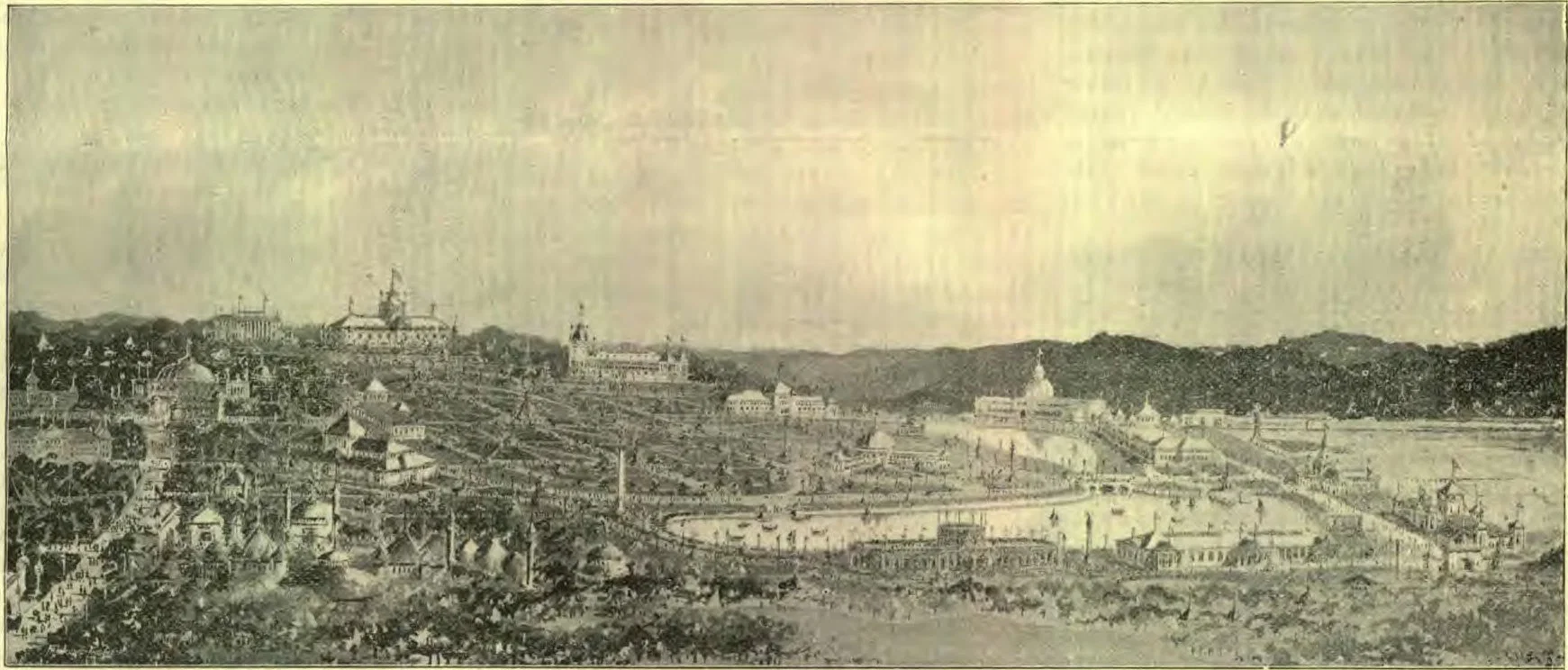
BIRD'S-EYE VIEW OF THE COTTON STATES AND INTERNATIONAL EXPOSITION.
After these thirty years, in which a new generation has grown to be the bone and sinew of the country, the world is to be invited to come to visit the sunny South, and view the achievements of this people, that it may render its own verdict as to whether or not the new South has done honor to itself in what has been accomplished. For this purpose the Cotton States and International Exposition will be held in Atlanta, Georgia, Sept. 18 to Dec. 31, 1895. It seems peculiarly fitting that Atlanta should be the place for this exposition. It was here that the desolation of the war was most keenly felt, and here the pulsations of the new life in the South have been the most active. Of nearly four thousand houses in Atlanta before its destruction, only four hundred were left standing at the close of the siege, and many of these were racked and shattered by the shells of the contending armies. From these smoldering ruins Atlanta has risen to a city of one hundred and eight thousand people. Its magnificent structures, both public buildings and private residences, are the pride of the South. It has sixty miles of paved streets and one hundred miles of electric railway; while ten lines of railway centering here extend to all quarters of the continent. RODNEY S. OWEN.