EASTERN REMINISCENCES

4%

S. D. A. Publishing Association · Battle Creek, Mich. · Apr 18, 1895

FromThe Youth’s Instructor, Vol. 43, No. 16.

Read the full edition

EASTERN REMINISCENCES.

A few days ago we took the steamer for Scutari, on the opposite side of the Marmora, in Asia Minor.
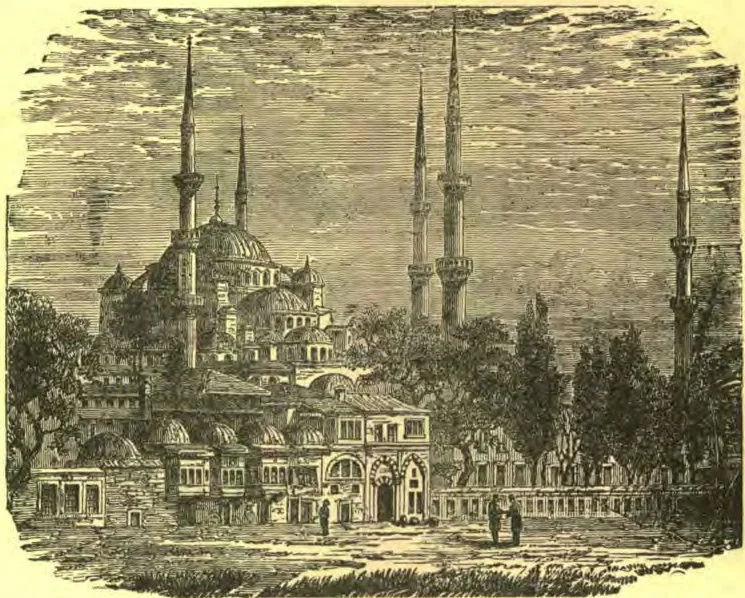
THE MOSQUE OF ST. SOPHIA.
Such a strange crowd as we got along! The steamer, a dirty little affair, had a compartment for women and one for men, but we went to the upper deck. Upon our arrival on the other side, we took carriages, and after considerable squabbling between the drivers and guides, we started to visit the English and Turkish cemeteries.
The former contains the bodies of the officers and soldiers killed in the Crimean war. The officers have tombstones, but the privates are wrapped in their blankets, and laid twenty and thirty in a single grave. Queen Victoria and her subjects have raised a monument there to the fallen heroes. The hospital where Florence Nightingale was nurse is near by.
The Turkish cemetery, a strange, broken-down looking place, is shaded by cypress trees and filled with queer tombstones, shafts surmounted by turbans of every shape, and many with the fez often colored red, with a black tassel. We were told that the monuments were for the men and the flowers for the women, and that in all the cemeteries there were as many graves as twenty times the present population, which is estimated at six hundred thousand.
From there we drove to Mt. Bulgurlu to get the beautiful view; and it was magnificent, embracing the city, the Marmora, the Bosphorus, the Golden Horn, and the old road to Mecca, where the pilgrims used to wend their weary way. It took six months to walk there, and the treasure which they carried as offerings was put upon the backs of camels. Now all go by water. A pilgrim who has made this journey is known by his green turban. The trip to Scutari was most interesting, but it was very hot and very dusty.
In the evening a party of us, with two guides, went to evening service in the Mosque of St. Sophia, in Stamboul. Usually the whole city is closed up, and people are in bed, or out of sight, at seven o’clock in the evening, as they rise with the sun; but during the fast of the Ramadan they are up all night.
We drove over the dimly lighted bridge to the rear entrance of the mosque. The minarets were all lighted, as were all the minarets of the other mosques, making a strange, weird effect in the dark night. We were received by two Turks at the entrance, and we passed up a long incline, instead of stairs, turning again and again until we reached the gallery.
Here we sat on benches, and looked down upon the worshipers. At first we were dazed by the lights. We were told that there were twelve thousand inside and three thousand on the outside of the mosque.
There were queer lamps hanging in festoons, in rows, from huge bronze chandeliers, from dome to gallery, everywhere, which were merely glass tumblers suspended from wires, and half filled with water, on top of which was a little oil with two tiny wicks floating in it. On each side of the altar were enormous candles, all of twenty feet high and over a foot thick, and these candles were lighted.
The worshipers took off their shoes as they entered, and arranged themselves in rows along the width of the mosque, with their faces toward Mecca, standing on the edge of the big rugs, only one row of men on a rug, with their shoes on the space left for that purpose on the marble floor, between their rug and the one in front of them. There were as many rows of men as there were rugs.
In a small balcony were the chanters, and at certain parts of the service the whole congregation would bend over, then drop on their knees, and prostrate themselves twice, touching their foreheads to the floor; then all would rise simultaneously to their feet.
At intervals a voice arose in a weird, musical tone that would vibrate through the whole building like the wail of a lost soul, and that, with the dull thud and rushing sound produced by the prostrating of the worshipers, sent a thrill through one that was anything but pleasant; yet the whole service was solemn and impressive.
After remaining for about an hour, we took carriages for a drive about the city, as we wished to see the strange street scenes that can be witnessed at no other time of year. I shall never forget that drive. All the booths were open, everything exposed for sale. Music halls had crowds of people pouring in and out. The streets were so full of men that our carriages could with difficulty be gotten through; and strange to say, among this tremendous crowd we saw only five women, one attended by a slave, and four veiled ladies attended by the black guardian of the harem, with his insignia of office, a whip, which he would not hesitate to use if any one looked too closely at his charges, and the crowd would uphold him if he did use it.
As we drove along, we saw in many booths what looked like enormous cheeses, and one of our dragomans bought a piece of one, when much to our surprise we found it was almond candy. The Turks are very fond of sweets.
We saw in one place a very strange sight,—a large ring of men taking hold of hands and dancing a sort of shuffle, back and forth, but not going round, to the tune of a most doleful drum. They seemed to be in a dream. In all this strange crowd no one paid any attention to us, and we arrived safely at our hotel, feeling that we had seen a great deal.
On Friday afternoon our Greek dragoman took us to see an impressive service at the Greek church. It so happens that this year the Christian Lent and the Turkish Ramadan come together, so we have the unusual opportunity of witnessing the services at the Mosque of St. Sophia and also the Christian service of the Greek Church.
It was Good Friday, and early in the morning—so we were told—a large canvas, supposed to represent the body of Christ, was lowered into a tomb inside the church, and covered with flowers; people came and went all day, bringing flowers which they threw onto this canvas. In the afternoon, amid impressive services, it was raised, and carried in a solemn procession out from the church into the street. Everybody tries to get a spray of flowers from the body, as a talisman against bad luck for the coming year.
The church was so crowded we could not get in, so we were taken to a building opposite, where we could witness everything; and we were introduced to several prominent members of the church, who received us very politely. As the procession began to move from the church, a bell began to toll. The crowd of sight-seers filled the street, making it difficult for the procession to move.
First came altar-boys carrying gilded symbols; then others, with priests dressed in their strange, mournful garb, all chanting; then the archbishop, dressed in a magnificent robe of heavy white silk, embroidered with gold; then four black-robed priests, carrying the canvas covered with flowers.
The crowd surged and swayed, grasping for the flowers, till it seemed to us that half of them would be crushed to death. Happily no one was injured. As this is a Mohammedan country, we were surprised to see so many Greek Catholics.
Saturday morning we visited several mosques and tombs of sultans, and also visited the great cistern of “a thousand and one columns,”—in reality about four hundred columns. This cistern was formerly used to store the extra supply of water for the city, in time of siege.
In the afternoon we drove over the crowded bridge to Seraglio Point, where there are several palaces once occupied by sultans, but which are now preserved as museums. In one we saw the Divan of Justice, where the sultan sat to administer justice to his subjects, they standing outside a long window, on a balcony, and presenting their petitions through a prime minister, who in turn transmitted them to the sultan, as no one was allowed to approach him in person.
We next visited the royal treasury, another ancient palace. This contains the treasure of the dead sultans. When a sultan dies, all his personal effects, jewels, swords, etc., are placed here, and it requires a great deal of red tape to get in, through the triple iron doors, to see these wonderful and most beautiful treasures,—jewelled daggers heavily studded with gems, magnificent state robes, rubies, diamonds, and emeralds of enormous size. We saw the so-called emerald of Solomon, as large as my fist, and also his sword. I do not know how authentic this story is; but they pretend that the relics are the true ones.—Adelaide Turney, in Boston Commonwealth.