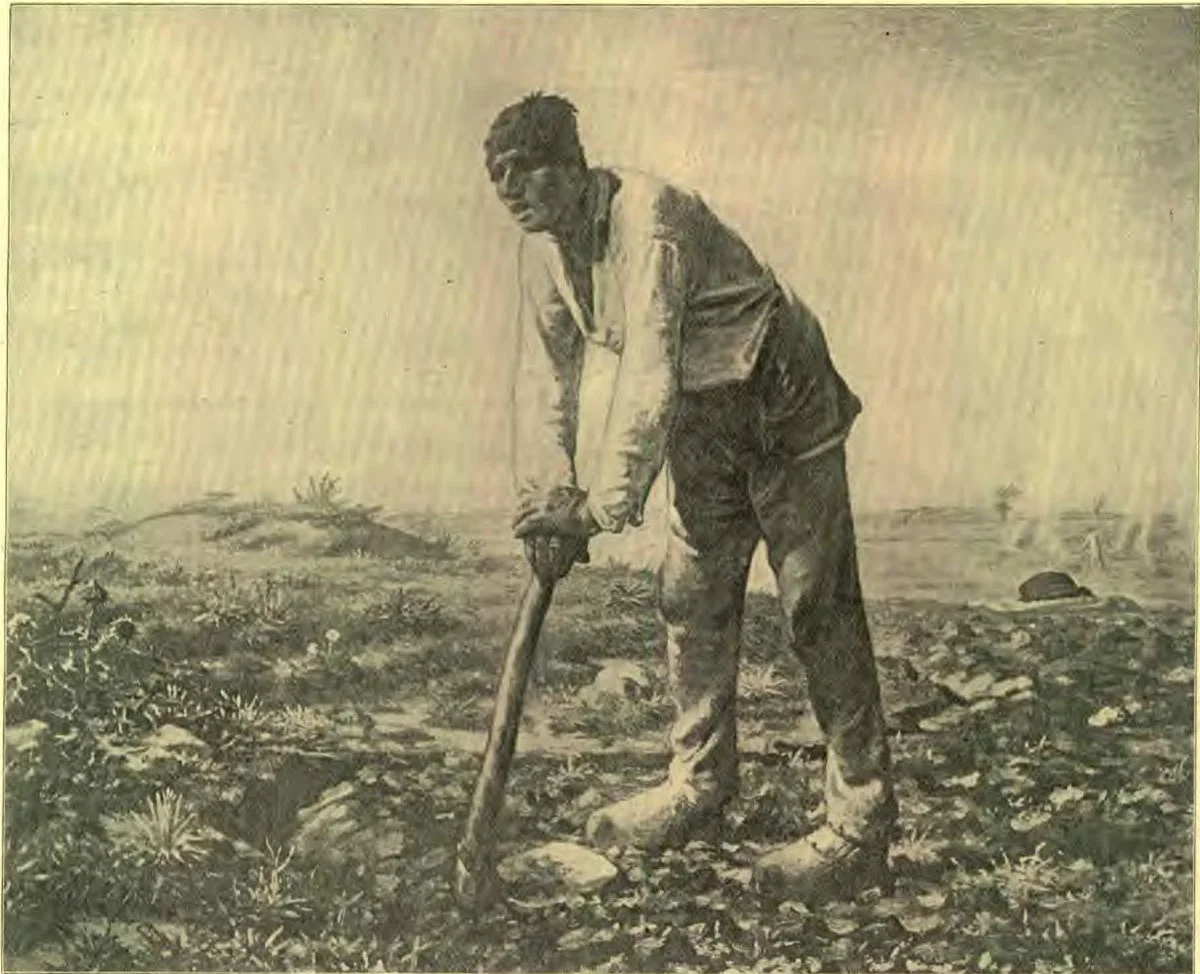
THE MAN WITH THE HOE

4%

Review and Herald Publishing Company · Battle Creek, Mich. · Aug 24, 1899

FromThe Youth’s Instructor, Vol. 47, No. 34.

Read the full edition

THE MAN WITH THE HOE.

The following poem by Prof. Edwin Markham, of the University of California, has attracted a great deal of attention, because of the terrible question which it raises, and which a greedy world does not like to face:—
THE MAN WITH THE HOE.
Bowed by the weight of centuries, he leans Upon his hoe and gazes on the ground, The emptiness of ages in his face, And on his back the burden of the world.
Who made him dead to rapture and despair, A thing that grieves not and that never hopes, Stolid and stunned, a brother to the ox? Who loosened and let down this brutal jaw? Whose was the hand that slanted back this brow? Whose breath blew out the light within his brain? Is this the thing the Lord God made and gave To have dominion over sea and land;
To trace the stars, and search the heavens for power; To feel the passion of eternity? Is this the dream he dreamed who shaped the suns, And pillared the blue firmament with light? Down all the stretch of hell to its last gulf There is no shape more terrible than this,— More tongued with censure of the world's blind greed, More filled with signs and portents for the soul, More fraught with menace of the universe.
What gulfs between him and the seraphim! Slave of the wheel of labor, what to him Are Plato and the swing of Pleiades? What the long reaches of the peaks of song, The rift of dawn, the reddening of the rose? Through this dread shape the suffering ages look, Time's tragedy is in that aching stoop; Through this dread shape, humanity, betrayed Plundered, profaned, and disinherited, Cries protest to the judges of the world,— A protest that is also prophecy.
O masters, lords, and rulers in all lands! Is this the handiwork you give to God,— This monstrous thing, distorted and soul-quenched? How will you ever straighten up this shape; Touch it again with immortality; Give back the upward looking and the light; Rebuild it in the music and the dream: Make right the immemorial infamies, Perfidious wrongs, immedicable woes?
O masters, lords, and rulers in all lands! How will the future reckon with this man? How answer his brute question in that hour When whirlwinds of rebellion shake the world? How will it be with kingdoms and with kings— With those who shaped him to the thing he is— When this dumb terror shall reply to God, After the silence of the centuries?
That is a very strong production of a fearless pen; and yet, according to my mind, it falls short of its opportunity. I have therefore written a reply, which I submit, with Professor Markham's poem, to the young people who read the INSTRUCTOR, sincerely hoping that they will see and appreciate the truth that is taught in the two poems:—

TRANSFORMED.

O solemn questions for the world to take Home to its heart, and answer! But alas! It has no answer: dumb it stands, and quails Like any criminal that faces doom.
And yet there is an answer, and from man. No man need fear what any man hath borne Of penury or sorrow; and there comes Another Man, a working Man, who bears A kit of tools upon his back, and yet Walks upright, like a man before his God,— A homeless Man, who can not know the love Of wife or child; upon whose shoulders weighs The burden of all emptiness and loss; Whose heart hath seasoned been to all despair, To grief, to hopelessness, to loneliness, To utter desolation; and who, yet, Not stunned, but quick as is the naked nerve, Has felt the keen edge of the agonies That through long centuries have wrought to make That brutal jaw, that slanted brow, that brain So like the reeking fungus of a cave Deep under ground, to which no light can come.
This other Man, through all these centuries, Has walked abreast with this degenerate, As brother walks with brother; and his hand, Under the dragging end of that dense weight That pulled against his strength and kept him down, Has helped him on, although he knew it not,— Has led him by his hoe, as by his yoke An ox is led to slaughter or to stall. But not to slaughter or to stall this dumb And senseless travesty of manhood comes, As he is led to take his fitting place Amid the closing scenes of this dark world. You call him dumb; a thing; only a shape: Yet he is even that by wondrous grace And special care of that one other Man Who kept his step, and led him on till now.
And it has been no easy task to save Enough of him to lead; or e’en to keep That hoe within his hand, that he might have That much to lean upon when he should come To stand alone in sight of earth and heav- en,— The last exhibit of a selfish world, The finished product of its skill and power. This is his mission in this awful day When Lust and Love, when Satan and when Christ, Shall bring the fruit that each has harvested From loom and field, from shop and factory, From home, and church, and school, from haunts of shame,— From every place where motive, thought, or act Has grown from seed to fruit,—and in the light Of truth shall spread it out to be admired And coveted of those who love its kind. And then shall ye return, and shall discern Between the righteous and the wicked man,— Between the man that serveth God and him That serveth self,—for by his finished work The workman shall be known.

Therefore behold

The finished product of the centuries,— The man that Love hath made and perfected, Who, with the light of morning in his face,— The morning when the sun ariseth fair Without a cloud, and as the tender grass That springeth by clear shining after rain,— Doth brighten and doth feed a starving world, Darkened with age on age of midnight;—and That thing that Lust perverted from the shape To which God gave his Spirit and his breath, Until he stands, himself a clumsy tool, As dull as is the hoe on which he leans, And just as capable of being used To deal a murderous blow as plant a seed.
I see the tool, the thing of lust and greed, The stolid creature leaning on his hoe: But ah! the man—the perfect—where is he?
While yet this cry was on my questioning lips, The miracle of all the ages burst In bloom and fruit before my wondering eyes. The other Man, who bore the kit of tools,— The homeless one, who seemed bereft of all That makes the life of man in any age,— Came close and closer to that soulless thing, And breathed upon him, lip to sensual lip; And touched his eyes, and looked into their night; Folded his arms about him; held him close, Heart to his heart, brow to his slanting brow, Until the creature groaned and moved and clutched, And cried out, “Bread!” the only word he knew, The only name.
So long had he been held Subject to vanity, so long waited For what he did not know, only he thought Its name was Bread; and as a witless babe Opens its mouth on any proffered cheek As if it were its mother's breast, so he Turned always with that cry of “Bread, Bread, Bread,” To any hand that touched him.
Bread to him Was as the unknown God; and he who stood And held him answered with a tone that thrilled The very marrow of his bones, and brought Him wide-awake and opened-eyed: “Lo, I That speak to thee am Bread, the living Bread.”
He looked and saw. With eyes and heart and brain Quickened by that warm touch of loving life, He saw, and understood, and answered: “Oh, Out of the depths my soul hath cried to Thee! I have asked bread, and thou hast brought me life.”
Then once again the Man who held him laid His lips upon his mouth, and breathed through them His own sweet breath; and as a windmill wakes, And spreads its wings to catch the breath of heaven, And turns upon its axis, and begins To grind the grain, or make the water flow, So he uprew himself, his shoulders squared To bear the burden of the centuries,— Upright, and like a man,—while from his face There burst the glory of the morning light,— A morning without clouds, transparent, clear As truth, and beautiful as perfect love.
And in that light he saw his hoe, and laughed,— It looked so small a thing to lean upon, As he had leaned,—a childish thing, to toss Amid the refuse of the childish past. And as he looked and laughed, the other said, “Brother, what hast thou in thy hand?”
“A hoe,” He said, “a silly hoe.”
“Give it to me;” And as he reached it forth obediently, And as the other touched it with his hand, He laughed again,—a laugh that rose to song; For while within his hand he held the same Old hoe, it was transformed as he had been. He saw a thousand things that he could do Therewith; and if its present form should fail To meet his need, he saw a thousand forms That it might take, under a skilful hand,— That hand his own,—for in that breath of life That through his nostrils had been breathed, that breathes Still out, and in a steady tide of power, He sensed instinctive skill for any task That life should bring, as well as strength to lift And bear with manly dignity whate’er Of burden any centuries might bring. And then, with quick, glad energy, he laid His hand upon the other’s.
“Comrade, stay,” He said. “I’ve waited, groaning, long, until The manifested Son of God should be Revealed in me; but now, redeemed And saved by hope, I take this homely tool To make it work together with the things That work for good, both thine and thee. Stay thou Here with me in my long-neglected patch That I must dig, and plant, and cultivate The while you saw, and plane, and join, and build; And so this little desert place shall bloom And teem with happy life.”
And He who hears And answers every call replied, “Brother, Lo, I am with you to the end of time!” And so they took their tools, and went to work; And where the shadow of that brutal thing That leaned upon the hoe had laid, as dark As death, there fell the steady light of life, And beauty sprang fruitful from every stroke Of that old hoe. The man still delved and toiled; Knew weariness; sweat still was on his brow, Grime still upon his hands, his clothing stained Because of frequent contact with the earth: But all his face was luminous; his form Had lines of strength and grace that only spring From purity; he moved like one who knew Just where to put his foot and strike his tool: And that old patch of fallow ground rejoiced, Budded, and blossomed, and bore luscious fruit In glorious promise of the time to come, When, in the earth made new, the centuries Shall come and go, freighted with strength and joy, Without a lingering shadow of the curse. MRS. S. M. I. HENRY.