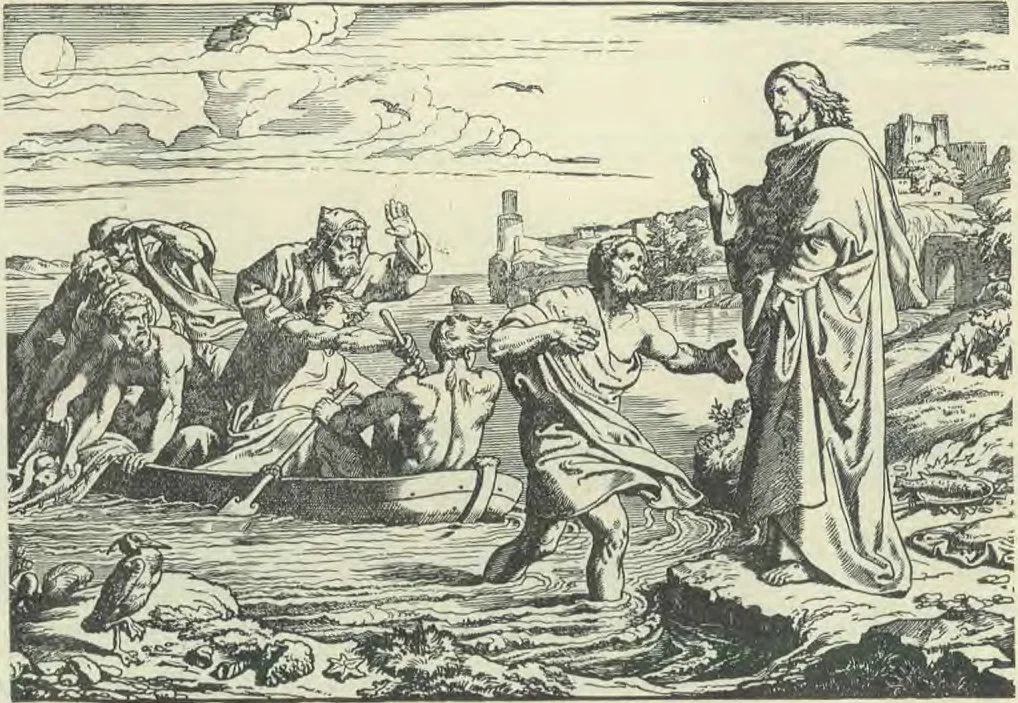
TIME: A. D. 31. PLACE: In and about Capernaum. PERSONS: Jesus, Simon Peter, Andrew, James, John, Zebedee, man with an unclean spirit.
QUESTIONS AND NOTES.
1. As Jesus taught by the Sea of Galilee, how great was the interest to hear him and the desire to be healed? Luke 5:1. What familiar objects were lying by? What were the fishermen doing? V. 2; note 1.
2. What favor did Jesus ask of one of these fishermen? V. 3. Was it granted? Why did the people follow Christ in such large numbers?
3. After the discourse, what did the Saviour ask Simon to do? V. 4. Did Simon think it would be of any use? Why? V. 5; note 2. What was the result of obeying Christ’s command? Vs. 6, 7. What lesson may we draw from this? Note 3.
4. Seeing the miracle that had been performed, what did Simon Peter do? V. 8; note 4. What assuring words were spoken to this disciple? V. 10. Give in brief Matthew’s account of the calling of Peter and his three friends to the work of the gospel ministry. Matt. 4:18-22. Had these men joined themselves to Christ before this? Note 5.
5. Where did Christ and his four disciples now go? Mark 1:21. How did Christ’s sermon in the synagogue affect the people? V. 22. What was there peculiar about his teaching? Why could he teach with authority? Note 6.
6. How was the service in the synagogue interrupted? Vs. 23, 24. With what words did Jesus rebuke the devil? V. 25; note 7. What took place at his command? V. 26. What was the effect upon the audience? V. 27. How far did the news of this miracle reach? V. 28.
1. The Sea of Galilee, also known as Lake Gennesaret, because of a most beautiful and fertile plain by that name to the north of it, is about thirteen miles long and six miles broad, and lies five hundred feet below the level of the Mediterranean. It is even to-day a sheet of water of surpassing beauty, and teeming with fish, though the shores are all deserted. No trace remains of Capernaum. Tiberias and Mejdel (the ancient Magdala) are small, decaying villages, whose inhabitants live in great filth and degradation. One miserable little boat has taken the place of the three or four thousand craft of all kinds that formerly sailed on the bosom of this lake.
2. All night Peter had toiled in vain. “During the lonely hours he had thought of the fate of John the Baptist,278who was languishing alone in his dungeon. He had thought of the prospect before Jesus and his followers, of the ill success of the mission to Judea, and the malice of the priests and rabbis. Even his own occupation had failed him; and as he watched by the empty nets, the future had seemed dark with discouragement.”—“The Desire of Ages,” page 245.
3. The miraculous draught of fishes was due to the fact that the nets were let down at the word of Christ. The disciples had toiled all night in their own strength, and had taken nothing; their arduous efforts had been entirely fruitless. Now they take up the same work, but under the guidance and direction of Christ, trusting in his word, and the result is perfect success. Many a man, nearing the close of life, looks back on years of hard, toilsome work and painful drudgery done solely in human strength and for selfish purposes, and sadly admits that he has labored in vain. Let us who have life before us seek heavenly guidance, let us let down our nets at the word of God, and we shall have real success.
4. Conflicting emotions overcame the erring disciple. He had, in great measure, lost sight of Christ’s calling, of which he had been convinced a few months before. His was now the cry of self-loathing, as his true self of unbelief and unholiness was clearly revealed by the flash of supernatural illumination.
5. Some months before this these men had voluntarily, but temporarily, it seems, joined themselves to Christ, as related in John 1:35-42. They had listened to his teaching and witnessed his miracles; but having also seen the combination of religious leaders formed against him, they had, in the midst of some doubt and hesitation, found relief in assuming their former occupation.
6. Christ could teach with authority, because he was on intimate terms with the Father, and knew his will concerning man. This privilege, which he enjoyed as a man, and not as the Son of God, is to-day vouchsafed to every true Christian; but few avail themselves of it, few are willing to endure toil, and sacrifice their ease and comfort, in order to find time for communion with God. Few are willing to walk in the light given, and therefore God can not reveal to them the fulness of his knowledge. For further discussion of Christ’s method of teaching, see “The Desire of Ages,” pages 253, 254.
7. A strong expression, which would be rendered literally: “Be thou muzzled.” The Lord would not recognize this satanic testimony to his office and work. His calm intrepidity gave force to his word of authority, and a dignified standing to his heavenly message. For further comments on this case, see “The Desire of Ages,” pages 255, 256.