For more than a century there has not been a stable, permanent government in France, and really there does not seem to be one up to this day. With the outbreak of the French Revolution—June 20, 1789—that most bloody period of cruelty and inhumanity which ever stained a professedly civilized country, France gradually took on such freaks of development that regal rule was abolished Sept. 22, 1792, by a decree of the National Convention, a raw body of lawmakers, composed of seven hundred and forty-nine members, who declared the country a republic. Jan. 21, 1793, the head of King Louis XVI fell by the knife of the guillotine. Ever since that time—not to go back to the treacherous and satanic slaughter of the Huguenots, on St. Bartholomew’s night, Aug. 24, 1572, when in Paris two thousand and in the country twenty thousand, together at the very lowest calculation twenty-two thousand souls, composing the very best blood of France, were butchered like hogs—the people seemed to have lost all stability, and have evidently been unable for any length of time to settle upon any one form of government or dynasty, and to abide by that. After destroying all the representatives of royalty they could get into their clutches,—the queen, Marie Antoinette; Princess Elizabeth, the sister of the king; the crown prince; and many others of the nobility and the citizens, irrespective of age or sex, causing human blood to flow in streams under the very eyes of the people, for a series of months; namely, from January 1793 to July, 1794, not only from the guillotine but at the insatiable mouths of cannon and musketry, and drowning countless numbers more,—it would seem as if such atrocities could not be left unpunished by Heaven much longer.
As a matter of fact, the new republic thus created lasted till the year 1800, when General Bonaparte was made first consul, and ruled alone as such until he had himself proclaimed and crowned as emperor, Dec. 2, 1804. In the years from 1792 to 1815 the French, with little interruption, carried on a steady, aggressive warfare with all Europe, so that after the last signal defeat of Napoleon I on that memorable eighteenth of June, 1815, at Waterloo, the aged General Lafayette exclaimed mournfully: “For more than ten years three million Frenchmen had to die for one man [Napoleon I] who to-day still proposes to hold out against the whole of Europe!”
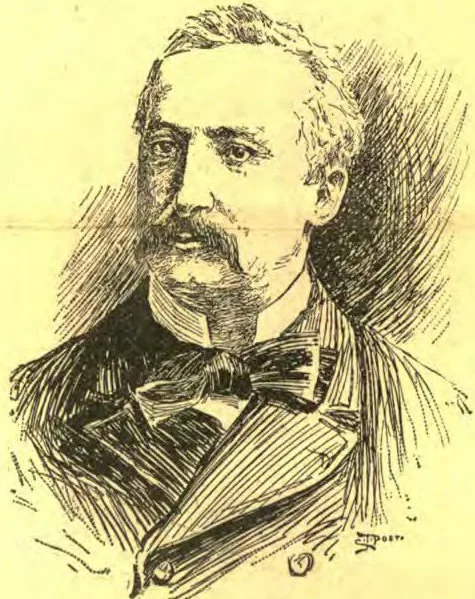
M. FELIX FAURE.
THE SECOND REPUBLIC.
After the downfall of Napoleon I, the Bourbons came to the throne of France again, and maintained themselves in power as “the kings of France and Navarre,” as the old Bourbon kings used to call themselves. But the July revolution of the year 1830 put an end to their rule, and brought the Orleans line to the front. August 7 of the same year Louis Philippe, Duke of Orleans, was proclaimed king of the French. But Feb. 24, 1848, he found himself compelled to abdicate and flee to England, for this was the beginning of the Second French Republic. Dec. 2, 1848, Louis Napoleon, son of Louis Bonaparte, the brother of Napoleon I, was chosen president of the government thus inaugurated; but he, by a stroke of state, before his term of office—four years—had yet expired, made himself sole ruler, Dec. 2, 1851. Exactly one year from this date he was proclaimed emperor of France, as Napoleon III. But he, too, was not to reach the end of his years as occupant of the throne he had thus created for himself.
THE THIRD REPUBLIC.
In 1870 he had so completely entangled himself that his only way out was a successful war against the Prussians and their confederates, who, since their victory over Austria in 1866, had become exceedingly formidable. His defeat in that disastrous undertaking, at the battle of Sedan, Sept. 2, 1870, is still fresh in the memory of even the most youthful student of the history of the last quarter of a century. The Napoleonic empire was crushed, never to rise again. After this came a provisional government of a few months—presided over by General Trochu, with Jules Favre as vice-president, Jules Ferry as secretary, and Gambetta as minister of the interior and later minister of war,—the last-named really exercising at times dictatorial powers in the government. It was he who, Sept. 4, 1870, proclaimed the Third Republic of France. Thiers, the historian, a former minister of Louis Philippe, was chosen president of this French republic on Feb. 17, 1871. But it was not till the bloody Commune of Paris, which began March 18 of the same year to repeat some of the atrocities of 1792, was put down (May 28), that Thiers could really enter upon his office, May 29, 1871. Only two years later, however, he found himself compelled to abdicate, in consequence of the shameful intrigues of the monarchists. Marshal Mc Mahon was then chosen president, May 25, 1873. Although he was voted presidential powers for a period of seven years, he could nevertheless not conform to the more and more unreasonable demands of the Republican leaders, and found himself gradually surrounded by such difficulties that he voluntarily withdrew from office, Jan. 30, 1879.
His successor, Francois Grevy, hitherto president of the Chamber of Deputies, saw himself disgraced by the criminal conduct of his brother-in-law, Wilson, who had committed forgeries and embezzlements on a grand scale. This compelled Grevy to resign in December, 1887. Hereupon Sadi Carnot, a grandson of the great minister of war of the First French Republic, who had so skilfully organized the National Assembly of those days, took the reins of government. He fell by the dagger of an Italian assassin, June 24, 1894. And the new president, Casimir-Perier, chosen but three days later, tendered his resignation Jan. 15, 1895. His reasons for so doing, as given in a manifesto, were that in his efforts to fill his office nobly, regardless of party preferences, as president of the entire French people, rather than of a mere party for party ends, he met nothing but ingratitude and base desertion from every party, thus showing that they were all corrupt. With astonishing rapidity the French National Assembly had already on the second day after, January 17, settled on the person of Felix Faure, up to that time minister of marine, as the new president of the republic.
THE PRESENT CHIEF EXECUTIVE OF FRANCE.
Felix Faure was born Jan. 30, 1841, in Paris, and had established a flourishing shipping trade at Havre, where he was chosen as president of the Chamber of Commerce. During the war of 1870–71 he was commander of a battalion of the “Garde Nationale Mobile,” of which troops he sent a party of volunteers to Paris to put down the Commune. In 1881 he was elected for the first time to the Chamber of Deputies, and November 14 of the same year, Gambetta appointed him under-secretary of state, in his newly created ministry of commerce and colonization.74In January, 1882, he retired with the entire cabinet of Gambetta, but was called to the same post again by Jules Ferry, Sept. 24, 1885. The elections of Oct. 4, 1885, brought Faure into the Chamber of Deputies for the Department of Seine Inferieure, and in the first Cabinet Tirard he was once more made sub-secretary of state. From the second electoral district of Havre he was returned as deputy, Sept. 22, 1889, which office he filled up to the day of his promotion to the head of the nation. In the last legislative period he was vice-president of the Chamber of Deputies, and in the last Ministry Dupuy he held the marine budget. In this cabinet he was still active because of the presidential crisis, even though it had tendered its demise before the resignation of Casimir-Perier.
Time alone can tell how long this state of things will last, though judging from the past we need not wait very long for another change to take place. A. K.