Chinese Girls

5%

Review and Herald Publishing Company · Battle Creek, Mich. · Oct 19, 1899

FromThe Youth’s Instructor, Vol. 47, No. 41.

Read the full edition

Chinese Girls

Very few girls in China can read. No one thinks it necessary for girls to read books, or to be educated in any way. Boys are cared for, and brought to school while quite young. The father calls his boys, and says, “Get ready, hunt up your books, and come along; I am going with you to school.” So the boys, with fear and gladness, gather their small study-books, and start for school. Here they study the life of the great philosopher, Confucius, and are put through a course with the pan-tsi,—a board two feet long and three inches broad, which the teacher frequently uses on the backs of his pupils when they do not remember their lessons.
The poor little girls’ education is of quite a different character. When all the boys are in the village school, and father is sowing or reaping in the field, or perhaps at town to get some opium and other things that he thinks are necessary in the home, the mother and her small girls are doing different kinds of housework. When all things are quiet and settled, the mother’s mind turns to the education of her daughters. She calls one of the girls to come to her, and then says: “Now it is time for you to get ready to be married; it is time for you to be a woman.” The poor little girl knows well what this means. She has seen her older sisters made ready for marriage, and well she remembers their cries and tears. Now her turn has come. She weeps bitterly, and begs her mother to wait until to-morrow. “No,” says the mother, “it will not do to wait any longer. I have been slack in my duty too long already. And who do you think will marry you if you go sailing about on big boats (feet) like those foreign barbarians?”
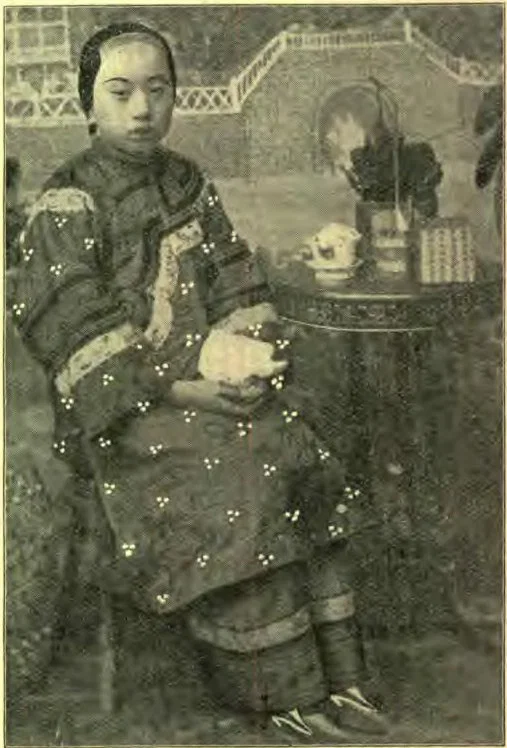
HIGH-CLASS GIRL IN SHANGHAI, CHINA.
So the mother begins her work. First she soaks in very hot water the little girl’s feet; then the toes are turned in under the sole of the foot, only the big toe being left unbroken. In order to keep the toes under the foot, a long, strong bandage is wound tightly around each crippled foot and leg. It hurts terribly to be tortured in that way, but there is no help for it; it must be done. The poor little girl pleads for mercy, but the door of mercy is shut; no mercy is to be had. The proprieties of life must at any and all cost be performed. Sometimes if the girl will not stop crying, the mother beats her severely. Again she ties her hands and feet together, and hoists her up under the ceiling several times; or makes long needles of iron red-hot, and thrusts them into fleshy parts of the poor little maid’s body. The suffering child dares not cry, but lies down on the floor in great agony, sobbing and whispering, from her very heart, “Ma ko-lien, ko-lien O!” which means, “Mother, be merciful, be merciful unto me!” But the prayer of a suffering daughter is not to be heard by the mother.
The tortured child is not able to walk for several months, but is seen crawling on her hands and knees, as she must do the duty of a girl in the house now, the same as before her feet were bound. I have seen girls in that condition many times. It is pitiful to hear their heavy sobbing, and to see the silent tears streaming down their pale faces. They dare not cry aloud; for if they do, their mother will beat them. It is of no use to complain. One girl said to her mother: “Why bind my feet? I can not play with my hsiang-ti [younger brother] any more, and it hurts my feet to have them so tightly bound.” The mother then said: “Do not complain; this is the duty of life. Suffering will make you beautiful. The smaller your feet are, the bigger lump of silver can I get for you. Moreover, this is the right way of life, and the true road whereon you can obtain womanhood.”
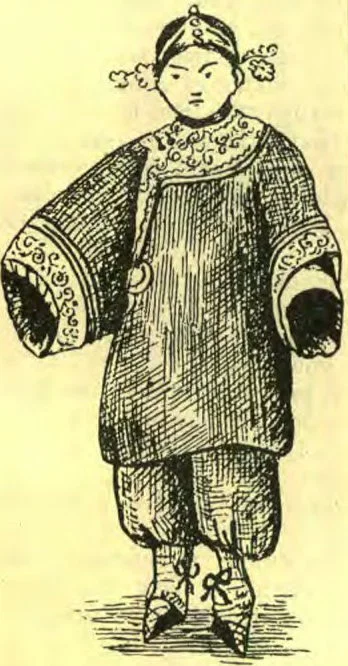
The bandages are renewed every fortnight, and every time they are drawn tighter and tighter, until the foot has reached the desired shape. I have seen twelve-year-old girls with feet not more than three inches long. On these small, broken feet they hobble slowly along; after walking a few yards, they must sit down, and squeeze first one little bound foot and then the other, because they ache so dreadfully. Often have I seen little girls of five or six years of age walking with a stick in their hands to help them keep their balance. Your suffering sisters in China can not walk and run as you can. The foot-education is not easy to obtain.
You may ask why they have such a bad custom in China as to bind the girls’ feet. It is because the Chinese have wandered far, far away from the love of Jesus. I suppose you understand, perhaps better than I do, that the farther one goes from the true God, the more bad customs are seen in the life. Even here in America I have seen customs not to be recommended for a friend of Jesus. But now I am made happy by the thought that all the dear readers of the INSTRUCTOR are willing to put away everything of which Jesus does not approve. You must bear in mind that the mothers of China do not know Jesus as you do; and it is because of this that they are so cruel to their children, especially to the girls. No doubt if they had the good papers and books that you have, they would become enlightened, and see that foot-binding is a bad custom, and so put it away; and perhaps all other bad things would be put away. Will you not pray, with me, for China?
In closing, I will give you a few stanzas from a book called “Nü-erh-king,” or “Classics for Girls.” They are translated by a friend in Peking, and run as follows:—
“FROM SEVEN TO TWENTY
“When the wheel of life’s at seven, You should study woman’s ways; Leave your bed when day is breaking, Early thus begin the days; Comb your tresses smooth and shiny, Keep yourself both clean and neat, Bind your lilies tight and tidy, Never go upon the street.
“When the wheel’s at eight or over, While you gradually do grow, Both your old and younger brothers You should intimately know; And while peacefully partaking Of the tea and rice and wine, About eating much or little Never quarrel while you dine.
“When the wheel at ten is turning, You should never idle be; To the making of their clothing And the mending you should see; Your position should be daily Sitting at your mother’s feet; Not, except upon an errand, Should you go upon the street:
“When the wheel has turned eleven, You have grown to womanhood, And all culinary matters Should be clearly understood; If for fancy work from cooking You can save some precious hours; You should spend them in embroidering Ornamental leaves and flowers.
A GIRL IN THE INTERIOR OF CHINA.
“When the wheel has turned to thirteen, Your propriety should prize; When your presence people enter, You politely should arise; Toward your aunts, your father’s sisters, And his younger brothers’ wives, You should not neglect your manners From the nearness of your lives.
“When the wheel has turned to fifteen, Or when twenty years have passed, As a girl with home and kindred These will surely be your last; While expert in all employments That compose a woman’s life, You should study, as a daughter, All the duties of a wife.”
Another time I will tell you more about our Chinese brothers and sisters.
UNCLE PILQUIST.