A DOLL STORY

8%

Review and Herald Publishing Company · Battle Creek, Mich. · Oct 19, 1899

FromThe Youth’s Instructor, Vol. 47, No. 41.

Read the full edition

A DOLL STORY

A FEW years ago some men were digging in the ground near the old city of Rome, in Italy, and what do you think they found?—A marble coffin, which had lain there sixteen hundred years. A young girl had been buried in it, and with her a beautiful doll, carved from oak. On the thumb of its right hand were two gold key-rings, which showed that it was a doll housewife. In those long-ago days it was the custom to offer dolls to the gods that the people worshiped, just before those who owned them were married; so the presence of this doll and other articles in the coffin showed that the young girl had died just before her wedding-day.
It is known, also, that little Roman children had tiny chariots to play with, whose doll drivers leaned out over high dashboards to lash horses about four inches high. One writer thinks the little Egyptians in the days of Moses had dolls; but however that may be, we can easily believe that these were among the earliest toys made.
In more modern times, dolls have sometimes been made for other purposes than to play with. French ladies of the fourteenth century, having no fashion-plates, made little images, dressed them in the newest “style,” and sent them from one great lady to another, that each might know how to make her gowns. But little girls fell in love with them; and to please them, dolls to play with began to be manufactured in Europe.
These were made of wood, and most of them came from the Netherlands. They were called “Flemish babies,” and an old couplet says:—
“The children of Holland take pleasure in making What the children of England take pleasure in breaking.”
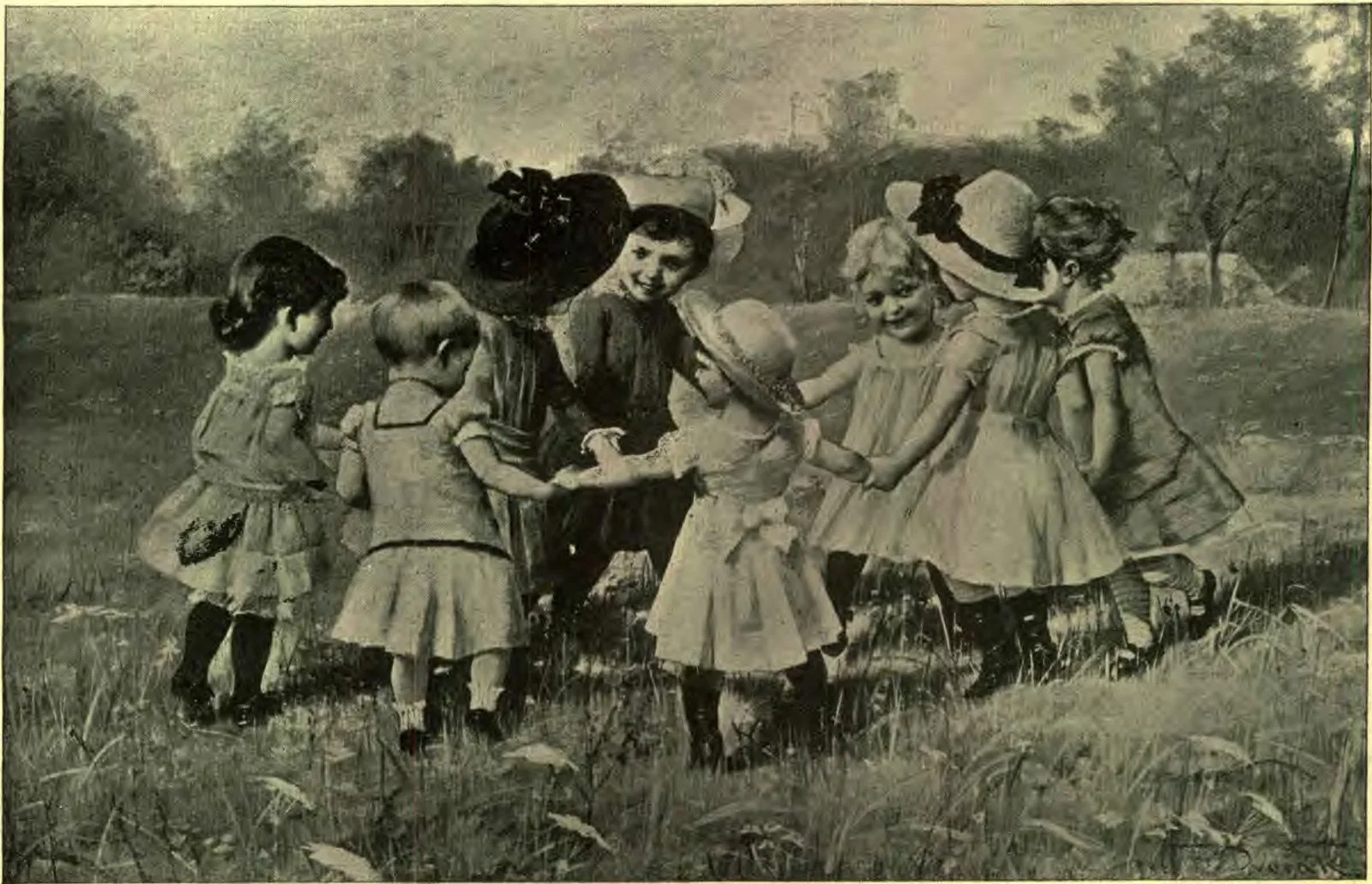
“HEARTS FULL OF SUNSHINE, LIPS FULL OF SONG.”
But it was in England that the wooden “Flemish babies,” with their queer little jointed bodies, found the name that is still dear to us. At that time the name Dorothy, which means “God’s gift,” was very popular, and often it was made “Dolly” as a pet name for little girls. So, naturally, it was applied to the children’s pets, and “dolly” it remains to this day, although in time it became what we call a general, or “generic,” name.
Germany has been for many years the country to produce most dolls, a hundred million being sent to other countries every year. Entire villages are given up to their manufacture. In such a town there are doll headmakers, doll legmakers, doll wigmakers, etc. Men, women, and children earn their living by making one small part of a doll.
In London the making of dolls’ eyes is a flourishing business, hundreds of thousands being exported every year. England also makes wax dolls, which were very popular when they first appeared.
The most beautiful dolls are made in France, and from that country come those that wink, “go to sleep,” sing, walk, and talk. But they are admired rather than loved, because you could hardly expect to hug a doll with a “singing machine” inside of her.
In New York there is a tiny store where nothing is sold but dolls’ clothes. In that city there is also a famous “doll doctor,” who can mend broken heads, arms, and legs, and even put on new noses; and she is kept busy all the time.—S. S. Advocate.