The oldest of the ancient classical nations, Greece naturally excites our interest. It is about half the size of Peru, with a mild climate and a diversified surface, and has nearly three million inhabitants. The numerous coast indentures furnish advantages for the arts of war; thus the education has always been more or less martial. “During the heroic age, to which belongs the immortal siege of Troy, education possessed but a single character. It was patriarchal. The father trained his sons to physical strength and filial piety; and the mother trained her daughters to household duties and domestic virtues. In the language of Schiller, ‘To throw a spear and honor the gods’ was the end of male education.” During the second and third centuries B. C., when Leonidas defended Thermopylæ, and Miltiades won the field of Marathon, there was a rivalry and marked contrast between the schools of Sparta and those of Athens. But as the readers of the INSTRUCTOR are undoubtedly familiar with ancient education in Greece, we will leave that subject, and turn our attention to modern education in this country.
The most interesting phase of Grecian education, especially to one who has been interested in the language before coming here, is the language itself. It is rather shocking for one who has held the language almost in reverence, not only because it was used by the ancient classical authors, but also because it was the original language of the gospel, to hear the street urchins speak it as readily as those in London use English, and to see it used in advertising the every-day commodities of life, and, of course, even liquors and tobacco.
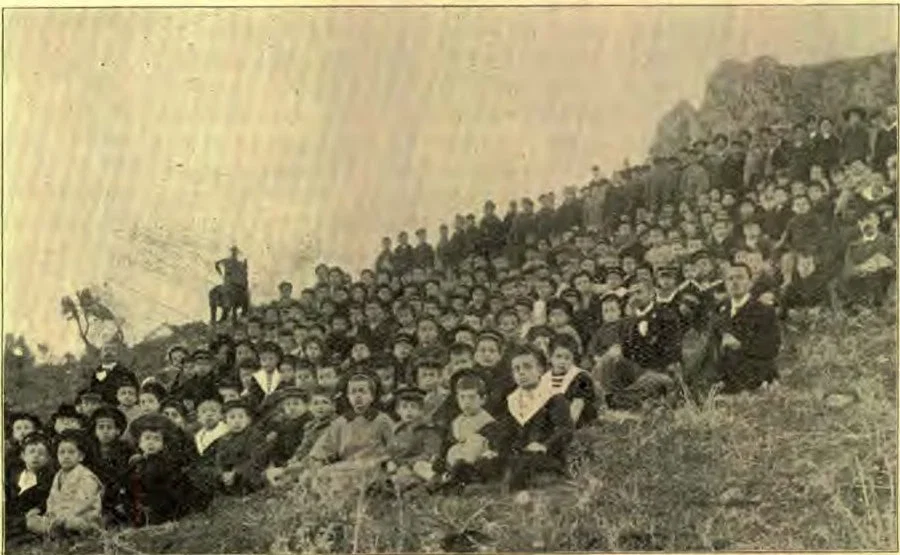
A GROUP OF CHILDREN IN THE PRIMARY SCHOOL, WITH THEIR TEACHERS.
It is often asked by teachers and students of ancient Greek if the modern language can be understood by one acquainted with the ancient. From personal knowledge, and from the testimony of those who have had a similar experience, I can say that when such a person first picks up a modern Greek newspaper, he feels very much as he does when he is confronted by some one whom he has met before, but can not recall, and has to acknowledge, “Your face looks quite familiar, but—but—I can’t recall your name.” As for the spoken language, it baffles the most efficient professor of ancient Greek. In fact, it is a joke among the Greeks that the teachers of Greek in the German, French, and English schools can not speak it. There are three reasons for this: (1) we do not learn the pronunciation; (2) many ancient words are obsolete, new ones have taken their places, and the construction often varies; (3) the puzzling way in which the words are all strung together, sounding like one continuous word, vowels and syllables often being omitted. This is much as Greek was originally written.
At the present time the cities and most of the villages are provided with schools; and as there is a village wherever there is available land, the schools are accessible to all. However, as education is not compulsory, many of the poor and a majority of the country people are unable to read and write. Higher education is here enjoyed almost exclusively by the sons of wealthy parents; while the less fortunate boy must discontinue his studies at an early age,—if, indeed, he has had the privilege of any schooling at all,—and go to work.
At the age of six years the child enters upon his first course of study. This is a four years’ course, and corresponds to our primary school. Here the child studies reading, writing, spelling, arithmetic, geography, vocal music, gymnastics, and the Odyssey and the New Testament in modern Greek.
The second course is of three years’ duration, and corresponds to our intermediate course. Here, besides the regular intermediate studies, the easier ancient authors are read, such as Æsop’s Fables and Xenophon’s Anabasis.
In these first two courses a registration fee of five drachmas is required for each class. (A drachma in silver or gold is worth about twenty cents, but these coins have almost disappeared, paper being used instead. This has so depreciated that it is worth less than fourteen cents.)
Next is the third course, which continues four years. It is called the “gymnasium,” and is something like our high school. A registration fee of ten drachmas is charged for each class. Here, with other advanced studies, the student reads the ancient authors, such as Demosthenes, Plato, Thucydides, etc. He also studies French and Latin, though this last is of late often supplemented by English.
The fourth and last course is in the university at Athens, where the student studies his profession. This university has a world-wide reputation, and we hope sometime to be able to give the INSTRUCTOR a detailed account of its workings.