The Small Letters.
The Latin alphabet had originally twenty-one letters, and ended with X. As the Latin civilization grew, and Greek was much studied, Greek words and names crept into Latin books, and two Greek letters, Y and Z, had to be borrowed in order to spell the new words. These letters were not put into the places where they were found in the Greek alphabet; but were tacked on at the end, where we now find them.
As books began to multiply, the old square capitals, so easy to cut on stone, were found slow and difficult to write. The scribes were anxious to copy as fast as possible; for they were not paid by the day, but by the number of lines they wrote; and we all know that most people work faster when they are not paid by the day. So they began to round the corners, or angles, of the letters, and to make curves instead of straight lines for the up-and-down strokes. If you will try making straight lines up and down, and work at it quite fast and carelessly for some time, you will find yourself making curves, and these curves will bow out toward the left—unless you write with your left hand. This writing, in which curves took the place of straight lines, is called “uncial.” It was a large, or majuscule, hand, as the old capital hand was.
There was another difficulty to be overcome,—letters had to be crowded close together, because parchment was costly, and books written in the larger hand were very heavy and clumsy. Consequently we soon find a small hand growing into general use, which took up little room, and was very easy to write. The words were also separated, and the letters within the word more or less connected, which made reading easier.
I have copied from various manuscripts a sort of table showing the change from the true capitals to the small letters as the printer found them when he began to cut his types.
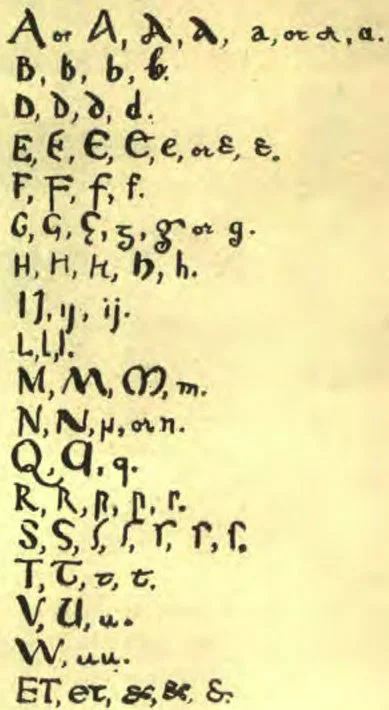
The small letters can easily be told from the uncials, as they are not so large. Such letters as C and O, which were not changed in form, have been left out. Most of the others tell their own story; a few have a curious history.
The right-hand stroke of A was the larger and more important; it was probably made first. The hurried scribe then finished the left-hand stroke and cross with a single loop, or else a U-shaped double stroke. This was the uncial A. It was a short and easy step to our small a. The cursive, or script, form, on the other hand, made the loop part the principal thing, and it was formed first. This gave to the letter the form a, which we find in some book-hands and all script.
B had a tendency to become heavy at the bottom, the top loop finally dwindling to nothing, giving something very much like our b. In D, curiously enough, the ease with which straight up-and-down strokes curve toward the left is seen in the bending of the first stroke; while in the course of centuries the second, or curved, stroke actually became a straight bar!
G has a strange history from the first. The sound it stands for is represented by the third letter of the Greek alphabet, gamma, Γ, which, as we now print it, looks like an L turned upside down. But in Italy it got turned over, so, <, and was afterward rounded into a C. This letter became confused with K, so that it got its sound, which it still retains in “cat,” “cup,” etc. Then the Greek letter Ζ (Z), which had no sound in Latin, and looked like an E with its tongue cut out, Ɛ, became also mixed up with K and the half-grown C, and came out of the scrimmage a full-fledged G, with the sound we give it in the word “goat.” What further tortures it had to endure before it became a good g, a glance at the table will show. Those of you who have amused yourselves by learning the Greek alphabet will now see why our G comes between F and H, instead of after B, and why C comes after B. You should not forget that Greek once had an F, which it lost, and that its H was once a breathy consonant, just as ours is.
J, as a letter different from I, is not yet two hundred years old. If you will look in Cruden’s Concordance, you will see that the two make but one letter. J was at first only a long form of I, and was used next to m, n, u, and i, because these letters consisted of up-and-down strokes, and an i might make an n look like an m, or with another i it might make a u; since the letter was not dotted till a short time before the invention of printing. The last i in a Roman numeral was made long, as it is now in druggists’ prescriptions; thus, viij, xij. Before u, where it frequently stood in Latin words, it was always pronounced as a consonant, with the sound of y in “yet,” and finally it became the rule to write the consonant i long, and the vowel i short. The sound we now give to j was brought over from France.
We find the cross-stroke of N making the scribes trouble. In some parts of the world, especially in Ireland, they got it away down at the bottom of the letter, while in the form which has come to us, we find it at the very top.
The serpent-like S was also a troublesome letter. It was hard to make gracefully, and took up much space. The curve at the top was able to hold its own; but the rest of the letter gradually became a straight bar. The older crooked s was used only at the end of words. At last, at about the time when our grandfathers were learning their A B C’s, they threw away the old long f altogether.
V and u were for many hundreds of years only different forms of the same letter. W was simply a pair of V’s run together at the top, and the small letters were never run together, but were always written uu, and for a long time they were printed so. The two letters, or rather one letter, represented three sounds,—a vowel, u; a consonant almost like it, written uu; and a consonant similar to f, written u. Finally the u was left for the vowel, and the form v was written for the f-like consonant, while the u-consonant was written w. The capital was still V for both u and v. Long after printing was invented, a u of a larger size of type was cut down, and used as a capital. Such u’s can be found in books printed in Charles the Second’s time. Finally a capital U was made with every font of type.
The conjunction “and” is so much used, as we all know, particularly by unskilful writers, that some people like to shorten it to a mere hook. That hook is the Latin word et, with the e and the t twisted together, giving the two forms & and &. This little character has a long name all of its own,—“ampersand;” that is “and per se and,”—“and by itself and.”
C. B. MORRILL.