Originally, Cleveland was but one mile square. Now its frontage on Lake Erie is nearly ten miles, running back some six miles, with an area of about thirty-two square miles, making it not only the largest city in the State, but also the largest of all the cities between New York and Chicago.
The city is divided into two sections, East and West Cleveland, by the Cuyahoga River, and all that portion west of the river originally formed a part of the first county created in Michigan. Cuyahoga County, in which Cleveland is situated, was not organized until 1810.
In 1795 a company of thirty-five persons banded together under the title of the “Connecticut Land Company,” and brought three million acres of land in what was then known as the “Western Reserve,” including the site of the present city of Cleveland. At that time General Moses Cleveland was the agent of this company, and in 1796 he laid out the plan of the city. He made a contract with eleven of the employees of the company to settle with their families in the prospective city during the year 1797; eighteen additional families were to follow in 1798, and twelve more in 1799. From this small beginning has arisen a city which, in 1890, contained 53,052 families, occupying 43,835 dwellings. There are but two cities of its size in the United States—Philadelphia and San Francisco—that show an equal average of families to dwellings, with five members to a family. The population in 1895 was 330,279.
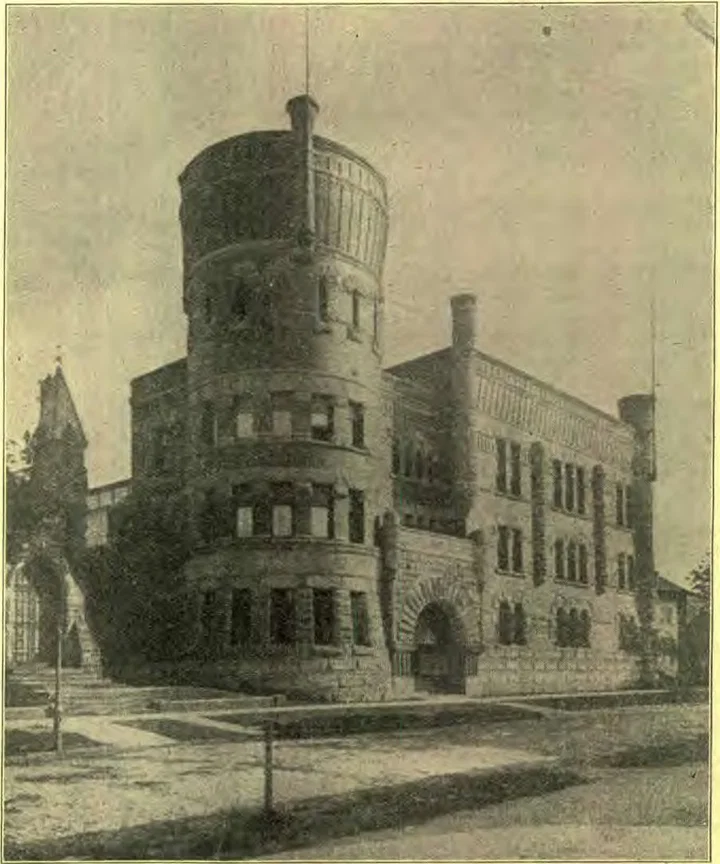
Originally all this portion of Ohio was under French rule, being a part of Canada, or New France. It reverted to the English at the taking of Quebec in 1760.
The first Indian occupants were the mound-builders. Very little is known of these people, but the supposition is that they came from Asia. Their tribal name means “People of the Lakes.” They left four small mounds in the area now covered by the city of Cleveland. Following these came tribes of Indians,—Eries, Hurons, or Wyandottes,—and eventually the so-called “Five Nations.” For years thousands of Indians would collect at Cleveland, haul their canoes up on the beach, and disappear in the interior in search of game, continuing the hunt all through winter and spring.
From the lake, Cleveland, lying on the south shore, has a commanding appearance because of the long line of high bluffs, which form, as it were, its approaches. Situated on the chain of lakes, and with its intersecting network of railroad lines, together with the Ohio Canal, its advantages are extraordinary. Ship-building is one of the main industries; and with the exception of the Clyde, in Scotland, Cleveland is the largest ship-building port in the world. In fresh-water and salted fish it is the largest fish-market in the world, from sixty to seventy thousand tons of fish being caught annually, Lake Erie furnishing a greater supply of fish than all the other lakes combined. One firm caught one hundred and six tons of herring in a single day.
Among the many industries are large chewing-gum factories, one half of all this product used being manufactured in Cleveland. This city is further noted as having been the first in the United States to open a high school.
The banks of the river being high, with flat approaches of varying widths, covered with buildings, the construction of several massive viaducts, or bridges, has been necessitated. These are of great length and towering height. One is 3,930 feet long, and with approaches, 5,229 feet, costing $675,574. Another is 3,211 feet long, costing $2,250,000. In all, there are sixty-one bridges owned by the city, ten of them with swings for the passage of vessels, and fifty-seven owned by railroads, or railroads and the city.
It would require several days to visit all the parks and boulevards of Cleveland. There are sixteen parks, containing twelve hundred acres of land, and their value is over six million dollars. Wade Park has a very complete Zoo, the delight of the children. The monument to Commodore O. H. Perry, costing six thousand dollars, and erected on the public square, was removed to this park. It is twenty-five feet high, and was unveiled in 1860.
The Garfield Memorial, dedicated in 1890, is situated in Lake View Cemetery. The crypt contains the body of the president and that of his mother.
Nowhere in America are there so many or so varied charitable and philanthropic institutions as here. For the benefit of the poor, afflicted, sick, and destitute, over three million five hundred thousand dollars is invested in lands and buildings alone. Prominent among these charitable institutions stands the Helping Hand Mission of the Seventh-day Adventists, which gives relief, shelter, and food to thousands of destitute and fallen men, besides caring for scores of families. Though enlarging its field of operations from time to time, it is entirely self-supporting and free from debt.
W. S. CHAPMAN.