THE STRASBURG CLOCK

6%

S. D. A. Publishing Association · Battle Creek, Mich. · Jul 18, 1895

FromThe Youth’s Instructor, Vol. 43, No. 29.

Read the full edition

THE STRASBURG CLOCK.

This clock has quite a history. The first time-piece on this plan was constructed as early as 1352, for the Strasburg Cathedral. It was called the Clock of the Three Kings, and ran two hundred years. In 1547 Conrad Dasypodius began a new clock, which was run for the first time June 24, 1574; but this clock was built on the Ptolemaic system, which taught that the sun went round the earth. In 1789 it got out of repair, and the French Revolution and later troubles prevented its being set in order again. In 1838 it was decided to attend to it; but upon investigation, it was thought best to have an entirely new clock constructed on the Copernican system. The work was begun June 24, 1838, and finished Oct. 2, 1842, by Herr Schwilgué, a mechanic and clockmaker.
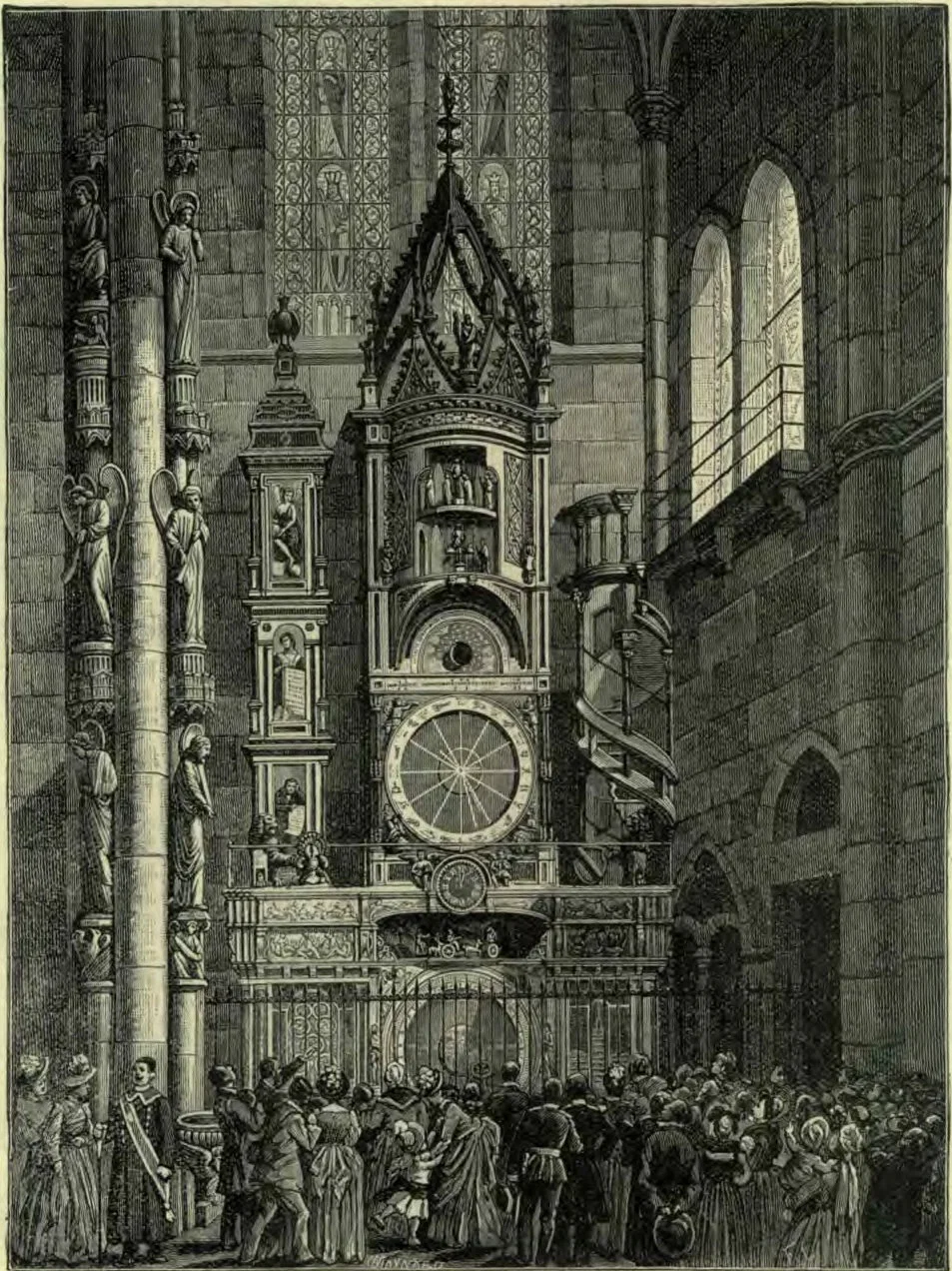
THE CLOCK IN STRASBURG CATHEDRAL.
The lower part of the clock is surrounded by an iron railing, through which the entire effects of the workings of the mechanism can be seen. On the right is a neat winding staircase to enable the visitor more closely to view the tower-like top. Experts in mechanics, however, are also admitted inside the railing at the base.
The first thing to occupy our attention, as we begin our study of this wonderful contrivance, starting from the ground upward, is a copper sphere of the heavens, resting on four beautifully carved metal columns. It is made for the meridian of Strasburg, containing all the fixed stars of more than one hundred constellations that are visible with the naked eye, from Strasburg; in all there are more than six thousand stars represented, up to the sixth magnitude. This globe turns from east to west, making one entire revolution in a sidereal day, which is three minutes and fifty-six seconds less than a solar day.
Immediately in the rear of this celestial globe is the perpetual calendar, the most interesting and remarkable part of the entire clock. It consists of a wide circular metal band, nine inches broad and twenty-nine feet in circumference, bearing upon a guilded background all the signs and requisites of a perpetual calendar,—the months, days, dominical letters, etc., also the names of the saints and all the immovable feasts of the Catholic Church. This rotating band or ring advances every day the length of a day mark, the motion taking place exactly at midnight, every twenty-four hours. At the immediate right of this calendar stands a figure representing Apollo, holding an arrow in his hand, which points to the date and feast of the saint occurring on that date. The figure of Diana is on the opposite side. This calendar makes in ordinary years one complete revolution in three hundred and sixty-five days, on leap years in three hundred and sixty-six days. It even accounts for the deviation of three days within four hundred years—according to the change in the calendar introduced by Pope Gregory XIII—so that the calendar of the clock at Strasburg will tally precisely for hundreds of years with the calendars in common use from year to year. At midnight, between December 31 and January 1 of every new year, the calendar bears the inscription: “Commencement of the Common Year.” But if the new year is a leap year, the word “common,” by a special mechanism that acts but once in four years, will be left out, and instead appears the date “February 29.”
Not only the immovable, but also the movable feasts of the Catholic Church—which depend on Easter, such as Septuagesima, Ash Wednesday, Easter-Sunday, Ascension day, Pentecost, Corpus Christi—are given every year, becoming visible on the calendar January 1 of each year, each under its proper date for that year. The space within the annual calendar gives sun time and moon time. Any one, even only slightly acquainted with astronomy, knows that when the sun at noon stands over the meridian of any place, clock time and meridian time may be found to vary, sometimes as much as sixteen minutes; and since the dial of a common time-piece is set into the front of this grand mechanism, it is an easy matter to compare common time with solar time. The dial of the sun clock, if we may so call it, even though it is also driven by the complex mechanism before us, shows for each day the precise moment of sunrise and sunset; the apparent time for any moment, night or day; the visible daily motion of the moon about the earth; the various phases of the moon; and finally, every eclipse of either sun or moon.
The hours for sunrise and sunset are indicated by a movable horizon that divides the circle representing the course of the sun into two parts, which make, however, two equal halves only twice a year,—at the vernal and at the autumnal equinox, March 21 and September 20; on every other day they are unequal in size, exactly indicating the proportionate lengths of night and day.
The section immediately above the calendar is designed for the days of the week, indicated by the seven pagan divinities, after whom they were named. On a circular track are seven chariots of these gods and goddesses, drawn by symbolic animals; in these vehicles the various deities make their appearance in the proper order of their respective days. Each Sunday, Apollo, the god of the sun, appears in a resplendent sun chariot, drawn by white horses. On Monday, Diana, goddess of the chase, the moon, and night, comes to the front in a chariot drawn by stags. She is followed, on Tuesday, by Mars, the god of war, in a war chariot drawn by fiery steeds. On Wednesday Mercury is in sight, as the god of commerce, with winged staff and purse of gold. Each Thursday Jupiter, the god of thunder, rules the day, in a chariot drawn by eagles. The conveyance which appears on Friday is drawn by doves, bearing Venus, with her son Cupid. Finally, on Saturday, Saturn, the father of the gods, and god of time, comes in sight, represented as about to consume a child, a fitting symbol of all-consuming time.
If you ascend the winding stair-way of the clock, you come first to the Lions’ Gallery, so called because of the two lions represented there, one of which guards the peculiarly crested helmet, the other the escutcheon, of Strasburg. On this level is the common dial of the day clock, with a little cherub or guardian angel at either side. The one bears a scepter in his left and a hammer in his right hand; with the latter he strikes the first stroke of each quarter hour. The other angel has an hour-glass filled with red sand, which he turns very skilfully after the last stroke of every full hour.
Above the Lions’ Gallery is the planetarium, arranged on the Copernican system. The center of it consists of a sun with gilded disk, from which proceed twelve golden rays, pointing to the twelve signs of the zodiac on the dial ring. Seven small gilded globes represent as many planets of our solar system as are visible to the naked eye; they are wrapped in various colored clouds, and fixed to the points of different rods, whose length varies according to the respective distances of the planets they represent, from the sun. Their movements on the planetarium are regulated to a nicety by the clockwork. The planetary globe which represents our earth, also registers accurately the movements of the moon about the earth.
In order to give a still more detailed view of the moon’s phases, you see immediately above the planetarium a large globe, representing the moon, behind which, upon a dark blue background, we see the starry heavens. The globe turns once in every lunar month about its axis, showing the light side of the satellite, and agreeing to a second with the date of the moon’s phases, as given by astronomers.
At length we come to that part of the clock which will probably excite the greatest attention, since it consists wholly of movable figures. In the lower niche, but above the large lunar globe, there appears every quarter of an hour one of four little figures representing respectively the four stages of human life,—boyhood, youth, manhood, and old age. At the end of the first quarter of each hour, after the cherub below has given the sign, the boy appears, and by one single stroke with a javelin upon the gong, or bell, near by, he indicates the first quarter of each hour completed. He is followed by a youth attired as a hunter, who indicates by two strokes with his arrow the half hours. The man in the strength of life appears in the garb of a knight in full armor, and tells the three quarter hours with three strokes of his sword. At the close of each hour an old man comes limping along, wrapped in warm fur, and leaning upon his crutch, with which, however, he is able to beat the four quarter strokes of every full hour. Each one of these little figures takes two steps forward in order to reach the bell in the center of the niche, and retreats again to its former position. A frightful-looking skeleton, representing death, with a scythe, stands upon a pedestal in the midst of the niche, and strikes the full hours with his bony arm on a second gong of peculiar sound, as soon as the old man who struck the full quarter hours has disappeared through the opening at the left, by which also each of the predecessors made his exit after striking his respective quarter.
In the midst of the uppermost apartment, which is elaborately adorned, the form of the divine Redeemer is seated upon a raised throne; in his left hand he holds the victorious banner of the cross, while his right hand is raised to bless. Every noon, after the figure of death has struck the twelfth hour, twelve figures, representing the twelve apostles, appear, who bow, one by one, in adoration before the Saviour, and each receives his blessing. Meanwhile the cock on the ornate column to the left, by flapping his wings repeatedly, raising his neck, stiffening the neck feathers, etc., crows three times, in remembrance of Peter’s denial of the Lord. The paneling of this column shows the pictures of the three great inventors of these mechanical contrivances: Schwilgué (the bottom one), Dasypodius, and the first originator of the first clock of the kind.
There is yet to be mentioned that, aside from all the movable figures and things pictured before us, the hands of the large dial (fifty-one feet in circumference), which is in the midst of the high tower of the Cathedral and faces the city, being visible from quite a distance, are moved by the same mechanism of this wonderful clock, standing on the floor of the cathedral. It is wound every eight days, and has but one principal motion, which is regulated by a second-hand. The pendulum moves in a regulator ornamented by precious stones. The lower works move the hands of the common clock, the hands of the large dial on the outside of the tower, the planetarium, the larger lunar globe, the seven groups of figures representing the days of the week, the dial registering solar time, the various phases of sun and moon, and the sphere of the heavens indicating sidereal time.
The other five movements are controlled by the works in the middle of the whole contrivance. Neither wood nor any other fragile substance is employed in the construction of this complicated invention, but every essential part of the mechanism proper is made of the very best and most durable metals. The whole is an unexcelled masterpiece of human skill and ingenuity,—a standing testimony of the consummate abilities and powers with which God endowed the human mind.
AUGUST KUNZ.