Mrs. Thurston, one of the first missionaries to Hawaii, thus describes the native dress in 1820, the time of her arrival:—
“Soon the islanders of both sexes came paddling out in their canoes, with their island fruit. The men wore girdles, and the women a slight piece of cloth wrapped around them, from the hips downward. To a civilized eye, their covering seemed to be revoltingly scanty. But we learned that it was a full dress for daily occupation.
“As we approached, Kawaihae Hopu (a native who had spent some time in America, and had become Christianized) went ashore to invite on board some of the highest chiefs of the nation. Kindly regarding the feelings of the ladies, he suggested that they put on garments; so they prepared for the occasion. Kalanimoku was the first person of distinction to come. In dress and manners he appeared with the dignity of a man of culture. He was first introduced to the gentlemen, with whom he shook hands in the most cordial manner. He then turned to the ladies, to whom, while yet at a distance, he respectfully bowed; coming nearer, and being introduced, he presented to each his hand.
“Kalakua (Kah-lah-koo-ah), with a sister queen, next welcomed us with similar civilities. Kalakua was the mother of three of the wives of the young king. Two wives of Kalanimoku followed. They were all attired in a similar dress, with the addition of the pau (pah-oo), which consisted of ten thicknesses of bark cloth three or four yards long, and one yard wide, wrapped several times around the body, and confined by tucking it in on one side. The two queens had loose dresses over these.
“Trammeled with clothes and seated on chairs, the queens were out of their element. They soon divested themselves of their outer dresses. Then one stretched herself full length upon a bench, and the other sat down upon the deck. Mattresses were then brought, that they might recline in their own way.
“After reaching the cabin, the common sitting-room for ladies and gentlemen, one of the queens divested herself of her only remaining dress, simply retaining her pau. While we were opening wide our eyes, she looked perfectly self-possessed and easy.
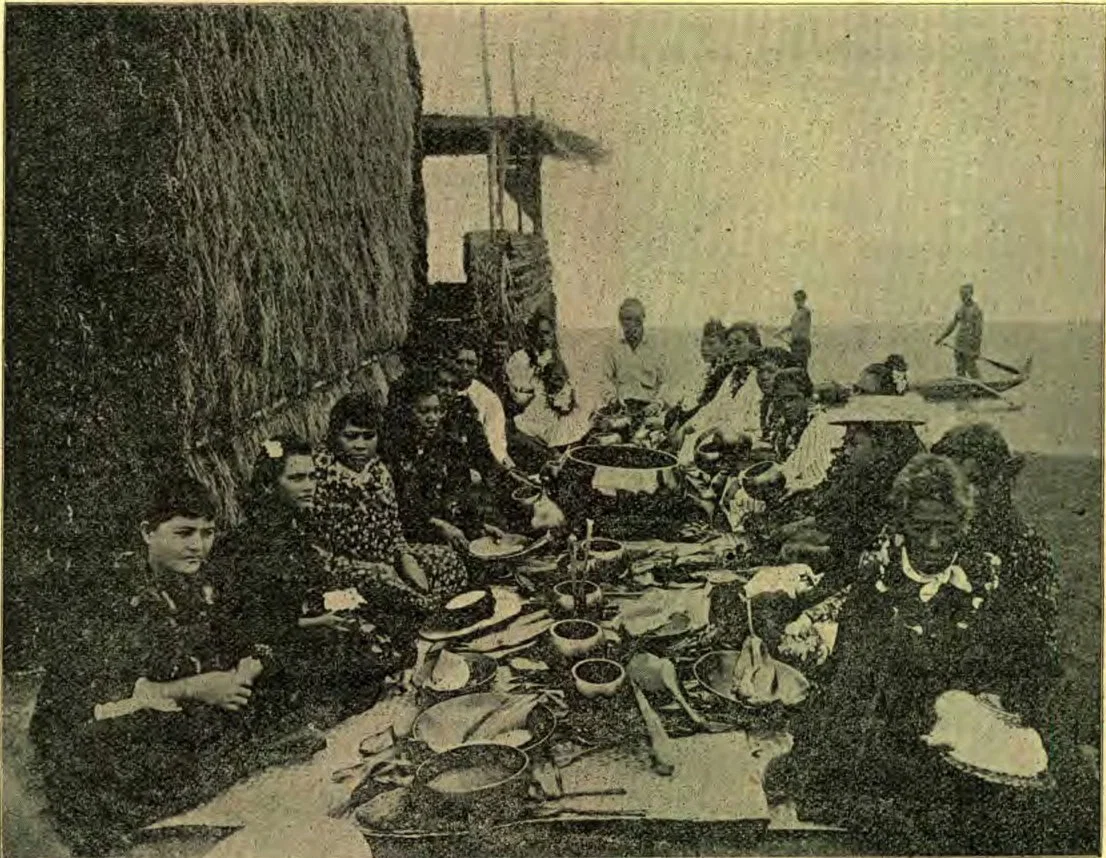
A NATIVE FEAST
“From Kawaihae the chiefs and their large retinue all sailed with us to Kailua, where the king resided. They all slept on deck on their mats.
“Kalakua bought a web of white cambric, to have a dress made for herself in the fashion of those of our ladies, and was very particular in her wish to have it finished while sailing along the western side of the island, before reaching the king.
“Monday morning, April 13, the first sewing-circle was formed that the sun ever looked down upon in this Hawaiian realm. Kalakua, queen dowager, was directress. She requested all the seven white ladies to take seats with them on mats, on the deck of the ‘Thaddeus.’ Mrs. Holman and Mrs. Ruggles were executive officers, to ply the scissors and prepare the work. The four native women of distinction were furnished with calico patchwork to sew,—a new employment to them.
“The dress was made in the fashion of 1819. The length of the skirt accorded with Brigham Young’s rule to his Mormon damsels,—Have it come down to the tops of the shoes. But in the queen’s case, where the shoes were lacking, the bare feet showed very prominently.
“May 4, Tuesday, one hundred and sixty-three days from Boston, the ‘Thaddeus’ was anchored before Kailua. The queen dowager, Kalakua, assumed a new appearance. In addition to her newly made white dress, her person was decorated with a lace cap ornamented with a wreath of roses, and a lace half-necker-chief, in the corner of which was a most elegant embroidered sprig of various colors. These were presents we had brought her from some American friends. When she went ashore, she was received by hundreds with a shout.
“April 6 the king and his family dined with us by invitation. The king was introduced to the first white women, and they to the first king, that each had ever seen. His dress on the occasion was a girdle; a green silk scarf put on under the left arm, and brought up and knotted over the right shoulder; a chain of gold around his neck and over his chest; and a wreath of yellow feathers upon his head.”
In describing a feast to commemorate the death of Kamehameha I, Mrs. Thurston says: “The king departed from his usual custom, and spread a table for his family and ours. There were many thousands of persons present. The king appeared in a military dress, with quite an exhibition of royalty. Kamam Iu, his favorite queen, applied to me for one of my dresses to wear on the occasion; but as it was among the impossibilities for her to assume it, the request2happily called for neither consent nor denial. She, however, according to court ceremony, so arranged a native cloth pau, a yard wide, with ten folds, as to be enveloped around the middle with seventy thicknesses. To array herself in this unwieldy attire, the long cloth was spread out upon the ground; then, beginning at one end, she laid her body across it, and rolled herself over and over till she had rolled the whole around her. Two attendants followed her, one bearing up the end of this cumbrous robe of state, and the other waving over her head an elegant nodding flybrush of beautiful plumes, its long handle completely covered with little tortoise-shell rings of various colors.
“Her head was ornamented with a graceful wreath of yellow feathers, of great value, from the fact that after a bird of the kind from which these feathers were obtained had been caught in a snare, only two small feathers of rare beauty, one under each wing, could be had from it. A mountain vine with green leaves, small and lustrous, was the only drapery which went to deck and cover her neck and the upper part of her person. Thus this noble daughter of nature, at least six feet tall and of comely proportion, presented herself before the king and the nation, greatly to their admiration. After this presentation was over, her majesty lay down again upon the ground, and unrolled the cloth by reversing the process of clothing.”
The accompanying illustration gives a correct idea of the serving of Hawaiian feasts, mentioned and described in the INSTRUCTOR of June 14. It also shows the dress and general appearance of the Hawaiians at the present time. LENA E. HOWE.