The large yellow star that is now to be seen in the southern skies immediately after sunset is the planet Jupiter. If you will watch for it any clear night, and notice the first star that appears directly in the south immediately after sunset, you will be able to point out to your friends this interesting planet, about which all have heard, but which few can locate. We wished to call your attention to this planet some weeks ago, but other work crowded out the time we intended to devote to the INSTRUCTOR family.
During the latter part of May we approached to within about 390,398,000 miles of this world, which is much nearer than we shall be again during the coming year. At that time a good field-glass or an ordinary three-foot achromatic telescope would have plainly shown four of Jupiter's five moons, and made the planet itself appear in the form of a globe. Since the twenty-seventh of May our earth has been rushing on past that beautiful star, leaving it so far behind that the smaller glasses will soon be too weak to show the sparkling gems of light that come to us from its moons. The constantly increasing distance between that world and our own affords an excellent opportunity for our amateur astronomers to train their faculties of observation in using their pocket-telescopes. We hope that when next the earth swings around in the neighborhood of Jupiter, our time will not be so taken up as to prevent calling the attention of our readers to this interesting portion of God's handiwork in time for them to observe its moons.
Jupiter is the fifth planet in order from the sun, and the second from our earth. Its mean distance from the sun is 483,288,000 miles; and it swings in an orbit 3,110,000,000 miles in circumference about the sun, requiring 4,332 days, fourteen hours, and two minutes of our time to make its yearly circuit. Thus the year, to the inhabitants of Jupiter, is as long as nearly twelve years of our time. The onward movement of this planet through space is thirty thousand miles each hour, or about eighty times the velocity of an ordinary cannon-ball. When we consider the great size of this world,— that it is 88,439 miles in diameter, thus equaling in bulk thirteen hundred worlds the size of the one on which we live,— we obtain something of an idea of the immense magnitudes and velocities, even in our own comparatively small solar system, with which the mind must deal in the study of the workings of an all-wise Creator and Redeemer.
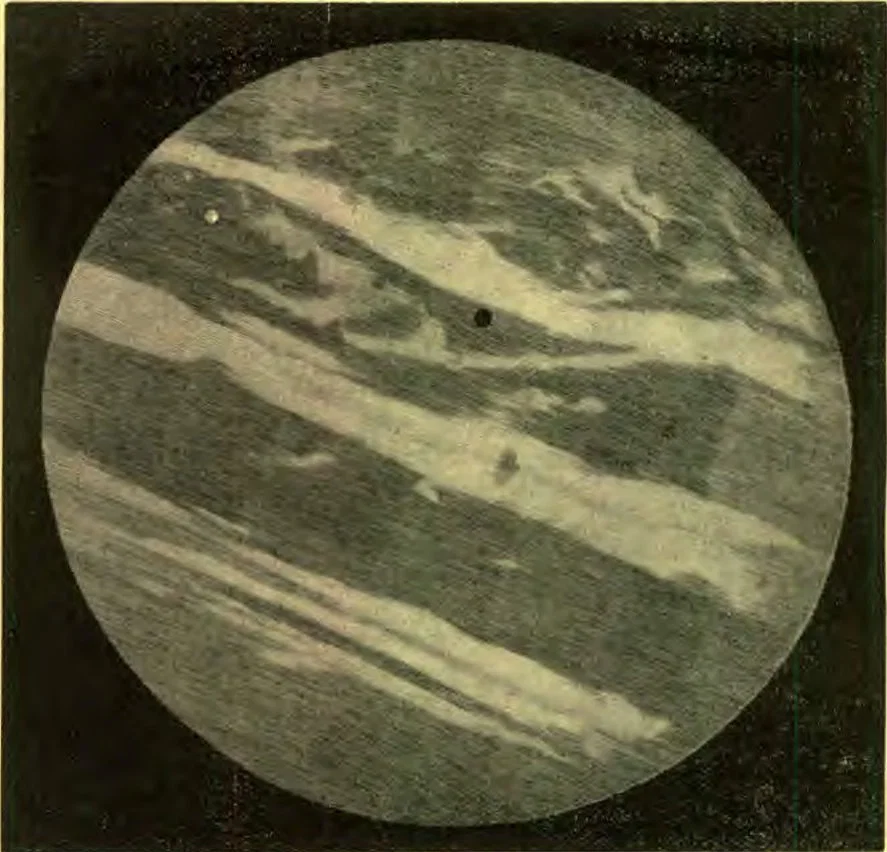
There are times when we come within three hundred and seventy million miles of this wonderful world; then again, we swing so far away from Jupiter that the light coming from this planet to us must span the distance of six hundred million miles. Although Jupiter is so many miles distant, when the earth approaches near this planet, we can see it, even with an ordinary telescope, as shown in the accompanying illustration, with the belts, or dark lines, upon its surface, also four of its five moons.
JUPITER
Would it not be well for every reader of the INSTRUCTOR to locate this wonderful world as it marches majestically along its God-given path in the heavens, and follow it during the coming summer and fall months, as it passes seemingly along among the stars that twinkle in the darkness beyond? Remember that although it appears to be right among the other stars, it is, in reality, many millions of miles this side of any of those you at present see in its immediate neighborhood. Get the location of the planet fixed in mind now; watch it as it moves along past the different stars, so far in the distance beyond; also notice how, each evening during the coming months, it will appear to be getting nearer the sun, or, to be more correct, the sun will be continually marching on through the heavens toward the east, and so getting in line between us and Jupiter.
If time permits, we will prepare a drawing during the coming week that will illustrate exactly the real relations and the apparent movements of the earth, the sun, and Jupiter, and will also tell you more about those moons that are represented in the accompanying small illustration. The large picture shows the planet as it appears when we see its full, illuminated face beneath a large telescope. The dark bands running across the planet show plainly in both illustrations. The dark spot, a little above the center, in the larger picture, shows the shadow of one of the moons of Jupiter;244and were we living at that particular place on that world, we should have the pleasure of seeing an eclipse of the sun similar to the one we had the 28th of last May, to which your attention was called in these articles.