THE HAWAIIANS

5%

Review and Herald Publishing Company · Battle Creek, Mich. · Jun 28, 1900

FromThe Youth’s Instructor, Vol. 48, No. 26.

Read the full edition

THE HAWAIIANS

Native Dress

After six thousand years of the curse, nature still provides, in a crude state, all that man needs to sustain life, and make him comfortable. She comes to the assistance of the indolent children of tropical climes, and kindly takes upon herself much of the labor that is required of those in cooler countries, where exercise and activity are not only necessary to supply physical needs, but also to maintain that physical health which, in its turn, adds mental and moral vigor. Perhaps nowhere is she more lavish of her gifts than in Hawaii, where are the most brilliant of sunsets, the brightest skies, the bluest waves, and the most gorgeous rainbows. Many tropical fruits grow without cultivation, and many more may be obtained with slight exertion: yet even here the word spoken to Adam after he sinned,—“In the sweat of thy face shalt thou eat bread, till thou return unto the ground,”—is literally fulfilled.
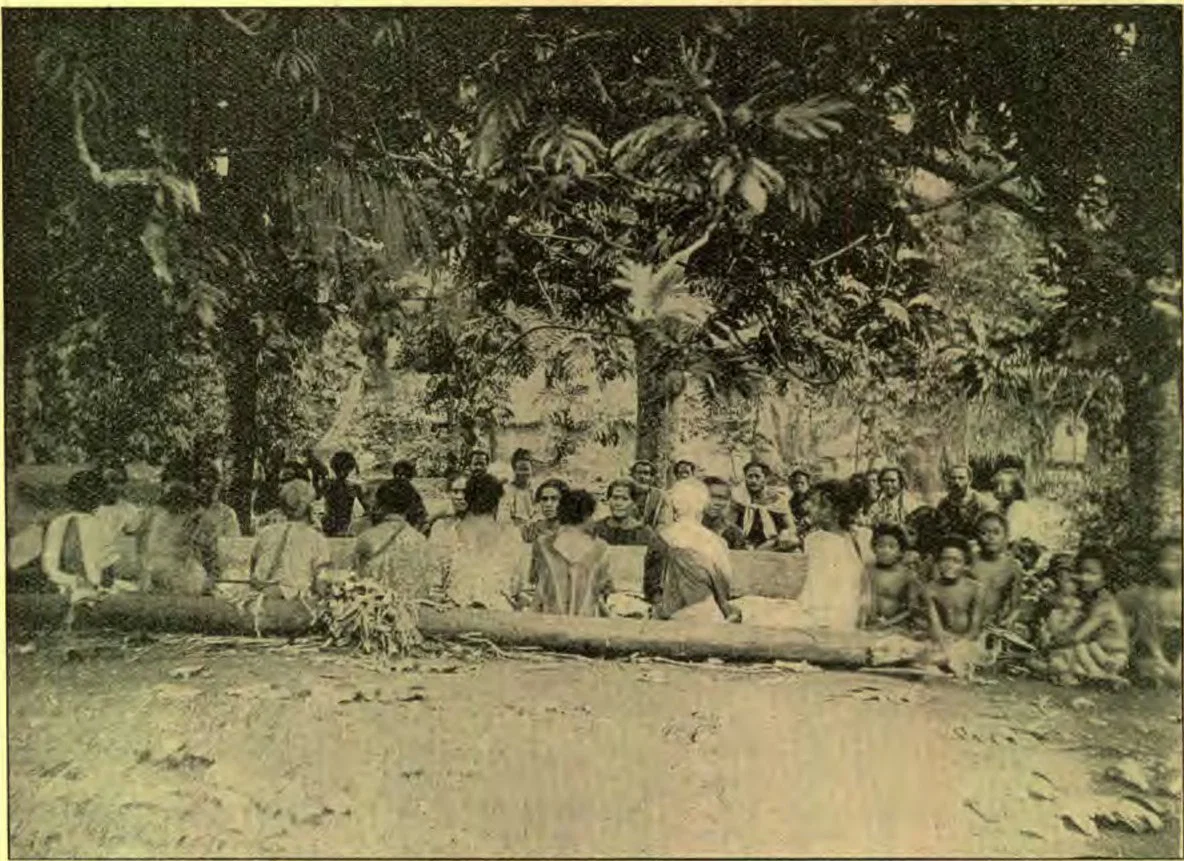
While the paper-mulberry and mamake trees supplied the bark for the manufacture of the kapa (cloth) from which the scanty garments of the native Hawaiians were made, still some labor was necessary in its manufacture. This labor was performed by the women. Strips of bark were peeled from the trees, and the outer coat was scraped off with shells. The strips were then soaked in water, laid upon smooth logs, and beaten with grooved mallets made of hard wood. The strips were united by overlaying the edges, and beating them together.
The fabric thus made was then stained or bleached white, and either left plain or impressed with bamboo stamps in a great variety of patterns, and in many different colors,—gray, red, different shades of blue, pink, green, etc. After this it was glazed with a kind of gum, or resin.
In general the kapa could not be washed, and lasted only a few weeks. Some of it was very fine, while other kinds resembled wash-leather. Many varieties and patterns may be seen at the Bishop Museum, and one can not but wonder at the ingenuity displayed in the manufacture of this curious fabric.
Besides the pāʻū of the women and the girdle of the men, the kihei was sometimes worn by both sexes. This was about six feet square.
MAKING KAPA
MAKING KAPA
The sleeping kapa consisted of five layers of common kapa, and was several yards square. The outside layer was generally stained or painted.
Besides the garments made of kapa, there were the magnificent feather cloaks, or robes of state.
The groundwork of these was a fine netting of olon, or native hemp, to which very small feathers of bright yellow or scarlet were attached so as to overlap one another like the scales on a fish.
The birds from which these feathers were taken are jet-black, with long, curved bills, and a tuft of yellow feathers under each wing.
In order to obtain them, the natives would decorate trees with the bird’s favorite flowers, and then smear the branches with a sticky gum. Seeing the flowers, the birds would light on the branches, where they were caught.
These choice yellow feathers were reserved for royalty, inferior chiefs wearing smaller and less expensive capes.
Several of the larger cloaks, or robes of state, are on exhibition in the Bishop Museum. One of these was the royal garment of Kamehameha the Great, and was used by him and all succeeding monarchs of Hawaii as a royal emblem. This cloak is about five feet long, all of yellow mamo feathers, and very beautiful. The bird from which the feathers were taken is now nearly extinct, and this cloak is the only one of the kind in existence. Another, equally beautiful, is made of yellow feathers, with a design on the back outlined and filled in with small, bright-red feathers. Still another has a border of yellow feathers mixed with red.
The cloak of Nahienaena, the daughter of Kamehameha the Great, is also on exhibition. It is eleven feet long and sixty inches wide, and is made of small yellow feathers, and lined with peacock-blue satin. It was worn by the princess, perhaps for the last time, on the occasion of Lord Byron’s visit in 1824. Since her death it has been used as a royal pall.
The Hawaiian kahilis, or plumed staffs of state, are rods from ten to thirty feet long, topped with feather cylinders from one to two feet in diameter, and from one to four feet in length. Some are of pink feathers, with just a suggestion of white near the edges. Others are of jet-black, pure-white, green, purple, and gray, and still others are of mixed colors. The lower parts of the cylinders are closed with beautiful satins of corresponding or contrasting colors. These are drawn down, gathered around the staffs, and tied with long satin ribbons.
The elegant feather helmets were made of wicker-work covered with small, delicate red or yellow feathers. The one we saw was of yellow, with a band of scarlet extending over the top from the front to the back. There is also an ancient feather helmet from Vancouver’s collection, which was obtained by exchange with the British Museum. The colors are very dull in comparison with that first described.
Wonderfully beautiful bands of feathers, several inches in width, are used as leis on hats.
The present dress of the native Hawaiian is almost invariably the holoku, a long, flowing dress similar to the American woman’s Mother Hubbard. A holoku without a train is a thing almost unheard of. On account of the warm climate, the material is generally quite light; and the Hawaiian woman, with one hand holding up the superfluous length, swings along with an ease and freedom of movement unknown to the wearer of high-heeled shoes and fashionable clothing.
When upon the street, most of the women known as “half whites,” as well as many of the younger Hawaiian ladies, dress in the same manner as do the white ladies; while many of the latter spend their mornings arrayed in the cool and comfortable dress just described.
LENA E. HOWE.