CHINA’s greatest national festival, the New Year, is approaching. The Chinaman’s eyes, at other times so devoid of expression, seem to brighten at the thought of what is coming. Energy, long dormant, rises to war with the usual ruling indifference, comes off conqueror, and treads seeming impossibilities underfoot. Every nerve is strung to its utmost tension in the usually calm Chinaman, and the effect on his disposition is wonderful. His pulse beats faster; the blood rushes to his head, and carries away, in part at least, that which has hindered his thought from dwelling upon the comforts of life during the year. He realizes that the New Year must be celebrated,—that it would never do for a son of the great and holy kingdom to break the rule of etiquette, and place a stain on his otherwise good name (?).
Even the most ignorant know what Konien means. The thought of the approaching festival passes like an electric current through great and small. The rich in his comfortable home, as well as the beggar in his cold, uninviting hut, makes it his object to celebrate the New Year properly. Each one tries his best to obtain a short period of pleasure and rest in his often dreary and comfortless life. None of us will think this strange; for all enjoy seasons of rest and gladness. I do not envy the Chinese all the happiness they can get.
Preparations for the New Year’s festival begin two weeks beforehand. Plans are laid by which to obtain money for needed decorations. One’s purse must be consulted to some degree; but in most cases this is overlooked, and any and every means for obtaining money for the festival are resorted to. Those who have nothing in their homes that they can sell, go off to find something to dispose of. One seems to think the woodwork on the temple suitable for a New Year’s fire, so he goes at it with saw and ax, and carries home what he needs. The more respectable steal chickens, which they afterward sell. Those who can put their hands on nothing else, steal cats and dogs, which to them are a double blessing, as the flesh is used for a New Year’s roast, and the skin is sold to the highest bidder. In this way they obtain money for the most “necessary” things for the festival.
There are also other means by which money is obtained for this occasion. The honest farmer is seen coming to town with grain, straw, cabbages, and other vegetables. All these are sold for cash. Now and then the wife and mother and one or two of the boys are allowed to go with the husband and father to the city. It may also happen that one of the girls, who has been good and obedient for a few days, will be seen with the company, provided the father is in the right mood. The mother is often obliged to go under these circumstances, as a number of articles must be purchased, and in many cases she is the better judge as to the right color of wall-paper for the sitting-room, etc. She must also have a new god for the kitchen, as the old one will soon have finished its service. The father goes about as a well-to-do man, selecting a nice tsie-shen-ie (“god of riches”); and should he perchance find the right one, he would even then be deceived. A visit to the meat market is not forgotten. “We must have a large slice of the fat pig hanging in that corner,” says the husband. Red pepper and oil are added to the list, together with vinegar, wine, spices, and, what is most important, ja-pien-ien (opium). Tallow, colored paper, and other small articles must also be purchased. U-ir and Luh-ir will perhaps each get a new hat.
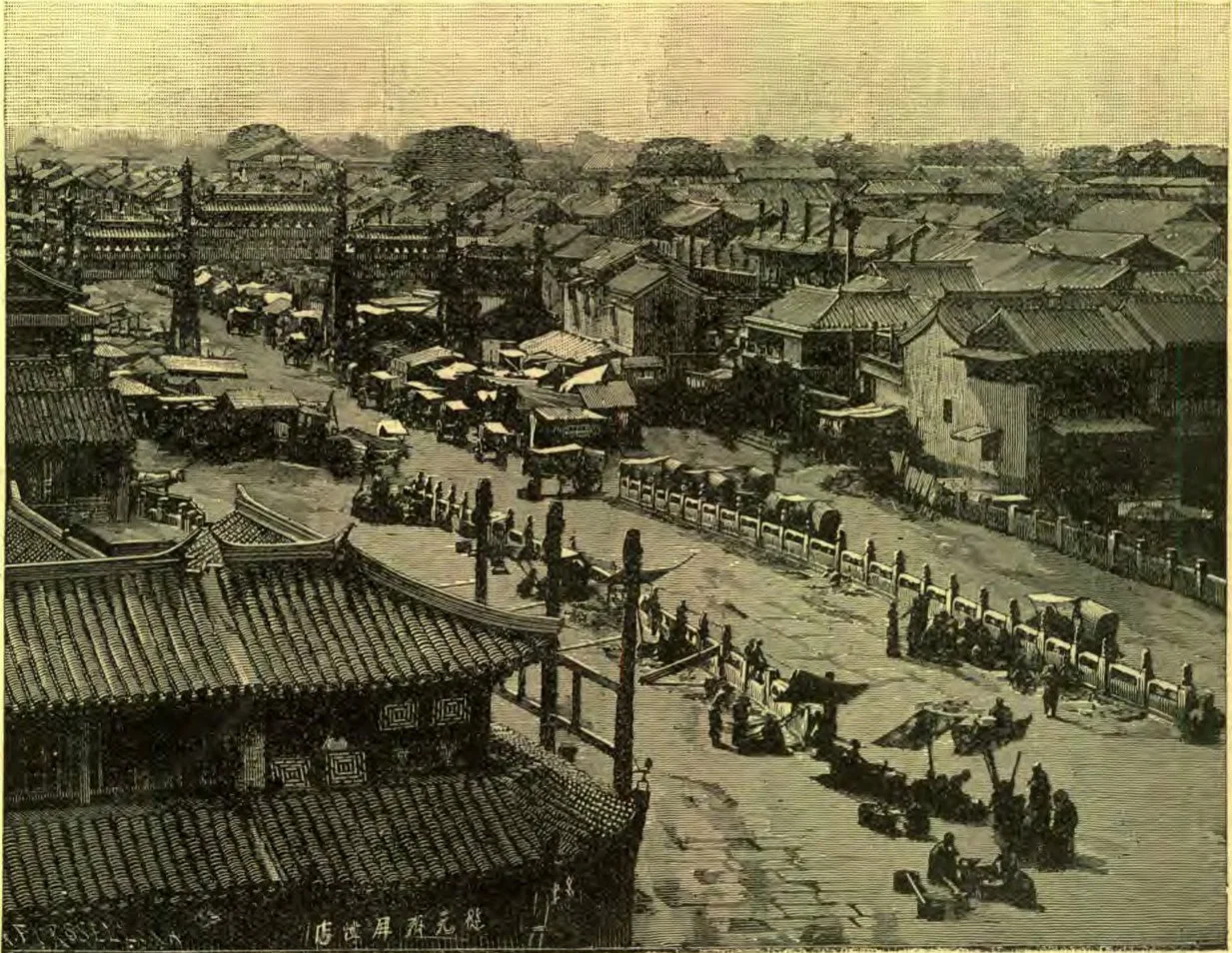
STREET SCENE IN PEKING
Thus, well supplied with that which, according to their idea, goes toward making the New Year’s festival pleasant and inviting, the homeward journey begins, the usual means of conveyance being a rude cart drawn by a cow. Into this cart the happy company bestow themselves, jostling among the newly bought articles, till at last they reach their humble abode, soon to be robed in festive attire.
Then begins a time of general house-cleaning. The dust and filth that have accumulated on the walls and ceiling during the year are removed. The spider is no longer left in peace; its silken web is destroyed. Cockroaches are brought forth from their hiding places, and make no delay in escaping for their lives. These guests are no doubt displeased with the New Year’s cleaning, but they are obliged to submit to a higher power. Large and small, old and young, assist in the work. Dust may be seen whirling in all directions until it finally lands in a dark corner, where no one is supposed to see it. The old paper is torn from the window, and new pasted on in its place. Everything is set in order. New Year’s day is regarded as a pattern for the whole year. On the outside of the doors are pasted strips of red paper, on which are written expressions of good wishes. Passers-by always stop and read these, and thus learn of their neighbor’s virtues, on paper at least. Above the door is generally found the motto, U-fuh lin-men, which means: “May all blessings tumble down at our door.” The five blessings are long life, riches, honor, virtue, and peaceful death.
Attention is paid to the kitchen god, the god of riches, and other inferior gods, which have served faithfully during the year; and they are replaced by new ones. The god that has constantly looked down in the not always clean kettle during the year must now be brought low or exalted, whichever way you take it. As a rule, all gods made of paper are gathered together, sugar is rubbed on their mouths, and they are then sent through the flames up to Nirvana, to speak well for the home in which they have spent their earthly existence. The new gods, seen everywhere, will no doubt render as acceptable service as have the old ones.
The poor do their best to prepare for the New Year. They have few comforts and pleasures, and go about down-hearted and sad as they see those in better circumstances going to their homes with an abundance of good things for the festival; while they do not have money enough to buy even the red paper needed to ornament the door of their hut.
In the city the poorer classes will be seen pawning their clothes and furniture in order to obtain money. One will be seen taking the tiles from the roof of his house, and doing his best to sell them. Another thinks he has too238many girls, and will gladly sell one if a purchaser can be found. A small sum is asked, hence the better the chance to sell. The child is “only a girl,” any way. One man in whose house I stayed sold his wife for four dollars in order to be able to celebrate the New Year’s festival. Nothing is too costly, nothing too dear, to be sacrificed in order to insure a pleasant New Year’s festival.
All the shops in town are gorgeously decorated the day preceding New Year’s. Inside and out are hung papers in all imaginable colors. The whole scene presents a striking contrast to the otherwise dull and uninteresting view. Colored lanterns are found in great abundance. These, with lighted tallow candles inside, are hung everywhere—in the yards, over the doors, on the streets, by the roadside, etc.
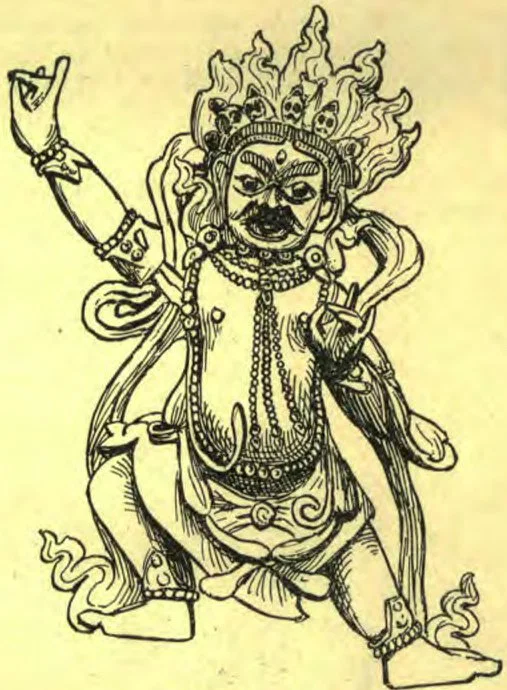
A CHINESE IDOL
New Year’s night has drawn its black veil over valley and hill. Everything is quiet. The sound of the weary traveler’s footsteps has died away in the distance. All the doors in the shops as well as private houses are closed. No sound of man is heard, either in country or in town, only the sound of stray dogs here and there. It is New Year’s night, and everything breathes quiet and rest.
In the next article we will tell what is going on within during the still hours of the night.