The Coming Eclipse

8%

Review and Herald Publishing Company · Battle Creek, Mich. · May 24, 1900

FromThe Youth’s Instructor, Vol. 48, No. 21.

Read the full edition

The Coming Eclipse

ASTRONOMICAL STUDY—NO. VII

The Coming Eclipse
ON Monday morning, May 28, is to occur the eclipse of the sun to which all our class have been looking for some time as an opportunity for observing the wonders of the heavens. It will be well to secure pieces of glass,—pieces of broken window-glass will do nicely,—and smoke them over a lamp in time to be ready to look at the sun when the eclipse occurs.
As our family is scattered all over the United States, we will not take the space to tell at just what time the eclipse will appear in each separate locality: you can look this up in your almanacs for yourselves. Suffice it to say that in Battle Creek, Mich., where the INSTRUCTOR is published, it will begin about 6:40, and end about 8:50, A. M.; and we hope it will be a clear morning with no clouds to obstruct the view.
As all have studied the article in last week’s INSTRUCTOR, and understand how the positions of the sun, moon, and earth as they will be at that time produce this special kind of eclipse, we will now speak more fully of how it will appear. The sun will be in the center of the constellation Taurus. The small picture in last week’s paper shows the position of three of our sister planets,—Venus being somewhat above, and, of course, to this side, of the sun; Mercury at the farther side, and to the right, of the sun; while Mars, though considerably distant beyond the sun, shows still farther to the right and above.
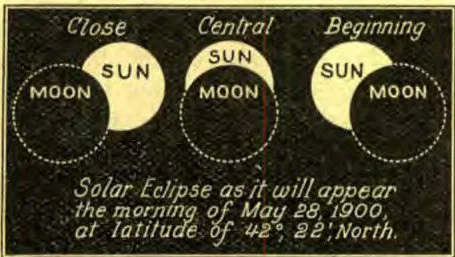
Solar Eclipse as it will appear the morning of May 28, 1900, at latitude of 42° 2' North.
To those living in the extreme southern and eastern parts of our country, the eclipse will be total; that is, the whole face of the sun will be covered by the moon passing centrally between them and the sun. To illustrate this, we have drawn an outline map of the United States, in which is a heavy dotted line running along our Eastern border, down through the Southern States, across the upper portion of the Gulf of Mexico, through Mexico, and on out into the Pacific Ocean, showing over what part of our country the shadow of the moon will sweep, and where the eclipse will be total. To those living in that portion of the country represented as lying to the north and west of that line, the upper portion of the sun will appear above the moon; while to those living to the south and east of it the lower portion of the sun will show below the moon. The farther we are either way from the path of this dotted line, the less of the sun’s disk will be eclipsed to us. To such it will present the appearance of a partial eclipse.
The small illustration shows the sun as it will appear to those living in Battle Creek, whose latitude is about 42°, 42′, N. In the large illustration we have drawn a slight dotted line passing through Battle Creek, and running parallel with the heavy dotted line of totality. Now although your latitude may not be that of Battle Creek, still if you live in any portion of the country traversed by the light dotted line passing through Battle Creek, you may expect to see the eclipse very much as it appears in the small illustration. If you live in that portion of the country which the map locates as being between the two dotted lines, the eclipse will be more nearly total to you than the illustration shows it to be; if, on the other hand, your home is farther to the north and west, you will see less of the sun eclipsed. All, however, will see it eclipsed to some degree; for by reference to the diagram shown in last week’s lesson it will be seen that the eclipse reaches far into the polar regions.
If we are favored with a shower, especially if it is attended by lightning, the day or evening before the morning of the eclipse, we may expect some beautiful colorings along the edges of the moon, these shadings partaking of the lighter orange and copper colors; but if it is dusty, warm, and humid, the somber shades will predominate.
Oh, the beauties of the handiwork of God! The heavens declare his glory; and why do not we have our eyes open to see more of his loveliness in the workings of nature around us? One can not study these subjects, with a mind to see God, without being drawn nearer to him. My very being thrills as I watch the onward progress of these mighty orbs, and realize that the same loving Hand that guides them in their courses, watches also over my soul. He that keeps these worlds, their satellites and suns, forever within the bounds of their trackless paths, will also keep my feet within the path that leads heavenward.
Remember that while you are looking at this eclipse, the most eminent astronomers, with the mightiest telescopes in the world, are also carefully surveying this interesting phenomenon. Thousands of dollars have already been spent in preparing to make the most of this scene. Astronomers are determined to find out, if possible, whether there is an intra-Mercurial planet. The belief that there is another world belonging to our solar system has found acceptance in the minds of so many that scientific men are bending all their energies to settle this perplexing question at this time. It is hoped that with our improved instruments it can be decided whether Vulcan really does exist, except in the minds of imaginative astronomers. If he is found, it is proposed to take his picture, and give him a proper installation in the grand brotherhood of our solar associates, and no longer look upon him as a merely hypothetical creation, at whose door the responsibility of so many of the storms that sweep across our continent are laid.
Dr. O. C. GODSMARK.